Bangladesh Politics Explained: Hasina Convicted, BNP Poised for Power
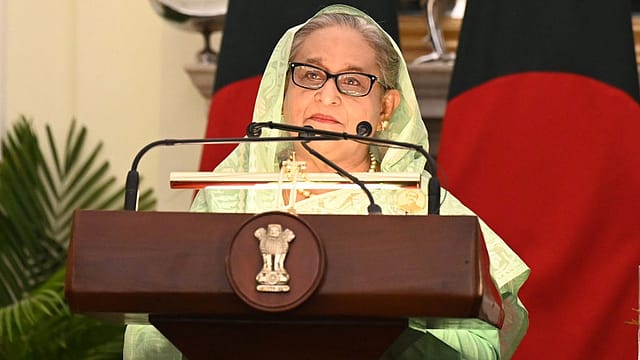
A special court in Bangladesh has sentenced former Prime Minister Sheikh Hasina to a total of 10 years in prison in two corruption cases linked to the allocation of government plots under the Purbachal New Town project in Dhaka.
The verdict, delivered by Judge Robiul Alam of Dhaka Special Judge Court-4, marks one of the most consequential legal actions against Hasina since she fled the country following the student-led uprising that toppled her government in August 2024.
What the court ruled?
In two separate cases, the court sentenced Hasina to five years’ imprisonment each for abuse of power and irregularities in allocating a 20-katha government plot. The sentences amount to a total of 10 years in prison.

Losing Memory
16 Oct 2026 - Vol 05 | Issue 42
The making of a medical and social emergency
The court also handed prison terms to members of Hasina’s extended family. Tulip Rizwana Siddiq, a British MP and the daughter of Sheikh Rehana, was sentenced to four years in prison across the two cases. Radwan Mujib Siddiq, Hasina’s son, received a seven-year sentence, while Azmina Siddiq was also sentenced to seven years in one of the cases.
The cases were filed by Bangladesh’s Anti-Corruption Commission (ACC) in January 2025 and involved 18 accused. After months of testimony from 31 witnesses, the court framed charges in July 2025 and concluded hearings earlier this year.
Why this verdict matters?
The sentencing significantly strengthens the legal case against Sheikh Hasina at a time when her political influence has already been severely curtailed. Following her ouster, the Awami League’s registration was suspended in May 2025, barring the party from contesting the upcoming parliamentary elections scheduled for February 12, 2026.
Hasina has been living in India since leaving Bangladesh, and the verdict effectively seals her political isolation, at least in the near term.
A political landscape transformed?
The ruling comes against the backdrop of a dramatic reshaping of Bangladeshi politics. After Hasina’s exit, an interim government led by Nobel laureate Muhammad Yunus, with the backing of the military, assumed charge and initiated sweeping legal proceedings against senior Awami League leaders.
This transition has coincided with the death of Khaleda Zia, Bangladesh’s first woman Prime Minister and Hasina’s fiercest political rival, bringing an end to the decades-long “Battle of the Begums” that dominated the country’s political narrative.
The End of an Era: Khaleda Zia’s Passing
Khaleda Zia died at the age of 80 after prolonged illness, including advanced liver cirrhosis and multiple organ complications. Her health had deteriorated sharply following years of imprisonment and house arrest during Hasina’s tenure.
Her death marked the symbolic close of a rivalry that shaped Bangladesh for over three decades, spanning coups, mass protests, alternating governments, and deep political polarisation.
How Khaleda Zia rose to power?
Khaleda entered politics after the assassination of her husband, President Zia ur Rahman, in 1981. She joined the Bangladesh Nationalist Party (BNP), founded by Zia, and rose rapidly through its ranks.
She played a central role in the movement that overthrew military ruler Hussain Muhammad Ershad in 1990 and went on to become Bangladesh’s first woman Prime Minister in 1991. She served multiple terms, though her later years in power were marred by allegations of corruption and political repression.
From rivalry to reckoning
During Hasina’s long tenure, Khaleda was jailed in 2018 on corruption charges, with her health worsening in custody. She remained under house arrest for years until her confinement was lifted after Hasina’s fall in 2024.
Now, with Khaleda gone and Hasina convicted, Bangladesh’s two most dominant political figures have effectively exited the active political stage.
What this means for BNP and Tarique Rahman?
Attention has shifted to Khaleda Zia’s son, Tarique Rahman, who currently serves as the BNP’s Executive Chairman. Having returned to Bangladesh after 17 years in exile, Tarique is leading the party into the February elections.
Political analysts believe Khaleda’s death could generate emotional support for the BNP, potentially strengthening Tarique’s electoral prospects in the absence of a strong third political alternative.
The wider political contest
With the Awami League sidelined, the political field is now dominated by the BNP, Islamist party Jamaat-e-Islami, and newer entrants such as the National Citizens Party, born out of the July protests.
The evolving contest will determine not only Bangladesh’s internal power balance but also its foreign policy direction.
Implications for India-Bangladesh relations
Relations with India remain a key concern. Historically, the BNP has promoted Bangladeshi nationalism with a strong Islamic identity and has often taken a confrontational stance toward New Delhi.
During BNP governments, India faced challenges related to border security and insurgent activity in its northeastern states. A BNP return to power could revive concerns over minority rights, cross-border security, and strategic trust.
However, Prime Minister Narendra Modi’s condolence message following Khaleda Zia’s death—praising her contribution to bilateral ties—signals New Delhi’s willingness to recalibrate relations regardless of electoral outcomes.
A defining moment for Bangladesh
The conviction of Sheikh Hasina, the death of Khaleda Zia, and the rise of a new political generation mark a historic turning point for Bangladesh. As voters head to the polls, the country stands at the crossroads of continuity, correction, and transformation.
(With inputs from ANI)