Radicalisation in Bangladesh and its Strategic Consequences for India
Bangladesh remains on the edge of turmoil and despite a veneer of calm, the underlying disorder and unrest continue to grip the nation. Violent protests against Indian missions and the closure of visa centres reveal a surging anti-India sentiment, driven by radical Islamists. Amid the worsening security situation, India has shut down its visa application centres across multiple cities - a step underscoring the collapse of law and order. Aptly, the Parliamentary Standing Committee on External Affairs has recently stated, in its 9th Report, that developments in Bangladesh pose the “greatest strategic challenge” to India since the Liberation War of 1971.
As Bangladesh grapples with unrest in the run-up to the February 2026 elections, a potentially more dangerous trend is unfolding: the increasing space for radical Islam and revival of long-suppressed jihadist networks amid weakening institutional guardrails. Radical and terrorist groups are emphasizing Bangladesh’s Islamic identity as against Bengali identity/nationalism, exploiting anxieties over perceived threats from India. Exploiting the political uncertainty, radical organizations such as the Jamaat-e-Islami Bangladesh, Hefazat-e-Islam, Ansar al-Islam, Jamaat-ul-Mujahideen Bangladesh, Hizb-ut-Tahrir, Harkat-ul-Jihad al-Islami-Bangladesh, etc are reorganising, rebranding and also networking with Pakistan-based jihadi groups. This convergence of street-level unrest, ideological hardening and terrorist regrouping - alongside Dhaka’s evolving external alignments - poses risks that extend beyond Bangladesh’s borders, sharpening concerns for India over infiltration, communal spillover in border states and the re-emergence of a volatile eastern security theatre.

Losing Memory
16 Oct 2026 - Vol 05 | Issue 42
The making of a medical and social emergency
Anti-India Sentiment
The anti-India sentiment, which was widespread last year during the overthrow of the Sheikh Hasina regime, again assumed frenzied proportions after the recent assassination of Osman Hadi, a radical Islamist leader of the Inquilab Mancha, which was part of the regime change agitation last year. The earlier narrative of Hadi’s killers allegedly fleeing to India has collapsed, as one of the prime suspects has now surfaced purportedly in the UAE - exposing the duplicity of radical Islamist propaganda in Bangladesh. The latest incidents, orchestrated by the July Oikya (July Unity) front, saw thousands of protesters marching toward the Indian High Commission in Dhaka and attempting to storm diplomatic facilities in Rajshahi and Khulna. In addition, the lynching of a Hindu man in Mymensingh, compounded by a spate of fresh killings and attacks on Hindu property, reveals a deepening pattern and systematic campaign of Islamist violence that has targeted Bangladesh’s minorities. The prevailing anti-India sentiment, meanwhile, is also amplifying the street-power of radical Islamists led by Jamaat-e-Islami and Hefazat-e-Islami and will enhance their political mobilisation in the run-up to the February elections.
Another layer of anti-India sentiment, albeit subtle, is also discernible. The recent gifting of the artwork “Art of Triumph", which carried a purported map showing parts of India as part of Bangladesh, by Chief Adviser Muhammad Yunus to Pakistan’s Chairman Joint Chiefs of Staff Committee, Gen. Shamshad Mirza, is suggestive of Bangladesh endorsing Pakistan’s anti-India narrative. The deliberate projection of distorted maps by the Turkish-backed NGO Saltanat-e-Bangla, claiming swathes of territory in India’s East as part of a so-called “Greater Bangladesh,” coupled with the provocative warning by National Citizen Party leader Hasnat Abdullah about sheltering separatist forces to sever India’s Northeast, are not isolated acts of rhetoric. These are attempts to undermine India’s sovereignty & territorial integrity, destabilize its border regions and foment separatism through ideological subversion and by weaponizing narratives of expansionism.
Radical Islamic groups from across the border are seeking to reshape the syncretic traditions of Islam into a more puritanical form in sensitive border regions of India’s Northeast. The Tablighi Jamaat’s presence is expanding rapidly, with frequent jalsas and visiting leaders delivering taqreers, while the proscribed Popular Front of India adds to the push. An ultra‑radical Bangladesh‑based Tabligh offshoot, Kalemar Jamaat, is also gaining ground, signalling a deeper ideological shift along the India-Bangladesh border.
Resurgent Radical Islamists
The ouster of Sheikh Hasina has emboldened radical Islamist groups, allowing them to resurface, recruit, and operate with greater impunity than they had under the previous administration, which had largely controlled terrorist activity after the 2016 Holey Artisan attack. Radical Islamists have been given a free run in the Yunus-led regime whose de-proscription of Jamaat-e-Islami and release of al-Qaeda-linked terrorists have galvanised these networks. The recent surge in Islamic radicalization is tied to the political instability after Sheikh Hasina’s ouster and consequent security vacuum which radical Islamists, especially those linked to Pakistan like the Jamaat, have exploited. With political transition impacting law enforcement and counter-terrorism capacities, banned radical organizations like the Hizb-ut-Tahrir and Ansar-al-Islam are regrouping.
The pro-Pakistan Jamaat-e-Islami Bangladesh (JeI-BD) has held massive rallies in Dhaka and also won key student union elections at Dhaka University & Jahangirnagar University (Dhaka) in September 2025. Claiming that it has become an unavoidable demand of the time to unite for establishment of Islam, JeI-BD has asserted that pro-India entities like Awami League are anti-Islam. While Jamaat’s street power was instrumental in escalating anti-India sentiments after Osman Hadi’s death, a senior JeI-BD leader has also threatened to wage war against India if the latter considers any intervention in Bangladesh. Addressing a public reception in New York (September 27, 2025), JeI-BD deputy chief, Syed Abdullah Taher, declared that Jamaat was ready for 'Ghazwa-e-Hind' - a term often used by radical Islamists to refer to a fictitious ‘holy war’ by Muslim armies to conquer the Indian subcontinent.
Hefazat-e-Islami (HeI), one of Bangladesh’s largest radical Islamist organisations controlling over 15,000 madrassas, has also been emboldened. HeI’s heft has amplified under Yunus regime, which was visible in the latter abandoning proposed gender equality reforms in April 2025 due to pressure from HeI. Hefazat-e-Islami members are alleged to have been part of the mob that attacked (December 18) the Assistant High Commissioner of India in Chattogram. The 12 HeI members arrested in this connection were released, within hours, at the behest of senior Hefazat leader Mufti Harun bin Izhar. Earlier on October 24, 2025, Hefazat-e-Islam organized large rallies in Dhaka and Chattogram, demanding a ban on the International Society for Krishna Consciousness (ISKCON), alleging it is an extremist organisation. Since August 2024, over 200 Hindu temples, including ISKCON centres in Jessore, have been vandalised, with arson and looting reported from Comilla and Dinajpur. Hefazat describes ISKCON as a danger to Bangladesh’s Islamic identity and propagates a narrative that vilifies Hindus, casting them as either loyalists of Sheikh Hasina or agents of Indian influence.
The Hizb-ut-Tahrir (HuT), a transnational radical Islamic organization which aims to establish an Islamic Caliphate, has also increased its activities since the ouster of Sheikh Hasina. Despite being a banned organisation, HuT is allowed to assert its Caliphate ideology in public spaces, as visible in its large “March for Khilafah” rally in Dhaka on March 7, 2025, HuT’s first public rally since 2009. HuT’s propaganda has consistently targeted India and its narrative urges the Pakistan Army to launch an offensive against India for the sake of the Ummah and establish a Caliphate.
A revival of Al-Qaeda-linked Harkat-ul-Jihad-al-Islami-Bangladesh (HuJI-B, originally formed in Pakistan), a terrorist group which had been lying dormant for more than a decade, has been discerned. HuJI-B has penetrated the Hefazat-e-Islam and a number of Qawmi (unregulated) madrassas are now pro-HuJI. Post regime change, HuJI-B has also increased its social media footprints. With close ties to Pakistan ISI, sources have indicated possible recruitment and organizational activity by HuJI-B along India’s eastern border.
Pakistan’s Inroads
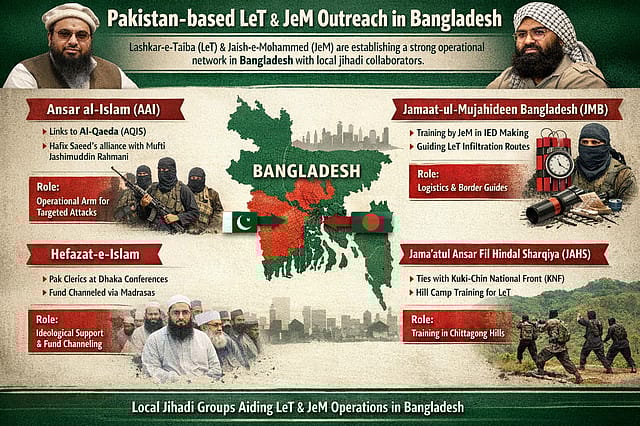
After a long hiatus, there are indications that the Pakistan-based terror group Lashkar-e-Taiba (LeT) is reviving its eastern focus to establish Bangladesh as a secondary front and a transit hub for operations against India. LeT is attempting to revive its dormant links with local jihadi leaders - particularly those affiliated with Ansar al-Islam, led by Mufti Jashimuddin Rahmani, and the Ahl-e-Hadith networks - while simultaneously prioritizing infiltration routes from Bangladesh into India’s Northeast. Recently, Ibtisam Elahi Zaheer, General Secretary of Pakistan’s Markazi Jamiat Ahl-e-Hadith and a close associate of the LeT chief Hafiz Saeed, was noticed operating freely in Bangladesh, including in districts near the India-Bangladesh border. Hosted by Abdur Rahim bin Abdur Razzaq of the Al Jamia As-Salifa, an Islamic institute linked to Ahl-e-Hadith Bangladesh, Zaheer visited Rajshahi and Chapainawabganj and other locations along the dia-Bangladesh border. Targeting India in one of his vitriolic speeches, Zaheer said it is Pakistan’s responsibility to raise a voice against alleged oppression in Kashmir, which he hoped will become part of Pakistan in future. Further in November 2025, prominent Pakistani radical cleric Maulana Fazlur Rehman (JUI-F) attended conferences in Dhaka alongside Hefazat-e-Islami leaders.
Of late, Pak-based groups like LeT are seeking to move beyond mere outreach towards establishing a robust operational network in Bangladesh. This is being facilitated by a cluster of local jihadi groups: i) Ansar al-Islam can act as the operational arm for targeted strikes in future; ii) Neo-JMB provides cross-border logistics and IED expertise; iii) Hefazat-e-Islam offers ideological legitimacy and a channel for foreign funding; and iv) Jama'atul Ansar Fil Hindal Sharqiya (JAHS) secures remote training facilities in Chittagong Hill Tracts. Pertinently, both AAI & JMB are already active in India, especially in Assam & West Bengal. Together, these groups have the potential to transform Bangladesh into a strategic launchpad for terror activities by Pak-based groups like the LeT & JeM in future.
There is also alignment between Bangladesh’s interim regime and Pakistan’s military establishment. Recent developments indicate a perceptible warming of Bangladesh-Pakistan ties, especially in the defence domain, marking a sharp departure from decades of limited engagement shaped by the legacy of 1971. This shift is reflected in high-level military exchanges, discussions on enhanced defence cooperation, including naval engagements such as Pakistani warship visits to Bangladeshi ports, and a possible strategic partnership. It indicates Pakistan’s efforts to re-establish strategic influence in Bangladesh and also encourage Islamic identity as a key variable in Bangladeshi politics, developments that carry implications for India’s security.
Prognosis
Recent actions by radical Islamist groups and political actors in Bangladesh point to a deeper anti-India sentiment that extends well beyond public demonstrations. The attacks on Indian diplomatic facilities are not random outbursts but indicate a broader agenda aimed at eroding India’s regional influence while promoting radical Islamist objectives. For New Delhi, the possibility of Bangladesh drifting toward an Islamist regime in February 2026 presents a serious strategic challenge.
The Yunus dispensation has allowed the resurgence of Pakistan-linked Islamist radicals and terror networks within Bangladesh, creating potential instability along India’s eastern frontier. A compliant regime in Dhaka enables the Pakistani establishment to intensify jihadi campaigns, targeting northern Bangladesh with the objective of fostering radicalisation and inciting unrest in India’s Northeast. Further amplification of radical Islam and anti-India sentiments in Bangladesh will adversely impact India’s security situation, especially in the North East. It is pertinent to note that the last BNP-Jamaat government (2001-2006) was a grave security challenge for India, as Bangladeshi territory was exploited by radical Islamist and terrorist networks to conduct anti-India operations. The reactivation of Bangladesh-based jihadist networks, terrorist regrouping and porous border raises the real possibility that the next major terror plot against India could originate from the east.