Liverpool and Man City Survive Penalty Drama. How Does the Carabao Cup Work?
What happened on Wednesday night?
Liverpool needed their eighth penalty. Manchester City needed their goalkeeper to save Brighton’s final two.
Both survived a tense evening on October 28 to reach the Carabao Cup quarter-finals.
At Anfield, Liverpool drew 1-1 with Chelsea before winning the shootout 6-5. Joe Gomez converted Liverpool’s decisive kick, then Wesley Fofana sent Chelsea’s eighth attempt over the bar.
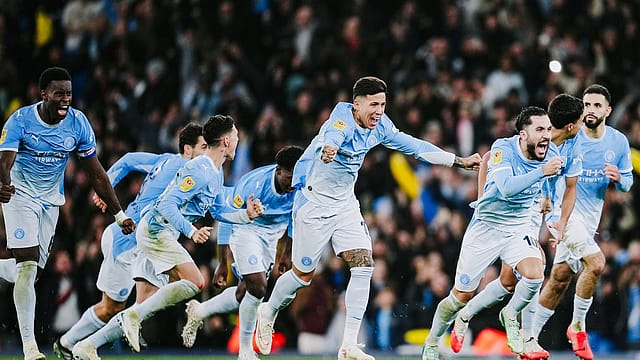
At the Etihad Stadium, City twice recovered from behind to draw 2-2 with Brighton. Goalkeeper Gerónimo Rulli then saved from Yasin Ayari and Lewis Dunk as the defending champions won the shootout 4-3.
The results kept two major contenders alive. They also offered a useful introduction to a competition whose names, format and rules can confuse occasional viewers.

Look Who's Talking Regime Change
23 Oct 2026 - Vol 05 | Issue 43
WHAT EXACTLY IS THE CARABAO CUP?
It is the English Football League Cup, commonly shortened to the League Cup. Carabao is its sponsor’s name.
The competition involves the 92 clubs in England’s top four divisions: the Premier League, Championship, League One and League Two.
That allows clubs from different levels to meet in the same knockout tournament.
It runs alongside the league season. Winning a Carabao Cup match takes a club into the next round; it does not add points to its Premier League total.
For supporters following English football from India, these are separate competitions involving many of the same players and clubs.
HOW IS IT DIFFERENT FROM THE PREMIER LEAGUE AND FA CUP?
The Premier League rewards performance across a season. Its clubs accumulate points through home-and-away fixtures, with the final table deciding the champion.
The Carabao Cup is a knockout competition. Lose a tie and the opportunity to win the trophy ends.
The FA Cup is another separate knockout tournament, with a much wider entry extending beyond the top four divisions.
Their rules also differ. The Premier League’s explanation of this season’s calendar states that drawn FA Cup matches go to extra time and, if necessary, penalties. Early Carabao Cup rounds go directly to a shootout.
A familiar opponent and the same stadium can therefore produce a match governed by a different tournament format.
WHY DID THESE GAMES GO STRAIGHT TO PENALTIES?
Because that is the Carabao Cup rule through the quarter-finals.
If a match is level after 90 minutes plus stoppage time, the teams proceed directly to penalties. There is no additional half-hour of extra time at these stages.
Liverpool and Chelsea therefore went to a shootout at 1-1. City and Brighton did the same at 2-2.
Stoppage time and extra time are different. Stoppage time compensates for interruptions during a half. Extra time is an additional playing period used when competition rules require it.
A level score after 90 minutes did not give either favourite another 30 minutes to find a winner.
HOW DID LIVERPOOL GET THROUGH?
Both goals during the match came from penalties.
Morgan Rogers put Chelsea ahead after Ryan Gravenberch fouled Moisés Caicedo. Cody Gakpo equalised shortly afterwards following Fofana’s handball.
The teams remained level through the second half and through the opening five kicks each in the shootout.
Liverpool’s account records both sides scoring five times from their first seven attempts. Gomez then converted, leaving Fofana needing to score to keep Chelsea alive. His attempt went over.
The distinction between the two types of penalty matters: Rogers’ and Gakpo’s goals counted towards the match score. The subsequent shootout decided which team advanced.
WHY DID LIVERPOOL NEED EIGHT KICKS EACH?
A shootout normally begins with five attempts per team, taken alternately. It can finish earlier if one side becomes impossible to catch.
If the scores remain level after five each, the shootout continues into sudden death.
That does not mean the first successful kick immediately wins. The teams must have taken the same number of attempts before a deciding advantage is established.
Gomez’s eighth kick put Liverpool ahead. Chelsea still had their corresponding attempt.
Fofana’s miss settled the tie because Liverpool then led after both teams had taken eight penalties.
HOW DID MANCHESTER CITY ESCAPE?
Brighton took the lead through Malick Yalcouyé, before Mateo Kovačić equalised. Georginio Rutter restored Brighton’s advantage early in the second half, and Vitor Reis made it 2-2 in the 72nd minute.
The shootout then swung sharply.
After both teams scored their first three kicks, Brighton goalkeeper Jason Steele saved Kovačić’s attempt. City were vulnerable, but Rulli immediately stopped Ayari.
Rayan Cherki converted City’s fifth kick. Rulli then saved Dunk’s attempt to secure the holders’ passage.
Kovačić’s miss had created an opportunity for Brighton. Rulli prevented them from taking it.
WHY DO BIG CLUBS CHANGE SO MANY PLAYERS FOR THIS CUP?
The competition creates a selection balancing act.
Managers must pursue a trophy while managing players’ workload across league fixtures and other tournaments. They can also give opportunities to younger players and squad members who play less regularly.
Liverpool made seven changes for the Chelsea match. City’s starting side included four academy players.
Rotation does not guarantee a weaker performance. It does mean coaches are testing combinations under the pressure of elimination.
For a player outside the regular starting XI, a cup appearance can become an important chance to earn greater responsibility.
WHO PLAYS WHOM NEXT?
Liverpool will host Bournemouth, while Manchester City will host League One club Bradford City.
Crystal Palace have been drawn at home to Sunderland. Fleetwood Town will host the winner of Everton versus Newcastle United, according to the announced quarter-final draw.
City’s tie brings together clubs from different divisions. That difference creates an expectation, rather than a guaranteed result.
For lower-division teams, a quarter-final offers the opportunity to turn a strong cup run into a place among the final four.
HOW FAR AWAY IS THE TROPHY?
The quarter-finals are scheduled for the week beginning December 14. The semi-finals are played over two legs, followed by a single final scheduled for March 21, 2027.
Extra time becomes available later in the competition if required under the rules.
Liverpool and City have cleared the fourth round. Each still needs to win a quarter-final, a two-legged semi-final and the final to lift the trophy.
Their shootout victories preserved that route. They also showed how quickly a major club’s cup campaign can depend on one goalkeeper, one defender and one kick.