EXPLAINED | Pakistan Chased Down India in 23 Balls. What Is the Hong Kong Sixes?
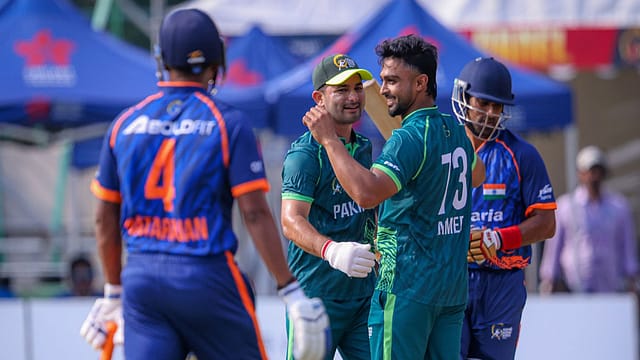
Pakistan needed just 23 legal deliveries to chase down India's total at the Hong Kong Sixes on October 30. India made 88/5; Pakistan reached 91/2 in 3.5 overs and won by four wickets.
India's difficulties continued on October 31. UAE beat them by six wickets before England won their Bowl semi-final by three runs.
The familiar rivalry has put an unfamiliar format in the spotlight. What exactly were these teams playing, and why can a match unravel so quickly?
What is the Hong Kong Sixes?
It is an international six-a-side cricket tournament organised by Cricket Hong Kong, China. Each team fields six players and has a maximum of six overs to bat. An over contains six legal deliveries, giving a side just 36 scoring opportunities, apart from additional deliveries for wides and no-balls.

Look Who's Talking Regime Change
23 Oct 2026 - Vol 05 | Issue 43
The competition began in 1992. This year's edition runs from October 30 to November 1 at Hong Kong's Tin Kwong Road Recreation Ground, with 12 men's teams taking part.
The name refers to the six-player format. You can still score singles, fours and other runs in the usual way.
What happened when India played Pakistan?
India's Shashank Singh hit 40 off 11 balls, including five sixes, but his team finished on 88/5. Pakistan's captain Abbas Afridi scored 35 off eight balls, while Khawaja Nafay made 41 off 12. Both were dismissed during the chase.
Krunal Pandya's opening over cost 31 runs. Pakistan had, therefore, collected more than a third of their 89-run target before the second over began.
The notation 3.5 means three completed overs plus five legal balls. That is 23 balls, with another 13 available in the innings. It does not mean 3.5 minutes or three-and-a-half overs.
Why was there also a handshake controversy?
Krunal Pandya and Abbas Afridi did not exchange the customary handshake at the toss. The interaction brought another political talking point to an India-Pakistan cricket meeting.
The sporting result needs its own context, however. These were small squads playing a specialised format in which one expensive over can consume a large share of the available recovery time.
Does almost everyone really have to bowl?
Yes. The wicketkeeper is exempt, but the other five players have bowling duties. One designated bowler can deliver two overs; the others bowl one each.
That changes team selection. A side cannot simply choose a collection of powerful batters and expect two specialist bowlers to handle the innings.
It also changes captaincy. There are fewer options for hiding a weaker bowler or repairing a bad start. With six fielders including the bowler and wicketkeeper, only four players remain to cover the rest of the ground.
The calculation for a batter changes too. Six deliveries without scoring would consume one-sixth of the entire innings. Waiting several overs to judge the bowling becomes an expensive choice.
Why doesn't the innings always end after five wickets?
The format allows the last batter to continue.
When the fifth wicket falls before the overs are exhausted, the remaining batter keeps batting, with the fifth dismissed player acting as a runner. The surviving batter must face every delivery. The innings ends when the final batter is dismissed or the overs run out.
That is why a six-player team can have six wickets recorded against it. India's 94/6 against UAE is a practical example.
There is another twist: a batter reaching 50 retires not out and can return if one of the last two batters is dismissed. Reaching a fifty can therefore take a successful batter temporarily out of the action.
Why are there a Cup, a Plate and a Bowl?
The organisers divide the teams into four groups of three. Each side plays its two group opponents.
Group winners enter the Cup semi-finals and compete for the main title. Second-placed sides enter the Plate competition; third-placed sides enter the Bowl competition.
These are different finishing brackets. Losing a group match does not automatically end a team's tournament, but appearing in a later final does not necessarily mean it is contesting the championship.
India finished bottom of the group containing Pakistan and UAE. Their subsequent loss to England came in the Bowl bracket.
Does this tell us how India's usual team would fare against Pakistan?
It tells us how the selected players performed under these rules.
Krunal led a seven-member squad featuring Shashank Singh, Rahul Tewatia, Nitish Rana, Rahul Tripathi, T Natarajan and Kulwant Khejroliya. The organiser announced Krunal's appointment after Bhuvneshwar Kumar was called up for India's New Zealand tour.
The result belongs to that squad and this competition. Extrapolating it to an 11-player contest with a different team and many more overs would overlook the conditions that produced it.
What happens next?
India are scheduled to face Bangladesh in the 11th/12th-place play-off on November 1. The main Cup final is scheduled for 3.10 pm Hong Kong time, or 12.40 pm IST, the same day.
Finals day also includes a women's exhibition match between Hong Kong and China. For viewers following the results, the essential detail is the bracket: Cup, Plate or Bowl. It tells you what the teams are actually playing for.