Vijay: Tamil Nadu’s Hero

Tamil Nadu has been here twice before. In 1967, a party that had never governed walked into the assembly with 179 seats—along with its allies—and ended Congress’s hold on the state. In 1977, an actor who had split from that winning party formed his own, took roughly a third of the vote, and began a decade of rule that shaped the state’s politics long after his death. Both times, the established order insisted it was watching a temporary disruption. Both times, it wasn’t.
On May 4, 2026, Tamilaga Vettri Kazhagam, a party two years old, led by another film actor, dismissed until recently as a vanity project, won 108 seats in Tamil Nadu’s 234-seat assembly on approximately 34.9 percent of the vote. The DMK, which governed with 133 seats five years ago and swept all 40 parliamentary constituencies in 2024, came back with 59 seats (73 with its allies). The AIADMK dropped to 47, reaching 53 with its alliance partners. Congress held 5. The BJP contested 33 seats and won 1. TVK is 10 seats short of the majority mark of 118. It is otherwise the dominant political force in Tamil Nadu, and the coalition arithmetic that now preoccupies commentators should not obscure what has actually happened: the Dravidian duopoly, which has governed this state without interruption since Annadurai’s 1967 victory, is over.
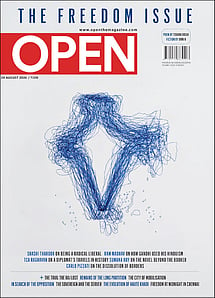
Freedom Issue 2026
14 Aug 2026 - Vol 05 | Issue 33
Shashi Tharoor on being radical liberal | Ram Madhav on how Gandhi used his Hinduism | TCA Raghavan on a diplomat's travels in history | Sumana Roy on the novel beyond the Booker | Carlo Pizzati on the dissolution of Borders
Even on the night DMK ran second to TVK, its alliance—Congress, VCK, CPI, CPM, DMDK and IUML—was 20 seats stronger than the AIADMK’s alliance. But they are both battered blocs, neither presently capable of challenging what has replaced them. “Most media failed to perceive what was coming. The TVK wave was a silent undercurrent, visible in local networks and the enthusiastic voter turnout but invisible to the cameras that followed the louder campaigns,” says Maalan Narayanan, a writer and political commentator.
TVK’s average winning margin across its 108 victories was 22,842 votes. AIADMK’s average winning margin was 15,164. DMK’s was 9,310. TVK won 2.5 times more decisively per seat than DMK did. This is what a wave looks like. Vijay himself won Perambur with 58.9 percent of polled votes, the highest individual vote share of any winner across all 234 constituencies. In Chennai, TVK won consecutive constituencies from Thiruvallur to Royapuram and from Thousand Lights to Thiruporur, an unbroken arc across the heart of the DMK’s traditional metropolitan core. TVK also did not lose a single electoral deposit—the one-sixth-of-votes threshold below which a candidate forfeits their fee—in any of the 234 constituencies it contested. Not one. It has reportedly won approximately 24 seats in the Gounder belt, 18 in the Vanniyar belt, and 18 in the Thevar belt.
“This is a generational change, a new kind of electoral politics, and whether it is temporary or permanent remains to be seen,” says Narayanan. He also draws a distinction between Vijay and the actor-politician he is most often compared to. MGR didn’t simply wave his hands, Maalan notes. He campaigned. Between April 14 and April 21, the final week of campaigning, Vijay spoke for only 35 minutes at public meetings. Elsewhere he waved from vehicles. Other parties were building visible momentum, and there were people who genuinely wondered whether Vijay was losing interest.
People voted for Vijay without even knowing who their local TVK candidate was. This is something unusual in Tamil Nadu’s political history, a state where caste arithmetic, local candidate credibility, and community-level organisation have always been decisive in electoral calculation. What TVK achieved was a vote transfer so complete that the identity of the individual candidate became secondary. The five tightest contests in the state had a combined margin of under a thousand votes. Five entire MLA seats decided by fewer voters than fit inside a single suburban cinema hall. The assembly TVK is sending to Fort St. George is itself unlike previous ones. For starters, there are 23 TVK MLAs under the age of 35, and 12 women.
“We will form the government with the support of well-wishers,” said a cryptic KA Sengottaiyan, the newly minted TVK lieutenant who won from Gobichettipalayam, speaking to Open. The nine-time MLA and former Jayalalithaa minister was expelled from AIADMK in 2025 after nearly five decades with the party. Now, in all likelihood, the man who knows exactly which of his former colleagues can be persuaded to look the other way on a confidence vote.
The BJP’s collapse underlines the extent to which TVK drew from every available pool. The BJP lost badly not simply because of urban liberal rejection, but because TVK absorbed AIADMK-BJP votes in constituencies where that bloc had previously held. There was effectively no vote transfer between BJP and AIADMK, Narayanan points out. In Nagercoil, the BJP fielded a strong candidate in Gandhi and still lost. In Modakurichi, which they had won as recently as 2021, they lost again. “Only Ooty it seems has not reacted to Vijay. Maybe the hill was too high for the wave to reach!” Narayanan jokes.
As for Stalin, he had held Kolathur for three consecutive terms, winning with 61 percent in 2021. TVK’s VS Babu, a former DMK district secretary who helped Stalin first win Kolathur in 2011, drifted to AIADMK and then to TVK just before the election, and beat him by 8,795 votes. Only one sitting chief minister had previously lost their own seat within Tamil Nadu’s Dravidian era: Jayalalithaa, who lost Bargur to the DMK’s Sugavanam in one of the most complete demolitions the state had recorded, in 1996. Karunanidhi, across six decades and multiple terms as Chief Minister, never once lost a seat he contested. Even careful observers thought Stalin would scrape through in Kolathur. In 1991, Karunanidhi had won his Harbour seat while the DMK collapsed to just two seats statewide. The assumption was that Stalin, with deep roots in his constituency, would do the same. He didn’t.
Fifteen of the DMK’s 32 contesting ministers lost their seats. Udhayanidhi Stalin held on to Chepauk-Triplicane by 7,140 votes. That is the family’s entire salvage from the city the DMK has governed for decades, with 14 of Chennai’s 16 assembly seats going to TVK. DMK’s general secretary Duraimurugan lost Katpadi. The party president and the general secretary being defeated in the same election is believed to be a first in DMK’s history. What follows from that—whether the party appoints a senior figure like Thangam Thennarasu or KN Nehru as Leader of Opposition, or whether it hands the role to Udhayanidhi and thereby doubles down on the dynastic arrangement that contributed to its defeat—is the question that will define whether the DMK understands what happened to it, or mistakes survival for vindication, Narayanan says.
What is clear is that TVK as the single largest party by a substantial margin will be invited by the Governor to prove its numbers on the floor. The calculus for any party considering a vote against that government is uncomfortable: defeat it, and Vijay calls fresh elections against opponents depleted of money and credibility, facing an electorate that has already expressed a clear preference. The rational calculation is abstention. A government that endures because its opponents are afraid of what comes next is still a government, and sometimes a more nimble one.
If Vijay takes office, Tamil Nadu will for the first time have a chief minister from a minority religious community. The state that has been governed since 1967 exclusively by Hindus will have, as its chief executive, a man whose religious identity was itself a point of pre-election controversy, with some critics arguing he was mobilising communal votes by introducing himself as Joseph Vijay, and the result suggesting that the electorate either disagreed or didn’t care. That the cross-caste, cross-community consolidation that elected him happened in spite of, or perhaps precisely because of, his minority identity is one of the more striking facts in Tamil Nadu’s modern political history, and it has not yet been adequately absorbed.
What TVK is, at bottom, remains genuinely contested. Its candidate composition suggests a real commitment to social representation that goes beyond tokenism. Its economic positioning is populist-welfarist. Its rhetoric has been explicitly anti-BJP while maintaining a studied distance from DMK’s version of Dravidian politics. Whether it will govern differently from the parties it replaced, or replicate the same patterns of patronage, corruption and parallel power, is an open question.