Assam: Security First
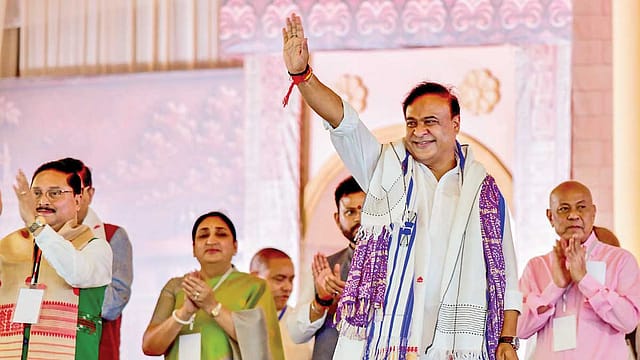
ON WEDNESDAY, MAY 13, MORNING Himanta Biswa Sarma began his second term as chief minister of Assam by paying homage to Gopinath Bordoloi—the first chief minister of the state in independent India—at his memorial in Guwahati. Sarma declared the priorities of his government soon afterwards while speaking to the media.
“Assam’s identity and Assam’s security will always be of paramount importance for us. We will also want to develop Assam in a way so that we can contribute to the growth of the nation,” Sarma told reporters.
Hours later, after he had held the first meeting of his council of ministers, Sarma declared that a Bill to enact the Uniform Civil Code (UCC) would be introduced in the Assembly this month.
Assam had been considering a UCC since 2024 and had closely observed the Uttarakhand legislation. The plan was to wait and see if a nationwide law emerged during this time. On May 13, Assam decided to push ahead with a state-specific UCC, one that excludes its tribal population from the planned law. The second Sarma ministry had also decided to appoint a committee to examine how the government could create two lakh jobs, something that BJP had promised in its election manifesto. These and other decisions were taken on May 13 and Sarma spoke about them in detail after the ministers’ meeting.
This development was not surprising. Before the ministerial meeting, Sarma had said politics in Assam should revolve round the identity, security, and development of Assam.
These themes have broadly resonated with Assam’s electorate for a decade now. From the first time BJP formed a government in the state in 2016 until now, the issue of Assam’s worsening religious demography and its security has gone hand-in-hand with developmental aspirations of the state.
The chief minister made a special mention of the decisions taken by the new BJP government in West Bengal and said that the decision to hand over land to the Border Security Force (BSF) for fencing off the border with Bangladesh gave a boost to Assam’s security. Explaining the importance of the decision taken by the Suvendu Adhikari government, Sarma said that the security of eastern and northeastern India was linked. Elaborating the rationale for the linkage, he said people and organisations in Assam had demanded that the state’s border with Bangladesh be sealed. This was meaningless in isolation and unless the border along West Bengal was fenced, security and illegal immigration could not be checked.
With BJP governments in power in both West Bengal and Assam, coordination on security issues—and illegal immigration from Bangladesh—now promises to be smooth. Sarma said this did not happen earlier when different parties were in power in West Bengal.
In managing this matter, Sarma has been clear from the start. Under his leadership, from the time he became chief minister for the first time, managing Assam’s security and disencumbering encroached lands from illegal immigrants have been a priority. Over the past five years, Assam passed a number of laws to ensure land around heritage sites does not slip into the hands of illegal immigrants. The passage of the Assam Compulsory Registration of Muslim Marriages and Divorces Bill in 2024 was another step in this direction.
In the interaction with reporters, Sarma was asked if his government would be “inclusive”. His response was instructive: “I don’t know the meaning of the word inclusive. These are words coined by various intellectuals. I’ll run my government according to the election manifesto of BJP and NDA and within the overall ambit of the Constitution.” The alleged “sidelining” of Muslims in Assam has been a constant theme among intellectuals. But this does not cut any ice with the voters of Assam as election results have shown in three successive polls to the Assembly as well as Lok Sabha. The controversies about the eviction of illegal immigrants from lands forcibly occupied by them have often been in response to judicial orders or well within the confines of the law.
The morning visit to the memorial of Gopinath Bordoloi was not accidental. In the dying months of British Raj, Bordoloi took great pains to ensure Assam was not clubbed with Bengal in the ‘grouping’ menace. His predecessor Muhammad Saadullah had made a strong case to that end. Even earlier, the settlement of migrants into Assam was planned and executed by Saadullah. These machinations came to nought in no small part due to the exertions of Bordoloi. The symbolism of Sarma’s visit to his memorial reflected the continued salience of these issues in Assam where security and demography are inextricably linked.