Dalits, women, Brahmins, a Muslim and Congressmen—Vijay’s ministry is unlike anything Tamil Nadu has seen
Yesterday morning in Chennai, two MLAs walked into Lok Bhavan and took their oaths as ministers—Vanni Arasu, representing the Viduthalai Chiruthaigal Katchi (VCK), and AM Shahjahan representing the Indian Union Muslim League (IUML). Both had, until recently, been loyal constituents of the DMK-led Secular Progressive Alliance. DMK MP and deputy general secretary A Raja posted on X: “If the coconut tree in my garden bends over and gives tender coconut to the neighbour’s house, in literature it is called muttatthengu—a bent coconut tree. What name should we give it in politics?” VCK fired back that it did not grow at the mercy of other parties. Former Chief Minister MK Stalin appealed for restraint, noting that every party has the right to decide its own course. What is unmistakable, though, is the consolidation of a political order that is pulling apart the coalition DMK had spent decades assembling around itself.
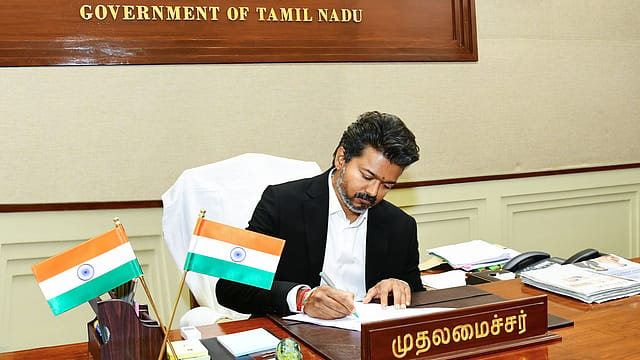
Chief Minister C Joseph Vijay’s cabinet expansion on May 21 took the strength of his ministry to 33, just short of the constitutional cap of 35. The induction of two more MLAs on Friday completed the coalition cabinet. The coalition was assembled seat by seat in the uncertain days after the election. TVK emerged as the single largest party with 108 seats, 10 short of the majority mark of 118. Congress, with 5 seats, crossed over to support Vijay. The CPI, CPI(M), VCK and IUML extended support and a rebel faction of the AIADMK followed suit.
TVK’s unprecedented victory has produced Tamil Nadu’s first non-Dravidian government since 1967. Vijay’s cabinet now includes eight Dalit ministers, the highest representation in Tamil Nadu’s history. Tamil Nadu’s Dravidian parties had built their political identity on the promise of social justice, on Periyar’s legacy, on the proposition that the marginalised would find their voice through the state. Six decades of that tradition never produced this scale of Dalit representation at the cabinet table. A party that did not exist two years ago has.

Open Minds 2026
26 Jun 2026 - Vol 05 | Issue 26
The power of ideas and arguments in 50 portraits
Four women ministers sit in the cabinet, another record for the state. Nine ministers are under 40 years old. Of TVK’s 107 elected MLAs, a striking majority are first-time legislators. Profession distinguishes this cabinet as much as age. The cabinet now includes professionals, former athletes, doctors, strategists, social media experts and entertainers, in what is one of the most unconventional political teams in Tamil Nadu history. One minister quit civil service to help draft TVK’s policy manifesto. Another is the President of the Basketball Federation of India. The Dravidian parties built their cabinets from career politicians who had climbed party structures over decades. Vijay has drawn from a far wider field.
Two Brahmin ministers also sit at the cabinet table, alongside the eight Dalit ministers. What this points to is a cabinet attempting to hold together the historically excluded and the historically dominant under a single political roof.
Congress has returned to power after 59 years. Party leader Manickam Tagore called it an emotional and historic moment for party workers, noting that Congress ministers had secured cabinet berths for the first time since 1967. The party contested the 2026 election in alliance with the DMK, then broke away in the post-poll realignment to back Vijay. Two of its five MLAs were inducted into the ministry: S Rajesh Kumar, who won from Killiyoor, and P Viswanathan, who won from Melur in Madurai. Both came in on thin margins—1,311 and 2,724 votes respectively. Their performance in office will be scrutinised not merely by their constituents but by a Congress organisation that needs this gamble to pay off electorally over the next five years.
With Chennai accounting for a disproportionate share of ministers—nearly every prominent TVK face from the capital has found a berth—Vijay’s generosity towards his urban base has already produced murmurs within the wider coalition. Besides, several districts that delivered substantial support to the party remain unrepresented.
The 25 rebel AIADMK MLAs who joined the coalition have been excluded entirely. Congress and the Left pushed back against bringing them in, and Vijay held the line. In a way, this preserves the ideological shape of the alliance. But, all said, a cabinet is an argument. Governance is the proof.