Running, Never Arriving: Rahul Gandhi appears to be on a journey of self-discovery
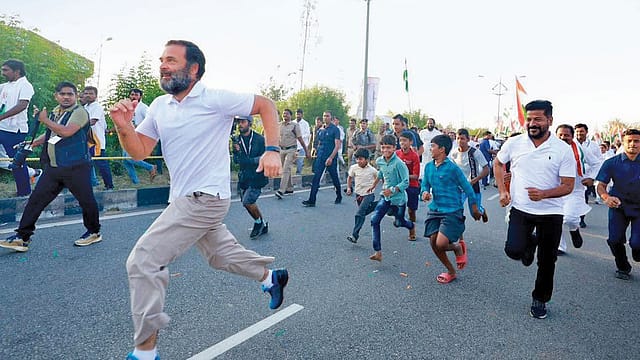
FIRST THINGS FIRST, and this is not a ritual offering one feels compelled to make before criticising Rahul Gandhi. There is an unwritten pressure to always begin by saying it, only that it happens to be true: Rahul Gandhi is a nice man; he is a kind man. Whenever we see him speaking to ordinary people on the street, there is a warmth to him that is difficult to fake. The poison arrows of hardcore Hindutva fans apart, these meetings fill our hearts with warmth, the kind one may experience after playing with a Punganur cow. When he lays his arm round a poor autorickshaw driver or a coolie, we are transported to the vision of his father applying pain-relief spray over the ankle of his personal security officer after his supporters had kept trampling on it—this kindness made him ask Jayanthi Natarajan in Sriperumbudur if his boss was fine seconds before he died, oblivious to the senior Gandhi’s corpse lying atop him.
The die-hard Modi fan is a different species. But why are many who would be happy to see Modi go unable to put any trust in Rahul Gandhi? They all want to like him, but then they cannot ignore the stench of statistics. In 2013, when Gandhi started, Congress was in power in 14 states. Today, it is contained in five, surviving largely through alliances, regional satraps and the resurgence against local anti-incumbency. The old timers’ memory of Gandhi is of a boy, standing next to his grandmother’s corpse; at one point he wipes the edge of her mouth with a piece of cloth. Impervious to crowds, writes Sugata Srinivasaraju in his book Strange Burdens, on Rahul Gandhi, it seemed there was a conversation happening between the two. Somehow—and many are unable to reconcile with this—the same boy who now commandeers a party cannot have a conversation with India.
WE HAVE NOW moved on from the central political fact of contemporary India that Narendra Modi dominates the national imagination. But it has been 12 years, and in politics that is an eternity. The failures of his government are piling up and getting muted recognition by even his ardent supporters. There is institutional corrosion, economic anxiety, social polarisation, and the ghoul of unemployment, among others. Yet, despite years of effort, Gandhi hasn’t been able to occupy even a scaffolding in the imagination in which Modi remains the main actor.
This simply cannot be explained away by propaganda or media capture or the formidable electoral machinery of the Bharatiya Janata Party (BJP). The deeper problem is that Gandhi is keen to show that he possesses a secret potion-like coherent understanding of what ails India. He shares this often in his conversations with the people he meets; he speaks like a mountaineer who took months to peak a summit and has returned with innate knowledge of its heights. But when it comes to providing a map, his listeners find none; they only find anecdotes. Sometimes when he tries explaining “stuff”, it feels like an eager student has seen scores of Instagram reels on a deep subject like consciousness and is now trying to explain it to an audience which is getting late for weekend binge drinking. Those who hate Modi or what he represents love Gandhi blindly because every now and then he wakes up and says things about the Rashtriya Swayamsevak Sangh (RSS), which lulls them into a false optimism that the diagnosis is complete and now it is just a matter of prescribing medicine. But the doctor who is supposed to dole out that medicine walks away after diagnosis because he has to practice his Aikido moves. Despite mounting evidence, his followers are still unwilling to accept that the doctor may not have the medicine after all. But every time he speaks, they have this hope that he is on the verge of dispensing it.
Rahul Gandhi entered public life carrying a story about himself. It was a story he would repeat often in different forms: that politics was poison. From the beginning, therefore, his relationship with politics was marked by ambivalence. The anecdote was moving, but it also contained the seed of the problem. In 2022, speaking about it, he said India was filled with politicians who were interested in power. “I was born in the middle of the power, at the actual centre of power, but my strange ailment is that I am not interested in power. I am telling you the truth,” he said. But even after recognising this, it is not that he forsakes it. He may have called Modi’s government suit-boot ki sarkar, but it is not as if he left his bungalow to live in a Trans-Yamuna colony. Instead, he chose to enjoy all the fruits of being the scion of a political family.
In the states it rules and the governance model it follows, Congress suffers from the same equivocation. As a result, it offers no coherent alternative to a system that BJP has inherited and perfected. Where it governs, Congress rarely offers an alternative economic imagination. It courts the same investors, celebrates the same growth metrics, and relies on welfare schemes to cushion the social consequences. The result is a party that frequently appears as BJP minus the cow, and without the organisational discipline that makes BJP the leviathan it is today.
That is why across much of India, voters struggle to identify what Congress would do differently on jobs, inequality, corporate concentration or public services. If both parties promise investment summits, infrastructure corridors, private-sector growth and global capital, why should voters choose the weaker version of the stronger brand? In any Indian city, if one goes to choose a flat in an under-construction complex, the builder has sample flats to show to the buyer which gives him an idea of what his future flat would look like. Had Congress under Gandhi shown a sample of its ideal governance model in any of its ruled states, voters might have been able to visualise the alternative it seeks to offer India. Instead, it is the same wobbly building, like the one in Telangana which uses the same coercive measures Congress condemns in BJP-ruled states. Or in Karnataka, where a city like Bengaluru continues to remain a symbol of chronic civic dysfunction. One of Congress’ senior leaders served as chief minister in Rajasthan for three terms, including one till 2023. But can one say that there was something like a distinctive governance model in place there? What about Himachal Pradesh, or even Punjab before the Aam Aadmi Party (AAP) took over? The problem is not that these states are uniquely badly governed; it is that they are insufficiently different. None of them provides voters with a compelling preview of what a Rahul Gandhi-led India would look like. The sample flat never quite reveals a new design. Or, to put it more succinctly, there is no sample flat.

Perhaps it would have mattered if the Gandhi siblings had shown that authority and responsibility are inseparable; that one cannot claim the privileges of leadership while remaining insulated from its failures. What if Rahul Gandhi had occasionally staked his own political capital on the outcome? What if, for instance, he had put himself forward as Congress’s chief ministerial candidate in Uttar Pradesh, a state represented for decades by his family and central to the party’s historical imagination? He may well have lost. But voters would at least have seen a leader willing to place his reputation on the line rather than remain one step removed from the battlefield. Before Rahul Gandhi can persuade India that he is ready to govern the country, he must answer a more immediate question: Why has he so often failed to govern his own party? The wreckage lies scattered across states that should have been Congress strongholds. We all know what happened.
Congress today seems unable to contend with a profound transformation in the structure of Indian political consciousness, the one in which the party no longer occupies the broad civilisational and political space that once made it the natural party of governance. Congress’ historical achievement, as the scholar Bhagwan Josh once suggested, was not that it transcended caste, class and community, but that it managed to speak across all three codes of mass consciousness simultaneously. While communist parties largely mobilised through class, and parties such as the Bahujan Samaj Party (BSP) through caste, Congress presented itself as a capacious national platform within which these identities could coexist. But that image has steadily eroded. BJP on the other hand keeps working round the year on expanding its base, reaching out to Dalits and backwards castes, attempting to cultivate even sections of Muslims. The fence-sitters among the middle class who may want relief from BJP for a while look at Rahul Gandhi and find little reason to switch.
Rahul Gandhi should have been able to score this, given that many are now exhausted with BJP. Instead, they come across a man who talks about himself in third person like someone who has emerged from a Vipassana course. It is more likely Gandhi is on a journey of self-discovery, but it is at the cost of his party that is in desperate need of a commander. Years ago, Rahul Gandhi spoke about “escape velocity”, a term in Physics, as a way of describing how Dalits might overcome the gravitational pull of historical disadvantage. Today, there are many within and around Congress who wonder whether the party itself requires escape velocity—not from its opponents but from the handicap that Rahul Gandhi has come to represent. Many Congress well-wishers believe the party would splinter if the Gandhis were to step aside. But that is akin to keeping a terminally ill patient on a ventilator. The apparatus sustains the body, but it does not cure the disease. If a party’s survival depends indefinitely on a single family, that is not evidence of strength but of institutional exhaustion. The Gandhis may be preventing Congress’ collapse, but they may also be preventing its reinvention.
History wants to be kind to Rahul Gandhi. But it doesn’t know how.