Narendra Modi: The Marathon Prime Minister
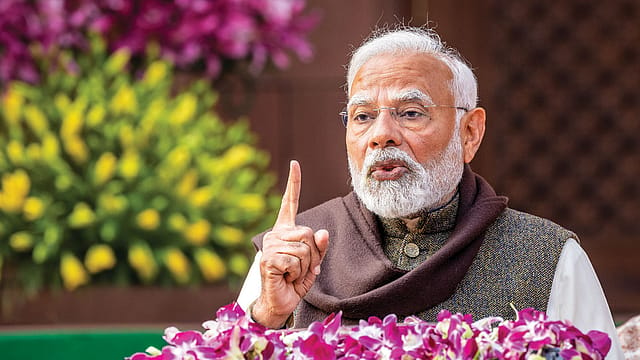
NARENDRA MODI’S landmark achievement of a record 4,339 days in office at a stretch as an elected prime minister is all the more remarkable when the unrelenting opposition to every major decision he took—rollout of Aadhaar, implementation of a Goods and Services Tax and an insolvency code, abrogation of Article 370 in Jammu & Kashmir, construction of the Ram temple at Ayodhya, criminalisation of triple talaq and the Citizenship Amendment Act—is fully considered.
Procedural hurdles in Parliament, vexatious litigation and even riots were resorted to to subvert the Bharatiya Janata Party’s popular electoral mandate. In the early days of Modi 1.0, even a fugitive like Edward Snowden, on the run from American law, was a legit voice in denouncing Aadhaar as a “mass surveillance” tool.
It required marathon hearings in the Supreme Court before the JAM (Jandhan-Aadhaar- Mobile) trinity became a eality and a digital revolution took wing. Within a few years, as many as 1,000 Aadhaar-enabled schemes were implemented. A fun fact? About 600 were run by states, many under opposition governments.
The opposition, led by Congress and the Left, was determined to use its majority in Rajya Sabha to thwart BJP’s majority in Lok Sabha. In other words, using the Upper Houase to undo the will of the directly elected Lower House was perfectly okay. A Left veteran came up with the idea of inserting references criticising the government over black money and corruption as amendments to the motion of thanks on the President’s address to Parliament. This was hailed as a major feat without for a moment considering the blatant abuse of a convention.
The government’s decision to declare the Aadhaar legislation as a “money bill” to obviate the Upper House veto and get around wilful opposition to the measure, however, evoked howls of protest over alleged constitutional impropriety. Within months of the passage of the Aadhaar Act, direct transfers to beneficiaries began to change the lives of millions for the better, with biometric confirmation of identity taking less than a second. Despite consensus among chief ministers of all hues that the UPA era “land bill” needed reconsideration due to its onerous acquisition clauses, a reformed legislation was blocked in Parliament till the Modi government decided states should revise rules to their needs and satisfaction. This is exactly what happened.
The arithmetic of Rajya Sabha changed, but more importantly, the political mood of the nation began to weigh on parties. When Home Minister Amit Shah introduced legislation withdrawing Article 370 from Jammu & Kashmir and dividing the state into Union territories of J&K and Ladakh in August 2019, the Bills were passed by a four-fifths majority in Lok Sabha and a two-third vote in Rajya Sabha, garnering support beyond the National Democratic Alliance (NDA) numbers. The regional parties who considered it prudent not to get on the wrong side of national sentiment included Biju Janata Dal, YSR-CP, Bahujan Samaj Party, TRS, Aam Aadmi Party, and AIADMK, apart from NDA partners Telugu Desam Party and Janata Dal (U).
It was evident from the beginning that it would not be good enough to win a Lok Sabha majority. The intellectual and cultural elites of Lutyens’ Delhi and a wider section schooled in a ‘secularist’ dogma were never going to accept the altered circumstances. For the elites, the situation was worsened by Modi’s complete disinterest, unlike previous BJP leaders, in seeking their acceptance. His description of this section of the populace as the Khan Market gang pretty much sums it up. The restructuring of Delhi’s official complexes and the Indira Gandhi National Centre for the Arts (IGNCA) as part of the Central Vista project was another blow to the dispossessed curators of public sensibilities. Physical relocation was traumatic even though what was brought down was largely stolid Soviet-style masonry. The remaking of central Delhi with a new Parliament and residential blocks for VVIPs was indeed very much a political project.
Modi’s ideological opponents are aggravated by the claim that he has passed the record of Jawaharlal Nehru, India’s first prime minister and an icon of the left-liberal ecosystem, as an “elected” prime minister. The comparison is intended to equate similar periods in office by excluding Nehru’s tenure as prime minister from 1947 to 1952 when the first Lok Sabha election was held. Unhappy at the suggestion that Modi had bettered Nehru’s score, critics cried that the record being claimed is ‘conditional’ and tailored to specification. They forget that Nehru’s stint immediately after Independence cannot be compared with any prime minister who followed.
The nub, of course, is that the Modi government’s advent has witnessed an unprecedented assault on Nehru’s political and economic legacy, and the undoing of the Nehruvian project runs in tandem with the rise of Hindutva and increasing acceptance of its political and cultural values. The expectation that the Modi storm will pass has not come to be. Rather, entrenched opponents like AAP and Trinamool Congress have fallen to the wayside while allies who broke with BJP have met a poor fate too. The 2024 Lok Sabha result provided hope of a reversal, but Modi has worked with energy and a rare self-belief to turn things around once again.
The prime minister’s ability to criticise the ‘appeasement’ politics of BJP’s opponents does not get in the way of welfare and governance measures that often help minorities. For example, Muslim women are significant beneficiaries of the Ujjwala cooking gas connections. The socio-economic criteria does not discriminate against any religious affiliation, and given that Muslims lag others on many counts, the community is well represented among welfare beneficiaries of schemes like free rations and housing support.
When Modi moved to New Delhi from Gujarat, the prevailing opinion was that while he may be an effective practitioner of domestic politics, he would struggle with foreign policy. People who held such opinions needed to have paid closer attention to his record as chief minister. He mooted the Vibrant Gujarat annual summit in 2003 when such shows were unheard of. As an administrator, he was very open to borrowing and adapting good ideas from any part of the world. He had an instinctive grasp of technology and its potential to change millions of lives. He understood the importance of economic diplomacy and trade deals.
Modi’s close relations with Arab states in the Gulf region are a revelation. He has been able to leverage the ties by knitting Indian and Gulf economies closer together while fugitives have been sent back to India to face trial for crimes such as terrorism and corruption. At the same time, the prime minister has forged ties with European nations as well, repairing relations and enlarging common ground. US President Donald Trump has prickly relations with most world leaders—and his mollycoddling of Pakistan’s military is particularly problematic—but he calls Modi a “good friend” at a time when he lashes out at just about anyone.