Suvendu Adhikari: Man on a Mission
IF ACTIONS SPEAK LOUDER THAN WORDS, Suvendu Adhikari’s decisions after becoming West Bengal’s first Bharatiya Janata Party (BJP) chief minister indicate he is acting on his pledge to let his work do the talking. It’s not that Adhikari is likely to adopt a vow of silence. He would be keenly aware of the importance of communicating how BJP plans to restore Bengal’s pride, rejuvenate its economy, and make a clean break with the politics of agitation and defiance that was a means to define identity and cultural exceptionalism. Despite 15 years in office, the Trinamool Congress (TMC) government embodied a state of perpetual rebellion, forever tilting at real and imagined windmills. BJP’s promise of ‘Sonar Bangla’ won the battle of the ballot decisively and it now needs to be actualised in tangible and substantive terms.
TMC leader Mamata Banerjee’s Maa, Mati, Manush slogan had hit the right notes as a protest anthem against the Left Front’s arrogance and highhandedness in dealing with popular dissent that had led to the police firing in Nandigram in 2007. But as a governing party’s mantra, its emotional appeal had dried up. Having witnessed TMC’s missteps as an insider before he left for BJP in December 2020, Adhikari has been quick to take decisions that address the deeply unpopular aspects of the TMC legacy, which voters expect BJP to use its exceptional mandate to correct or undo. There was a need for the new government to unambiguously signal a new beginning to drive home the message that the administration has indeed changed. TMC was out and BJP is in.
The decision to transfer land to the Border Security Force (BSF) for purposes of fencing the border with Bangladesh and other security measures represents a commitment towards halting illegal immigration and cross-border smuggling and is intended to stand in contrast to TMC’s deliberate foot-dragging on the issue. Despite interventions of the Calcutta High Court, the previous government did not hand over land for which BSF had already paid compensation. The idea was simple enough. TMC needed to impress on its supporters that it was not ceding ground to the Centre. By conflating border security with vote-bank considerations, TMC hoped to consolidate its Muslim support, but this provided BJP an opportunity to substantiate its appeasement charge. Reversing a
flawed policy was an urgent national security requirement and equally a demonstration of political resolve to act against illegal immigration.
Like some other erstwhile opposition governments, such as the Aam Aadmi Party (AAP) in Delhi, the Dravida Munnetra Kazhagam (DMK) in Tamil Nadu, and even the Biju Janata Dal (BJD) in Odisha, the TMC administration did not implement several Central schemes. The ostensible reason was a resistance to “conditionalities” that infringed on the rights of the state. The subtext was more political—a concern that the schemes’ benefits would rebound to the Centre’s credit rather than the state’s. As in the case of other opposition governments that went down the short-sighted path, the decision ended up as an act of self-harm. West Bengal was denied funds for healthcare, education, work guarantees, farm insurance, and assistance to local artisans. Failure to submit utilisation certificates meant that the rural employment guarantee—fully funded by the Centre—ground to a halt. Apart from the border land transfer, the first cabinet meeting convened by Adhikari decided to implement Ayushman Bharat, which offers a ₹5 lakh annual health cover per eligible family and similar benefits for all citizens above 70 irrespective of income. The rollout of other Central schemes will follow. Other decisions include permitting participation of officials in Central training programmes, full adherence to the Bharatiya Nyaya Sanhita (BNS), and implementation of guidelines for ongoing Census operations. Assistance to families of “martyrs” who fell victim to political violence and directions to the police—issued separately during a review of law and order by Adhikari—to crack down on crime, curb the coal and cattle mafia, and restrict the use of loudspeakers at religious places outline the new government’s priorities.

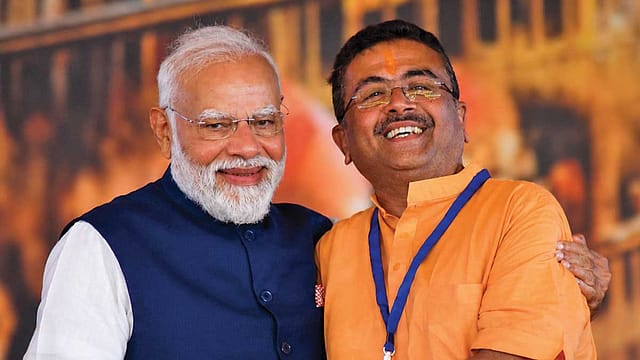
The swearing-in of Adhikari and five ministers on May 9 at the Brigade Parade Ground in Kolkata was unmistakably a ‘Hindutva moment’ and the BJP leader reflected the occasion’s symbolism by taking his oath in a simple saffron kurta and white dhoti. Genuflecting after he reached the dais, Prime Minister Narendra Modi knelt before a large crowd gathered to usher in the new BJP ministry. It was Modi’s way of expressing thanksgiving for BJP’s massive mandate that extinguished questions about the party being a cultural outlier in Bengal. The warmth with which Modi congratulated Adhikari and clapped him on the back could not be missed. It was a moment that marked an inflexion point. Dozens of stalls selling traditional sweets and ubiquitous jhal muri—the spicy snack that went viral after Modi stopped by at a local vendor during the campaign—embellished the cultural connect along with beats of the dhak and the cadence of the Chhau dance. Not long after he was formally sworn in as chief minister, Adhikari went to Jorasanko Thakurbari, the ancestral home of Rabindranath Tagore. The date of the swearing-in had been carefully chosen and Adhikari’s tributes to the national icon were again a pointed refutation of the narrative that BJP lacks cultural roots in Bengal.
“We have begun with homage to the Kobiguru and we will begin the task of Bengal’s rejuvenation (nav nirman),” Adhikari told the media. The prime minister, he said, was keen the new government begin working from the day of Rabindra Jayanti. “This is a important day for the nation and Bengal,” he said. The chief minister then went to the house of Bharatiya Jana Sangh founder Syama Prasad Mookerjee in Bhawanipore where, after garlanding Mookerjee’s bust, he recalled Mookerjee’s role in ensuring the formation of a Hindu-majority West Bengal after Partition. “The correct account of our history records the (importance) of June 20, 1947, when Syama Prasad Mookerjee was instrumental in a resolution that ensured we did not live in an Islamic country. Paying homage here was a priority (prathmikta),” he said. Adhikari iterated the connection between Mookerjee and founder of Bharat Sevashram Sangha Swami Pranavananda that offers a confluence of nationalist and spiritual movements and said, “It is believed Swami Pranavananda spiritually empowered Syama Prasad and entrusted him as the saviour of Bengali Hindus during the days of communal politics under the Muslim League and the turbulent years leading to the Partition of India, including Bengal.”
Adhikari’s political and cultural journey continued with a visit to Bharat Sevashram Sangha headquarters at Ballygunge where he met senior monks. He visited the Bishram Kaksha (resting chamber) associated with Swami Pranavananda and offered prayers after being garlanded by the Sangha’s monks and followers. His last stop was no less important—the Kalighat temple where he prayed to the Goddess and shared an account of what he described as a divine sign during a previous visit when a lotus fell into his hands from the feet of the Goddess—which he had read as a blessing. He wound up at the Shitala Mata temple, considered by devotees as a spiritually awake shrine, to the sound of conch shells and ‘Jai Shri Ram’ and ‘Bharat Mata Ki Jai’ slogans. Adhikari’s cultural expedition, with saffron-clad monks greeting and blessing him along the way, was an act of obeisance and gratitude while the surging and enthusiastic crowds signalled acceptance of the chief minister as one of their own. The carefully choreographed journey, rich in symbolism and replete with political messaging, was just the right denouement to a momentous day.
Adhikari has shown a desire to pick a capable team, ignoring criticism that some of his choices are officials mandated to poll duties in an election BJP won, and has set his sights on restoring a sense of professionalism in the police force. The task, despite a history of politicisation that goes back to decades of Left rule that preceded the TMC government, may not be as challenging as it seems. A policy consistency and well-defined parameters for law enforcement allow efficient personnel to come to the fore. When Janata Dal (U) leader Nitish Kumar took charge of Bihar as chief minister in 2005 after 15 years of Lalu Prasad-Rabri Devi raj, it did not take long to bring criminal elements to heel. The same police force that had been either complicit or helpless restored public confidence and before long Patna was no longer a ghost city after 6PM. A similar tale unfolded in Uttar Pradesh after Chief Minister Yogi Adityanath set about bringing criminals and the mafia, who enjoyed political patronage, to justice. It is a matter of political will and Adhikari’s success as leader of the opposition and his hard-fought victories over Mamata Banerjee in two constituencies shows he has the resolve and clarity of vision.