West Asian Crisis: Austere and Onwards
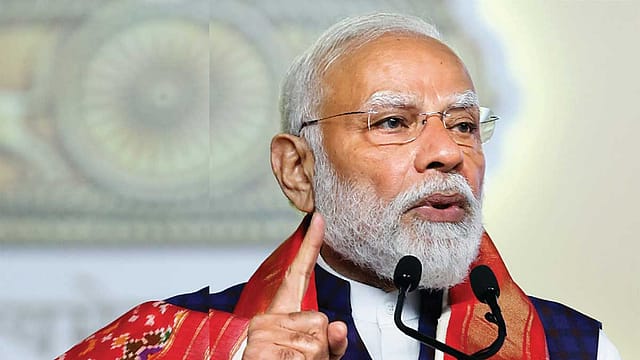
THE MOOD AT THE BHARATIYA JANATA PARTY (BJP) headquarters on the evening of May 8 was jubilant. Emotions ran high as the closing count of votes in West Bengal confirmed the party had touched giddying heights surpassing the expectations of BJP’s most ardent supporters. Prime Minister Narendra Modi, hand on his chin, seemed lost in thought. When the time came, he spoke of a “new dawn” in Bengal, BJP’s success in Assam and Puducherry, and thanked voters in all states that went to polls. But Modi might well have been looking ahead, considering decisions that could no longer be delayed.
Two days later in Hyderabad, Modi spoke for a while in the same vein, saying voters had punished parties for false and unkept promises as well as corruption before he turned to the war in West Asia and the need for collective action in the face of a storm showing signs of weakening. “When there is pressure on supply chains, difficulties increase despite various measures taken by the government… During a global crisis, we must place the country above everything else,” he said.
The need of the hour, said the prime minister, is to use petrol, diesel, gas and other petroleum products with restraint. He urged people not to buy gold on special occasions for a year, recalling a time when people donated gold for the country. “We do not have to donate now, but we should at least resolve not to buy to conserve foreign exchange reserves,” he said. Modi followed on his statements by asking his security detail to be curtailed by half and referred to Covid-time measures to emphasise the need for austerity. National Democratic Alliance (NDA) state governments followed suit, reducing official convoys and air travel.
Modi advocated use of the Metro, carpooling and trains to reduce petrol and diesel consumption and decrease pressure on forex reserves. It was apparent that Modi had moved out of campaign mode and was prepping the nation for some serious belt tightening. A few days later, Minister of Petroleum and Natural Gas Hardeep Singh Puri dropped clear hints that pump prices—unchanged since 2022—are in for a sharp upward revision. After the Iran War broke out in February, India managed to rejig supplies but soaring crude costs mean oil companies are losing ₹1,000 crore a day.
The prime minister’s comments were met with relief within the government as concerns were rising about the crude import bill as well as purchase and import of gold. India’s gold imports were a shade less than $72 billion in 2025-26. An IGST (Integrated Goods and Services Tax) demand of 3 per cent hit imports in April but on May 12 banks looked set to resume imports. A day later, the government hiked customs duty on gold, silver, platinum, and semi-pure metal. Duty on gold and silver rose from 6 per cent to 15 per cent and on platinum from 6.4 per cent to 15.4 per cent.
Aware that purchase of precious metals—an ingrained habit in Indian households—would be spurred by economic uncertainty, the government said the duty hikes are a carefully calibrated and proportionate intervention to encourage “moderation in non-essential” imports. “Whether it is crude oil purchases or import of gold, the price is being paid in dollars. The prime minister’s call for reduced consumption of fossil fuels and a check on precious metals is timely,” said an official. The decisions are intended to prioritise essential imports, such as crude oil, fertilisers, raw materials, and defence needs.
Government sources said there needs to be a focus on imports that support economic activity, manufacturing, infrastructure, and exports. “In contrast, precious metals, while culturally and financially significant, are predominantly consumption and investment-driven,” said a source. A measured moderation of discretionary imports can contribute to overall macro-economic stability and reduce the impact of external stress that is not in the control of government and policy planners.
The finance ministry said the duty increases are in keeping with the prime minister’s framework for “national economic discipline” and his call for citizens to support the country’s resilience through responsible consumption choices. The dramatic change in the global and domestic situation could be seen with the Union Budget presented on February 1 reducing import duties on gold and silver from 15 per cent to 6 per cent and on platinum from 15.4 per cent to 6.4 per cent, only to reverse the decisions three months later.
The opposition criticised Modi’s comments, saying that they amounted to an admission of failure. The political salvos predictably ignored the role of external shocks to the economy and made evident why the duty decisions and a likely fuel price hike did not happen earlier. No party or government would be willing to announce bad news in the middle of an election. Any electoral setback was sure to be promptly heralded as a dimming of the party’s popular appeal.
Modi has not shied from taking hard calls. His appeal for a “Janata curfew” just as Covid began to spread in India was a precursor to a tough lockdown that lasted two-and-a-half months before it was slowly unwound. The prime minister’s calls for acts of solidarity with Covid frontline warriors, such as banging of thalis and pans and switching off lights and lighting candles—mocked by critics as voodoo science— helped shore up public morale. It was a measure of Modi’s personal credibility that he was able to persuade millions to accept a nationwide lockdown and later implement a disciplined rollout of vaccination.
A day before he spoke in Hyderabad, Modi made a different but not unrelated point at an Art of Living event in Bengaluru. Touching on a theme that often runs through his speeches, the prime minister said that a campaign succeeds only when it is endorsed by society. “I have always believed society is more powerful than politics and governments. And any government can succeed only when society actively participates in nation-building,” he said. The austerity drive is the latest example of Modi’s bid to mobilise society for a national cause.