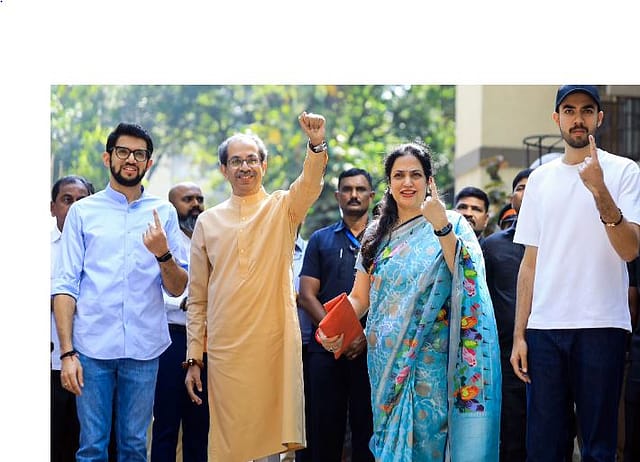
The Marathi Manoos has spoken and it is a thumbs down for Thackerays
In a pre-election meeting with home minister Amit Shah, Bharatiya Janata Party (BJP) functionaries spoke of the hurdles in recruiting supporters in slums and chawls, saying even repeated visits yielded modest results. Shah pointed out that while the party workers were looking to contacting a few dozen people at a go, BJP’s missed call appeal could prove much more effective. The “missed call” strategy – calling a designated number to express support -- was used effectively by the Modi campaign in 2014 and Shah saw benefits in expanding BJP’s voter base in civic elections that touch people’s lives directly.
BJP leader and former minister Prakash Javadekar is an organisational veteran having seen overseen elections in Maharashtra and many other states. A foray into a “zhopadpatti (jhuggi)” cluster in Pune uncovered a surprise. “Some 200 women had joined BJP. It did not seem likely even a few months ago,” said Javadekar. Inquiries revealed the women had used their own phones, those belonging to their grown children or husbands to place the “missed call” to numbers which BJP call centres tracked and followed up by despatching party workers to meet those who called. The newly enrolled supporters had a clear reason for voting BJP: They felt the party and Prime Minister Narendra Modi offered the best options for their future and that of their families.

India's Action Hero
27 Mar 2026 - Vol 04 | Issue 64
Riding the Dhurandhar Wave
Missing the woods for the trees
After the Maha Vikas Aghadi of Uddhav Sena, Nationalist Congress Party (Sharad Pawar) and Congress lost to the National Democratic Alliance (NDA) in the 2025 Maharashtra election – an outcome that overturned BJP’s reverses in the 2024 Lok Sabha polls – the shock in the MVA camp was obvious. At a media interaction Uddhav Thackeray wondered at MVA’s meagre returns, asking whether crowds he saw at election meetings meant anything at all. But the problem was that an honest analysis eluded MVA leaders. Just why did Uddhav Sena end up with 20 seats, NCP(SP) with 16 and Congress barely making it to double figures with 10?
The crude attempts to fire up the “Marathi” sentiment by assaulting shop keeprs and street vendors for their alleged inability to speak Hindi has cost the Thackerays heavily. The roughing up the vendors for no fault of theirs went viral several times over. The helplessness of the victims of the bullying went viral many times over. The derogatory references to other communities at the Uddhav Sena and Maharashtra Navnirman Sena rallies served to alienate non-Marathi communities – Gujaratis, Marwaris, south Indians and Hindis-speaking migrants who made Mumbai home decades ago. The Udhav Sena’s extraordinary pivot towards Muslim voters has fetched seats but exposed the limits of the gamble as the ploy failed to enthuse the party’s traditional voters.
Marathi-Hindutva false binary
The “Marathi Manoos” or son-of-the-soil narrative promoted by the Thackerays rested on a few claims. That Marathi-speaking people have been pushed out of the city to its fringes and are subservient to outsiders. And that there was a take-over of Mumbai – at attack on Modi and Shah – with the help of “pliant” subordinates like chief minister Devendra Fadnavis. The idea was to posit a Marathi identity versus BJP’s broader Hindutva appeal that seeks to encompass all Hindu communities. Yet again, this line of argument reflects an inability to acknowledge that the Marathi-Hindutva fault line is a false binary. Mumbai’s politics has indeed been influenced by identity politics. But Modi’s emergence on the national stage upended these facile assumptions as the Prime Minister has a strong following among Marathi-speaking people who rejected the Thackeray claims to represent their interests.
The steep decline in the fortunes of the Thackerays is not a surprise. The Marathi vote has not been consolidated for some time now, certainly the nativist appeal of even the undivided Sena waned after the death of Bal Thackeray. When BJP and Sena fought election in alliance, this vote rallied behind the Hindutva parties as the thumping win of the alliance in the 2017 Mumbai corporation election evidenced. This time around, the Thackerays could count on only a slice of the Marathi vote and Muslim consolidation and they clearly fell well short.
A new vote for development
The development and renewal of Mumbai infrastructure will remain work in progress for several years as the backlog is severe and will take time to overcome. Yet, politically coloured arguments about rising pollution and the annual disruption of life due to monsoon flooding did not work. This was not because these issues don’t matter but voters instinctively saw through the duplicity of commentators who did not hold past governments to similar yardsticks and deliberately ignored better news. The gloomy narration of how Mumbai’s new infrastructure is not solving the city’s problems and claims voter disillusionment were transparent efforts to fan negativity and most Mumbai residents – Marathi speakers included – did not fall for it.
The Thackerays, in particular Uddhav Thackeray, faced a pincer attack. On the one hand was BJP energised by a big win in Bihar and led by an astute politician like Fadnavis who could not be tagged as “anti-Marathi.” On the other they faced a tough and seasoned opponent in deputy CM Eknath Shinde who worked hard to woo Sena “shakhas,” the building blocks of the party, after he parted ways with Uddhav and joined hands with BJP to oust the MVA government in June, 2022. While Shinde came across as a down-to-earth Shiv Sainik who understood the party’s legacy and its commitment to Hindu unity, Uddhav Thackeray became distanced from the rank and file. The MNS and Raj Thackeray, as the results demonstrate, were an even smaller force.
The Maharashtra civic election results demonstrate that while identity politics cannot be wished away, a purely nativist approach will in itself prove insufficient. BJP promised a “Marathi and Hindu” mayor and yet its prospects rested heavily on convincing voters that it is committed to Mumbai’s welfare. This is why it managed to get the better of the Thackerays in the most consequential of battles and won the trust of nearly all sections of the electorate.