Tamil Nadu Assembly Election 2026: Edappadi K Palaniswami struggles hard to keep AIADMK in the sheltering shadow of Jayalalithaa
ON MGR ROAD IN NANGANALLUR—THE heart of the Alandur constituency from which MG Ramachandran (MGR) first cut his teeth in mainstream Dravidian politics—an MGR-lookalike dances alone on a stage to a popular MGR number. It is hot at three in the afternoon in Chennai, enough to melt the white face make-up onto the stiff collar of his shirt. Yet, the wannabe is dressed in his grandeur: a thick and curly wig parted indelicately by the side, a violet shirt wrapped within a beige blazer and tucked into beige bell-bottoms. A fat beige necktie. And, of course, those signature sunglasses, heavy and black, the only accessory providing any kind of relief to this performer at this cruel hour.
Below the stage, party workers from the All India Anna Dravida Munnetra Kazhagam (AIADMK) find themselves in different states of busy. Some carry enormous hoardings to fasten around electric poles, others distribute flags, while the lower cadre and volunteers handle large coils of insulation wires for amplifiers and microphones and even neon-lit portraits of the party’s former leaders, as well as the large green electric framework for the party’s two-leaf symbol. They are all in hectic preparation for Edappadi K Palaniswami’s (former chief minister of Tamil Nadu and AIADMK general secretary) first roadshow in Chennai ahead of the state elections on April 23, set to begin here on MGR Road at 4PM and wash into Tambaram by 6PM—the two halts for speeches by the man known simply as EPS.
A whole hour before the scheduled start, a fairly substantial crowd has already gathered across the stage, on which a performer playing a young J Jayalalithaa, her look complete with a high bun, exaggerated eye-liner and floral frock, joins MGR for a medley of their songs from the 1960s. The crowd recognises the tunes, for the men and women standing under the cover of shop awnings and the shade of Ashoka trees are largely in their 60s and 70s, most of this swell alive when MGR formed the party they now support back in 1972 and very much AIADMK voters when Jayalalithaa took control after her mentor’s death in 1987 after a decade-long tenure as chief minister.
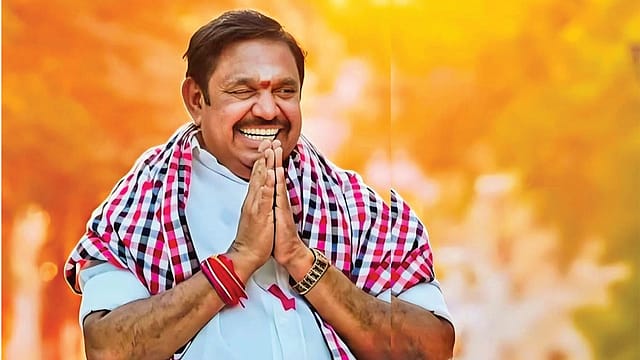
MGR and Jayalalithaa’s accidental successor, EPS, arrives a good two-and-a-half hours late, and by this hour, 6:30PM, MGR Road in Nanganallur is bloated with supporters and dignitaries. The convoy slices through the thicket of bodies and waving flags, police cars and ambulances in the front, the media vans carrying videographers on its roofs in the middle, and EPS’ recreational vehicle bringing up the rear. His beatific smile can be seen above the sun-roof of his bulletproof RV through which he has popped his upper torso for public view, fresh vibhuti on his forehead as well as AIADMK’s chequered scarf draped around a crisp white shirt.
While the RV moves, some from the crowd hand him bouquets of flowers even as a hype-man screams into a megaphone in Tamil on loop: “Your saviour is here. The saviour of Tamil Nadu is here.” The words make EPS smile wider. The RV halts near the stage, but EPS doesn’t alight. He will deliver his speech from the vehicle itself, so KP Kandan, Sholinganallur’s district secretary of AIADMK, pops through the sunroof too and helps his boss with his headset mic. EPS begins by invoking Puratchi Thalaivar (Revolutionary Leader, MGR’s honorific title) and Puratchi Thalaivi (Jayalalithaa) before bursting into his anti-incumbency, anti-Dravida Munnetra Kazhagam (DMK) rhetoric.
He points at the crowd in front of him. “I came from there to here. Can this happen in DMK?”
The crowd applauds. They sense a rant on DMK’s dynasty politics, given that Chief Minister MK Stalin is the son of M Karunanidhi, Tamil Nadu’s longest serving chief minister over multiple tenures. He obliges.

“Stalin and I took different routes to the chief minister’s seat. I came from down there, where you are standing, the hardest way, whereas Stalin had it easy, born to Karunanidhi. Now see, you can clearly see Kandan standing here next to me, sharing this space. Can anyone from DMK, apart from his son, stand next to Stalin?”
The crowd roars in approval. EPS continues, “I was one of you, ordinary. You then know the struggles I have endured to get here. Does anyone here not know my journey, from an ordinary worker in the party to its general secretary and chief minister?”
It is a rhetorical question, for everyone gathered here already knows the answer. And in that answer lies a story that has come to define the party in the years after Jayalalithaa—a churn of loyalty and intrigue, in which men rose, fell, aligned and turned, until a self-confessed nobody found himself at the helm of a party once ruled exclusively by matinee idols.
THE DRAMATIC AND sudden rise of EPS, and therefore the story of AIADMK 3.0, begins with the death of Tamil Nadu’s great matriarch.
In the winter of 2016, when Jayalalithaa died, the party she had held together through force of will did not so much fracture as lose its centre of gravity. For decades, AIADMK had been less a party than an orbit: everyone from ministers to booth-level workers arranged around a single, immovable figure. When that figure disappeared, what remained was motion without direction.
The first to step into the vacuum was O Panneerselvam (OPS), a loyalist and a lieutenant Jayalalithaa had trusted enough to occupy the chair in her absence but never quite the man to claim it as his own. His elevation carried the weight of continuity but not authority. That distinction would define everything that followed. Within weeks, the party’s attention shifted to VK Sasikala, Jayalalithaa’s confidante, who moved with the assurance of proximity, because inheritance could be claimed by close association.
What unfolded next has since hardened into political folklore, but at the time it was messy and intimate in its betrayals. OPS’ late-night rebellion at Jayalalithaa’s memorial (“I was forced to resign… Amma’s spirit made me speak the truth”) briefly suggested that moral claim could challenge organisational control. It couldn’t. Sasikala tightened her grip, installing EPS as chief minister when her own path was cut short by imprisonment. Power, once again, shifted not through mandate but arrangement. Years later, rivals would distil this period of tumult into a single line: EPS, one minister said, was “a master of betrayal”—a charge that lingered precisely because it captured how power had moved in those months. EPS, at that point, appeared to be a placeholder. But politics in Tamil Nadu has always had a way of rewarding patience. What followed was not a dramatic overthrow but a slow consolidation. In a twist that would have seemed improbable months earlier, EPS and OPS, hardened rivals, found common cause in survival, joining hands to edge out Sasikala’s influence from the party’s formal structure.
Even that alliance, born of necessity, was transient. Once the immediate threat had receded, the balance tilted. EPS, with the backing of legislators and the party’s organisational spine, began to outgrow the arrangement. The years that followed were marked by calibrated moves—resolutions, legal battles, symbolic assertions—through which he converted proximity to power into possession of it. OPS, increasingly isolated, drifted to the margins, his moral positioning unable to compete with EPS’ control. Sasikala, released but diminished, found herself pushed outside the party she had once sought to inherit, eventually forced to carve out a separate political space. OPS would, in time, seek relevance with his sworn rivals, DMK, even as the party he had briefly led moved on without him.
Running parallel to this internal churn was another realignment. AIADMK’s relationship with the Bharatiya Janata Party (BJP), once tactical, began to harden. Under EPS, especially after his renewed alliance a year before the 2026 elections, the party has had to negotiate a new axis of power, one that sits uneasily with its Dravidian inheritance. Critics within and outside have seized on this shift. OPS would later allege that EPS was being “dictated to by BJP”, turning what had once been a regional behemoth into a junior partner in a national coalition.
What this decade sans Jayalalithaa revealed was the nature of AIADMK itself. Stripped of its central figure, it did not collapse; it recalibrated. The party became what it had perhaps always been beneath the spectacle—a leader-centric movement forced to regain organisation. Under EPS, AIADMK acquired a certain hardness, a stability built not on charisma but control. And yet, beneath it, the fault lines remained visible, the memory of a different kind of leadership never entirely receding.
That memory stretches further back, to a fracture that still shapes Tamil Nadu’s political imagination. In 1972, MGR, already a phenomenon not only on the silver screen but within the Dravidian movement, was expelled from DMK by Karunanidhi, his friend, film colleague (whose scripts made him a superstar), and eventual rival. The official reasons were organisational; the underlying truth was simpler: MGR had become too large to contain. What followed was the immediate formation of AIADMK, and within five years, a sweeping victory in 1977 that redrew the state’s political map.
It is this inheritance that AIADMK and its legion of supporters in strongholds such as Nanganallur still contend with. A party born of charisma, sustained by it and then deprived of it now finds itself navigating a different brand of politics. Under EPS, the party has held together, on the rare occasion even asserting itself, but the question that lingers is whether a political party can push on when the memory of the figures that once defined it refuses to fade.
STANDING ON THE shoulders of these unfading giants, EPS clears his throat in Nanganallur and continues. He shifts his gaze to the new kid on the block, actor and superstar Vijay, who made his political plunge by floating his own party, the Tamilaga Vettri Kazhagam (TVK) in 2024. Quite like MGR, and the first since, Vijay was quick to mobilise his extensive and state-wide network of rasigar mandrams, or fan clubs, into a full-fledged political movement. Because TVK now threatens to eat into the anti-incumbency vote share, EPS’ attacks are scathing. He invokes the tragic stampede at the TVK rally in Karur last year, helmed by Vijay himself, which saw 41 people lose their lives. “He called the families of the bereaved to Chennai to meet him. Who does that? The people of Tamil Nadu should not be fooled by these cinema-people. Cinema is to be watched and appreciated, but please leave it at that. Real-life and reel-life are very different, please don’t be fooled by those actors posing as politicians and vote wisely.”
Kandan hands EPS another sheet of paper and when the leader goes through the points mentioned, the speech is all but over. But EPS cannot help but close the speech with one last stab at his rivals, DMK. It is rather direct. “One last point, and let’s end with this,” he says. “Repeat after me, ‘Bye, bye Stalin!’”
His crowd obeys. “Bye, bye Stalin!” they chant.
EPS smiles again, folds his hands and says: “Nandri, vanakkam.”
Slowly the two men lower themselves into the RV as it lurches ahead, inching its way through the gradually dispersing crowd. They flock around the RV for selfies and glimpses of EPS, who soothes his throat with a carton of orange juice. Along the sides of MGR Road, though, there are small ripples of violence. Under electric poles and streetlights decorated with ripe bananas and tender coconuts and an assortment of fruits are pools of hungry men, all of them pushing and shoving this way and that with their eyes firmly on the real prize.