Assam Assembly Election 2026: Reading the Tea Leaves
MARIANI HAS A SINGLE ROAD GOING to Jorhat, the main city in this part of Upper Assam. When a train crosses the railway track, all road traffic comes to a halt even if the train passes in a few minutes. But on the last Thursday of March, it was a procession of Hindu deities led by an impersonation of Lord Hanuman that blocked the road. At the head of the procession was Rupjyoti Kurmi, the scion of a political family, his head daubed with the ritual saffron vermillion. The crowd behind him roars “Glory to Lord Rama.”
Mariani is not your typical Hindutva territory. One can see the hills of Nagaland from the town. The constituency abuts Mokokchung district of Nagaland and a large portion of its south-western periphery is dominated by Christians, mostly belonging to the Tea Garden Labourers (TGL) community. But what is interesting about the Ramnavami celebrations that Kurmi was leading is the participation, with gusto, of the TGL community. It is not a traditional North Indian celebration as is the wont in many towns of Upper Assam where people from that part of the country live.
That provides a clue as to which way the wind is blowing in Assam. Just days later, Assam’s Chief Minister Himanta Biswa Sarma announced an increase in the amount of money that will be given under the Orunodoi Scheme that provides Direct Benefit Transfer (DBT) to women. Mati, beti and roti is no longer a formulaic slogan and Sarma’s political popularity with women is a mass phenomenon, visible to any observer of Assam’s politics.
This is perhaps one reason why Gyanashree Bora, the Raijor Dal’s (RD) candidate in Mariani is facing a challenging time convincing people to vote for her. Given Upper Assam’s ideological preferences in favour of Assamese nationalism, the idea RD espouses, this should not have been a problem. But by her own admission, Bora says it is an uphill task. “The opposition (BJP) is very well financed and very well established. The Kurmis (Rupjyoti and his mother, the former MLA) have ruled here since 1991. I was born in 1991,” she tells Open at the Hoolungoorie Tea Estate where she is trying to convince a group of TGL women.
In the neighbouring Jorhat Assembly constituency, the odds are more evenly placed between the two main parties. While Gaurav Gogoi, Congress’ top man in the state, is on his home turf—the neighbouring constituency of Titabor is the Gogoi family pocket borough—the contest is not one-sided. Pitted against him is Hitendra Nath Goswami, a Bharatiya Janata Party (BJP) veteran and a former speaker of the state Assembly, a respected politician known for his genteel politics.
Reputation and personal record matter a lot in Jorhat but beyond personalities are the hard material realities binding political outcomes. Gogoi begins with two advantages. After the delimitation in 2023, Jorhat now includes parts of Titabor and Teok constituencies, areas more amenable to the Gogoi charm. Within Jorhat, there is an undercurrent among young voters in his favour as well. As an MP, he is considered articulate and someone who can put “Assam’s voice” on the “national stage”.
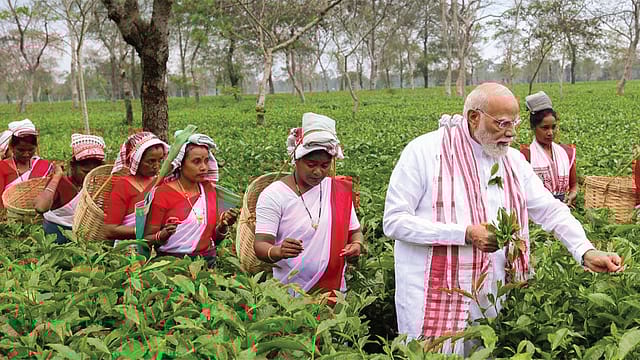
Goswami has his own advantages, in fact some of the things BJP has worked hard for over the past decade are now bearing fruit. TGL is a formidable constituency in the area, one that has been cultivated assiduously by the party. Some of the basic demands made by the community are now being met in a checkbox fashion. Roads within the tea gardens, often up to the dwellings of the workers, have been constructed on a large scale. Schools and education have been expanded in the tea garden areas and, most importantly, land rights are now being conferred on these workers who moved to the region from different parts of India over the last 200 years. This step is fraught with legal complications as the land originally belongs to the tea companies and is not for the government to give. There is litigation on the subject but a beginning has been made. This has been received well by the TGL community.

In Jorhat constituency there are 1.48 lakh voters. Approximately 17,000 are TGL voters according to Rintu Goswami, an advocate and neutral observer of Jorhat’s politics. Then there are around 15,000 Bengali voters and another 46,000 upper-caste voters. This is BJP’s core voter base. In contrast, Muslim voters and the Ahom community are, by and large, with Congress.
“Matters would definitely have been in Congress’ favour had there been a chance of Gogoi becoming the chief minister. Jorhat in 2026 is unlikely to be a repeat of the 2024 Lok Sabha election,” adds Goswami.
For his part, the BJP candidate is unassuming and gentle. “I have had many innings and considering my age, I should allow other people to come forward. Gaurav (Gogoi) is contesting and perhaps that is why my party has given me the ticket,” he tells Open at his home in Jorhat. But the calm around Goswami is one thing, the fight to win the seat is another matter and Goswami is no pushover. It is midnight and even at that hour, he is ensconced with leaders of the TGL community—a community that largely favours BJP—creasing out any political sticking points. Jorhat is Assam’s educational hub and its politics is genteel. Neither Gogoi nor Goswami has attacked each other publicly and often issue emollient statements about each other. The same manner of campaigning can be seen in other constituencies of the area— Mariani, where Bora focuses on what she calls “real issues”, as well as in Titabor and Teok. Goswami ascribes this to the “Ahom legacy as well as the educated population of the region who do not like people who attack their rivals.”
If discernment on the basis of candidates, issues and policy options go into making political choices for the people of Upper Assam, politics has a rough edge in Lower Assam. There is a gradient of sorts that sets in from Middle Assam—Hojai, Nagaon and Morigaon on the southern bank of the Brahmaputra and Darrang on the northern bank of the river—where demography, religion, and adverse occupation of land by illegal immigrants from Bangladesh have a far bigger political weight than any individual considerations.
In 2021, the Assam government removed encroachments from government land in the Gorukhuti area of Darrang district. This is an imperilled area. While some encroachers, mostly Bengali-speaking Muslims, were removed from an agricultural research station, a much larger population of illegal immigrants was left untouched. The area from Kurua Hill in the southwest that abuts the Brahmaputra to the northeast across a vast char (riverine island) is host to a very large population of illegal immigrants. Gorukhuti is just a tiny sliver in this large area. This remains encumbered land.
“This is the border between Assam and an ‘inland Bangladesh’,” Dijan Kalita tells Open at his pharmacy in Khalihai, a small hamlet beyond which lies the encumbered char where Phuratoli is the hub of illegal immigrant activities. No Assamese dares cross this hamlet to the char. It is a line that is physical as much as political. “Here BJP will win,” says Kalita. His assessment ought to be taken with a pinch of salt as he is a BJP supporter. But there is an underlying truth to what he says. Invariably, in Lower Assam, the rule is that where terra firma ends and char land begins, the population of illegal immigrants becomes absolute: no Assamese, Hindu or Muslim, will inhabit a char. The political corollary is that BJP’s influence drops to zero. Phuratoli is no exception. The result is that the fate of the Sipajhar Assembly constituency (which falls in the Darrang-Udalguri Lok Sabha constituency) will be decided by the balance of population between Bengali-speaking Muslims and the Assamese, indigenous Muslims and Hindus.
The same situation prevails as one moves diagonally in the southwest direction across the Brahmaputra to the Palasbari Assembly constituency under the Guwahati parliamentary constituency. Here, as in Sipajhar, the water’s edge is a marker of politics and political transitions.
FIVE YEARS AGO, when Open visited Biturteri village that falls in Palasbari constituency, there were just a few houses of illegal immigrants. The vast government land beyond the two small distributaries of the Brahmaputra remained unencroached. Now, more than five dozen houses, all of illegal immigrants, exist there. Almost the entire char is under cultivation. Last month, the state government carried out an eviction drive, but only a few residents were removed. The rest are happily growing wheat, maize, and other crops.
“One hundred bighas of my land have been taken away by these people,” Lakhiram tells Open on the char. He is unhappy with the partial eviction and wants the Bangladeshis to be driven out completely. “But I will vote for BJP as the alternative is far worse,” he adds. In Palasbari, BJP has better chances than the other riverine constituencies as much of the seat is at a remove from the Brahmaputra. It is as simple as that. Policies, programmes, ideas, and personalities count for little here; demography does.
On Saturday, March 28, there was a gentle drizzle in Guwahati. Many parts of the city had a wet look and a downpour is a distinct possibility as the rainy season has arrived with gusto. But that has not come in the way of Union Home Minister Amit Shah’s plans to hold a roadshow. It is late in the evening in the Aryanagar locality. The approximately 1.5km roadshow winds its way even as Shah makes a point that has great political traction in Assam. He makes a distinction between indigenous, Assamese Muslims and infiltrators and says that BJP is not against the former. He then goes on to say that the two are not the same and that “infiltration across the international border has been stopped.” Shah also lists the achievements of the BJP government in Assam and says that insurgency has ended and law and order is no longer an area of concern. He also lists infrastructure development as a major achievement of the BJP government.
One does not have to go into statistics like the length of new highways or the number of new bridges. A drive through Guwahati is enough to demonstrate that a palpable change has taken place in the quality of life for erstwhile harried commuters. The long jams are now a thing of the past. With multiple flyovers designed carefully to decongest the city, even peak-hour travel is not time-consuming. The new Kumar Bhaskar Varma Setu across the Brahmaputra—inaugurated in February—connects South Guwahati with the northern parts of the city, fulfilling a demand for connectivity pending for a long time.
This trademark ingredient of BJP’s efforts to further development has given it a political advantage, one not restricted to urban areas only. While very large expenditures have been incurred on infrastructure in Guwahati, the provision of basic facilities in places like the tea gardens of Upper Assam, where rudimentary roads, schools and health infrastructure were absent, has also not gone unnoticed among prospective voters. This is a factor that is resistant to quantification towards political advantage for a party but it exists nonetheless. A number of people Open spoke to in constituencies as different as Jorhat, Titabor, Mariani, Guwahati, and Palasbari testified to the difference better infrastructure has made to their lives.
What no one speaks about is the not-so-invisible rhinoceros in Assam’s politics: the ‘Muslim Question’ in the state. Each national party and its set of allies have tried to gain advantage or reduce disadvantages of dealing with Muslims, especially the miyas in Assam’s politics. BJP has tried its own and somewhat unorthodox strategy to overcome this disadvantage. It has roped in its alliance partner Asom Gana Parishad (AGP) to tackle this problem. Out of the 26 seats in AGP’s share, the party has given tickets to Muslim candidates in 13 seats or 50 per cent of the seats. This is a far cry for AGP that began as a party campaigning against foreigners—the Assamese expression for illegal immigrants—and has now given half the seats it is contesting to Muslims. Of these 13 seats, the majority are in Lower Assam—an area now fully dominated by miyas—and a couple of seats are in Barak Valley and one in the middle part of the state (the Laharighat seat in Nagaon Lok Sabha constituency). It is an interesting strategy on the part of BJP. With AGP fielding Muslim candidates in miya-dominated constituencies, the party has outsourced the “Muslim problem” to its alliance partner. If AGP is able to win even a handful of these seats, it would have opened a crack in the wall erected by parties on the other side like Congress, RD, and the All India United Democratic Front (AIUDF).
It is a neat strategy to secure a majority in the elections, dictated in part by the political realities of Assam as much as BJP’s ideological commitment against illegal infiltration. If BJP were to give a ticket, even a single one, to a miya candidate, it would be at risk of alienating mainstream Assamese opinion. But if it does not make an effort to win these seats, the asking rate from the remaining non-miya influenced seats would be too high. Parcelling out these troublesome seats to AGP solves the problem.
What of the other side, Congress and its alliance partners and the not-so-formal partners? They have their own version of AGP in RD. The party has fielded Abul Mian from Gauripur (Dhubri parliamentary constituency in Lower Assam), Azizur Rahman from Dalgaon (Darrang Udalguri parliamentary constituency), and Mehbob Mukhtar from Dhing (Nagaon parliamentary constituency). The political calculations in the Congress-RD alliance are different from those of the BJP-AGP alliance but they are a mirror image of sorts.
In many ways RD is a 21st-century variant of AGP in the last century, albeit in vastly different political circumstances. The problem for RD is more magnified than what AGP confronted in the 1980s and 1990s. On the one hand, BJP has walked away with the lion’s share of mainstream Assamese opinion that favours a tough line against illegal immigrants. What RD can hope for is a tiny sliver of this vote. Unlike AGP in the 1980s, it has to get some votes from the miyas if it is to remain solvent in state politics. But the latter vote bank is the preserve of Congress and AIUDF. The result is that RD finds itself in a nutcracker, ideologically and politically. In Upper Assam it can successfully pitch the anti-foreigner line while in Lower Assam it appeals as a ‘secular’ party. This magic lantern show can continue for a while but at some point, the contradictions in this strategy will become obvious to the people of Assam.