Tamil Nadu Assembly Election 2026: Stalin’s Plot
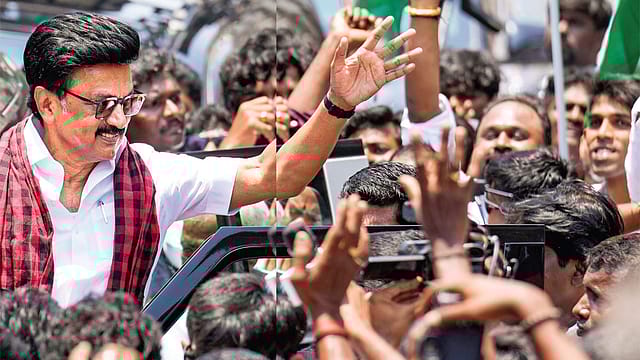
A COUPLE OF MONTHS before the Assembly elections were announced, on two Sundays, Tamil Nadu Chief Minister MK Stalin changed from his official white mundu and shirt into informal Western wear to interact with young musicians and sportspersons.
The episodes of Vibe with MKS, to project the 73-year-old as a relatable leader, played on social media. Around the same time, reels of women showcasing “ration kada (shop) sarees” started trending on Instagram, following Stalin’s Pongal gift package to eligible families. The Dravida Munnetra Kazhagam (DMK) leader is counting on a tactical playbook that focuses on reaching out to women and youth, promising a “Dravidian model” of governance and chanting “land, language, dignity”, as he pitches for a second consecutive term, unprecedented in DMK’s history.
Stalin is not MGR, All India Anna Dravida Munnetra Kazhagam (AIADMK) leader Edappadi K Palaniswami (EPS) had said on a campaign tour in Tiruchirappalli about six months ago. He was referring to the sway MG Ramachandran (MGR) had over women voters. EPS was reacting to state municipal administration minister KN Nehru’s claim that Stalin has gained more women supporters than MGR because of DMK’s “good governance”.
MGR’s successor J Jayalalithaa further consolidated the vote bank. The percentage of women voters was the highest in the 2011 (78.51) and 2016 (74.33) Assembly elections both of which AIADMK had swept. After Jayalalithaa, AIADMK started losing its grip over the constituency. The Lokniti-CSDS data estimated that AIADMK had around an 11 per cent lead over DMK among women voters in 2011, when it got 51 per cent of their votes against its opponent at 40 per cent, and in 2016, when it captured 46 perc ent while DMK got 35 per cent. In 2021, however, DMK won over 45 per cent of women voters, surpassing AIADMK, which got 42 per cent of their votes, as per the data.
STALIN WASTED NO time in reaching out to the newly acquired support. After taking over as chief minister, he rolled out initiatives like the Kalaignar Magalir Urimai Thittam (KMUT), which provides a monthly assistance of `1,000 to one crore women, the quantum of which he has promised to raise to `2000; the Pudhumai Penn Scheme, providing ` 1,000 monthly financial assistance directly to bank accounts of female students in government schools. Vidiyal Payanam, offering women free travel on ordinary state-owned buses, launched in 2021 soon after DMK came to power, has been one of the most used schemes. In February this year Stalin rolled out a direct benefit transfer scheme, paying ` 5,000 each to 1.31 crore women who are beneficiaries under the KMUT scheme. The women-oriented strategy was given a further push in the party’s manifesto, promising women a ` 8,000 coupon with which they can buy any household electronic item—microwave, television, washing machine, refrigerator, etc—under a scheme named Illatharasi.
“Offering coupons gives a choice to women, who in a patriarchal milieu were denied that. All our women-centric schemes are aimed at empowering them and giving space,” says DMK MP from Chennai South Thamizhachi Thangapandian.
Less than a week before DMK released its manifesto, AIADMK, hoping to win back its women voters, promised free washing machines to women heading ration-card holding families, besides a ` 2,000 monthly cash aid which would be transferred directly to their accounts. The party also promised extending free bus travel to men and waiving educational loans of students.
As the two Dravidian parties, which have dominated the state’s political template, compete in wooing women and youth, the emergence of actor Vijay’s Tamilaga Vettri Kazhagam (TVK) threatens to upset their calculations. Women constitute 51 per cent of the state’s population and youth, in the 18-29 age group, are estimated to comprise around 20 per cent. TVK, which has announced candidates for all 234 Assembly seats, has promised a monthly assistance of `4,000 for graduates and `2,000 for diploma holders. Vijay has been fierce in his attack on DMK, positioning his party as a better “secular” alternative.
For Stalin, this is a Tamil Nadu versus New Delhi election, setting the tone for an ideological fight, as his party takes on its main rival, AIADMK, which has rejuvenated its alliance with the Bharatiya Janata Party (BJP). In June last year, at DMK’s General Council meeting in Madurai, the party chief spoke of the fight against the “Delhi invasion”.
According to sources in the Indian Political Action Committee (I-PAC), a political consultancy firm which had also partnered with DMK ahead of the 2021 elections, the party started its election campaign with enhancing its membership drive, Oraniyil Tamil Nadu, at the meet. Stalin had cut the task out for the party to use booth agents to enrol voters at each polling booth, expanding the reach beyond families supporting DMK through face-to-face meetings on their doorstep. A month later, the party launched Ungaludan Stalin (Stalin with you), a public grievance redress initiative, through camps across the state, reviewed by the chief minister with district collectors and officials via video conferencing. As part of its grassroots mobilisation, teams of women went from house to house, with booklets reminding people of the state government’s welfare schemes and a QR code that carried a message from Stalin.
As the contours of political alliances shaped up, Stalin brought former chief minister and Jayalalithaa loyalist O Panneerselvam (OPS), after his expulsion from AIADMK following a face-off with EPS, into the DMK-led Secular Progressive Alliance (SPA). OPS is a Thevar, an OBC community concentrated in southern Tamil Nadu where he will now campaign against AIADMK. In a bid to blunt anti-incumbency, with some of its MLAs running into controversies, DMK has fielded 60 new faces on its list of 164 candidates. Stalin has given 70 seats to allies, including 28 for Congress. While AIADMK latched on to the Anbumani Ramadoss faction of the Pattali Makkal Katchi (PMK), which has support from the Vanniyar community in northern Tamil Nadu, DMK is hoping to consolidate the Dalit vote, with Thol Thirumavalavan‘s Viduthalai Chiruthaigal Katchi (VCK) in the SPA fold. DMK has given 10 seats to the Desiya Murpokku Dravida Kazhagam (DMDK), founded by the late actor-turned-politician Vijayakanth and now led by his wife Premalatha, which has witnessed a decline in its vote share over the last three Assembly elections.
“Charisma has a place in politics, but performance is important. Stalin waited 46 years to become chief minister. He is seasoned, suave and has proved himself. He has delivered. Tamil Nadu is a top performing state. DMK’s narrative revolves around who is standing for Tamil Nadu’s identity. It is a fight between polarisation and federalism,” says Thangapandian.
Coming out of his father M Karunanidhi’s shadow, Stalin, who has seen political battles since he was in his teens, has carved a brand for himself. He has set the stage for passing on the baton to his son Udhayanidhi, a deputy chief minister in his cabinet, rejecting accusations of dynastic politics by his opponents, saying success lies in winning people’s confidence. Stalin is not leaving any stone unturned as he braces for an election that is turning out to be a multi-cornered contest. The vote share margin between the two major alliances was less than 5 per cent in 2021. In the 2024 Lok Sabha polls, the vote share gap was less than 7 per cent even as the DMK-led alliance swept the state.
Addressing a party conference in Tiruchirappalli in March, Stalin had said that in a cricket match it is important to score runs from the very first over. At the same time, it is equally important to keep scoring consistently and finish strongly, to hit the last ball for a huge six and deliver a grand finish.