Tamil Nadu Governor Arlekar Followed Letter and Spirit In Vijay Case
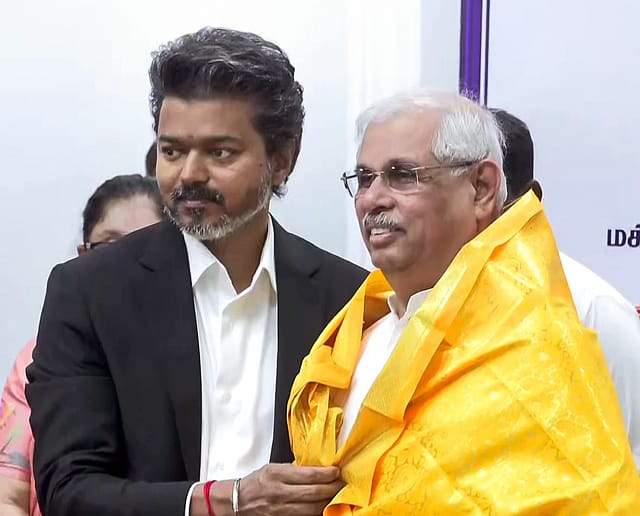
The trite observation that public memory is short often suffers from exaggeration. In fact, the public remembers quite well, has a fairly long memory and does not forgive easily. Rather, it is commentators and political pundits are prone to debilitating and selective erasures of memory. The flood of angry commentary over Tamil Nadu Governor R V Arlekar’s insistence that Tamilaga Vettri Kazhagam (TVK) leader Vijay provide letters of support before being sworn in chief minister is a case in point with the Goa politician accused of holding up the formation of the new government amid suggestions of a political motive at work.
To begin with, many who demanded Vijay be instantly sworn in had overnight jettisoned the Dravida Munnetra Kazhagam (DMK). This section of the commentariat, it would seem, identified Vijay as the new bulwark against the Bharatiya Janata Party (BJP) which -- despite its one MLA in the new assembly -- was touted as the force delaying Vijay’s investiture. In fact, when DMK allies CPI, CPM, VCK and IUML did declare support for Vijay, they claimed to be acting to check communal forces. DMK leader M K Stalin may now reflect not only on his allies, but on the fickle loyalties of intellectuals and columnists who till just a few days ago promoted his anti-Delhi posture as an expression of genuine federalism and regional identity. The opportunism inherent in seamlessly switching sides to a party that denounces DMK’s “Dravidian model” was evidently not the slightest impediment for TVK’s new drum beaters.

Open Minds 2026
26 Jun 2026 - Vol 05 | Issue 26
The power of ideas and arguments in 50 portraits
Karnataka May, 2018
The argument offered is that since TVK is the single largest party with a 108 seats and there was no competing claim, Arlekar should have appointed him chief minister and allowed him to face a floor test. Delays, it was said, would lead to horse-trading and reports of discussions between All India Dravida Munnetra Kazhagam (AIADMK) and DMK were seen as a likely subversion of the popular verdict. Parties that finished second and third could not be allowed to form the government. While this may sound plausible, the argument is patently selective and is dredged up only when the potential beneficiary has right credentials and fits a certain cause.
In the May 2018 Karnataka election, BJP emerged the single largest party just seven short of majority with 104 seats in a House of 222. Congress, who was the incumbent, won 80 and Janata Dal (Secular) got 47 seats. It could well be argued, just as in the case of Tamil Nadu in 2026, the ruling party had lost its mandate. The vote was not for Congress continuing in office. Governor Vajubhai Vala invited BJP leader B S Yeddyurappa to form the government and gave him 15 days to prove majority. The Governor’s decision was met with howls of protest even as Congress and JD(S) engaged in hectic negotiations. The matter was brought to the Supreme Court with Abhishek Singhvi representing Congress and Mukul Rohatgi standing for Yeddyurappa.
Governor’s discretion and a Stable Government
Rohatgi argued the Governor had used his “discretion” in assessing who could form a “stable” government and invited his client. Singhvi opposed the contention, saying Yeddyurappa claimed to have a majority but had not submitted names. On the other hand, Congresss-JD(S) submitted a list of 117 MLAs. Rohatgi said a floor test should decide the matter and the court finally slashed the 15-day period granted to BJP to just two days. Yeddyurappa resigned ahead of the designated date and the installation of JD(S) leader H D Kumaraswamy as chief minister was hailed as a new “model” and Congress was advised of the virtues of making “sacrifices” in a secular cause. The arrangement was riven with contradictions and was unworkable. The government fell 14 months later after 17 ruling coalition MLAs resigned with many recontesting on a BJP ticket.
If the SC was indeed right in giving Yeddyurappa a very brief window to prove majority and in effect expressed disapproval of the Governor’s action, then Arlekar did the right thing. In the case of TVK, the party needed 118 votes to form a government. Vijay contested from two seats and senior leader MV Karuppiah would be Pro-Tem Speaker and vote only in the event of a tie. Congress offered the support of its five MLAs but TVK needed more. Interestingly, constituents of the DMK alliance like Communist Party of India, Communist Party of India (Marxist) and Viduthalai Chiruthaigal Katchi (VCK) criticised Arlekar for not promptly inviting Vijay to form the government. But what would their stance have been should the AIADMK-BJP alliance been just short of majority and the single-largest block in the Assembly? It is not hard to guess.
Vajpayee Govt asked for letters in 1998
Arlekar’s actions can certainly be discussed and the grey zones in the governor’s powers make this inevitable. His possible decision in an alternate scenario can be considered too but we can only guess as the National Democratic Alliance (NDA) finished third. The rub lay in DMK allies wanting to be spared the decision of announcing their support in advance of an invitation to Vijay to form the government. They would rather Vijay was asked to face a floor test after which they would be seen to be supporting a chief minister who has received the appointment letter. This was not to be and they had to make the hard choice of announcing their support which they finally did. They were also joined by the Indian Union Muslim League (IUML) which had earlier declined to support TVK and the number crossed the majority mark.
It is pertinent to remember when did the practice of seeking letters of support come into vogue. President K R Narayanan asked BJP leader Atal Bihari Vajpayee to produce letters of support from all NDA constituents after the 1998 Lok Sabha election despite the grouping being a pre-poll alliance. The letters were deemed necessary to assure the President of the formation of a stable government. AIADMK leader J Jayalalitha delayed her letter of support demanding, among other things, a promise from BJP to dismiss the DMK government led by M Karunanidhi in Tamil Nadu. She did finally forward her letter but the Vajpayee government fell by one vote after 13 months when Jayalalitha withdrew support. But that is another story.
Governor’s choice
For the case of Arlekar and TVK, it is apparent that the Governor acted prudently. He ensured Vijay had adequate support and then, as has been set out by the SC, asked for a floor test as the final acceptable proof of majority. His decision forced CPI. CPM. VCK and IUML to take a stand. But that is their outlook and not the Governor’s concern. Political savants may look the other way, but the public memory is not that short. As the popular song in the 1974 Bollywood “Roti” went – “Yeh jo public hai sab janti hai (Nothing is hidden from the public).”