Blood in Bengal
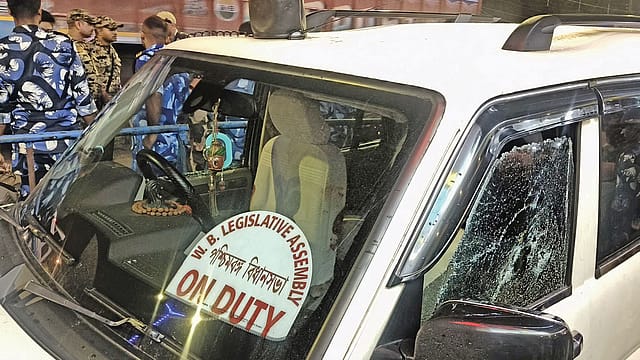
LATE ON THE NIGHT of May 6, the long-time personal assistant of West Bengal BJP leader Suvendu Adhikari, Chandranath Rath, was gunned down in the Madhyamgram area. The killing took place barely hours after the Election Commission of India (ECI) had completed the election process in the state, reminiscent of violence in the aftermath of the 2021 state Assembly elections.
West Bengal has a long history of political violence, something that marks it off from other states where changes in government are smooth and violence-free. BJP’s top leadership is cognisant of this reality and wants to break this cycle of violence that accompanies such transitions in the state. Prime Minister Narendra Modi said as much in his speech from the party’s headquarters in New Delhi on May 4. The prime minister said that West Bengal needed badlav (change) and not badla (revenge).
Incidents like the killing of Rath queer the pitch for the party’s leaders who have a vast number of followers who have been victims of political violence under the rule of the Trinamool Congress (TMC) in 2021 and on earlier occasions as well, such as the panchayat elections in 2018. There is abundant evidence for such violence, contrary to the curt liberal denials of political violence in the state. The Armed Conflict Location and Event Data (ACLED) project, a non-profit organisation that tracks data on violence across the world, reported that during the 2021 election season in West Bengal, there were 300 events of violence and 58 deaths. In the 2018 panchayat elections, there were more than 100 incidents of violence and nearly 50 people were killed. Interestingly, the most violent districts in 2018 were Murshidabad (most violent), South 24 Parganas, Birbhum and Kolkata.
Against this background, the state leadership of the party has a difficult task ahead. It has to prevent violence even as it has to fulfil demands for justice from the very large number of families whose kin have either been killed in the past rounds of violence or have suffered in myriad other ways. Rath’s killing does not help matters.

At the very minimum, a systematic inquiry into past violence, one that is probed thoroughly, with perpetrators of violence being identified clearly is the starting point. It would be better to have special law and fast-track judicial courts where such cases are tried. The punishment should be exemplary and harsh to the point that it restores deterrence against such wanton acts of violence. To repeat: the punishment needs to be harsh. The Centre ought to devise ways in which the judgments of such special courts—if they are established—are not overturned by higher courts where procedural tactics are often abused.
If these recurrent cycles of violence and thuggishness are to be broken, it would provide a degree of justice to the people of West Bengal. The use of violence for political control—pioneered by the Left in West Bengal—is a lasting black mark against it. It is not surprising that Left parties now face political oblivion. If one were to trace political violence in the state, there is a straight line from ‘Dum Dum Dawai’ to the killing of Rath. The Left, and TMC, the Left’s lineal descendant when it comes to violence—loom large in this infamous story.
West Bengal, or Sonar Bangla as it once was, has been left far behind in the race for well-being and prosperity among India’s states. BJP won power in the state, in part, from the desire of the people to move ahead economically. The first step in that direction has to be the restoration of order in the state. The other necessary steps will follow in a logical sequence. BJP is a party that prioritises development wherever it is in power. That will be the case in West Bengal too.