Poriborton Supercharged
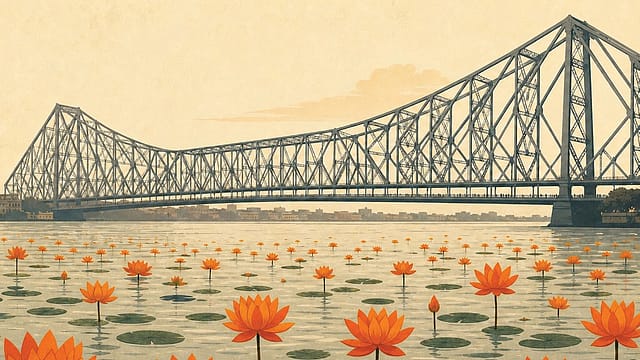
ON MAY 4 MORNING, a filmmaker friend who had returned to Kolkata to observe the elections and cast his vote texted: “Ami last 4 din toto wala theke mastermashai theke didir taka pawa boudi der ke jiggesh kore janlam, sabai bollo paddo te chhap diyechhe (In the last four days I have asked Toto e-rickshaw drivers, schoolteachers, and women who received money from Didi, and they all said they had voted for lotus).” An overwhelming majority of voters in West Bengal, including the beneficiaries of Mamata Banerjee’s welfare schemes, had decided it was time to eject the Trinamool Congress (TMC) from office. Extending that logic to all the migrant workers and domestic helps across India, reportedly gifted train tickets by Didi to come home and vote for her, ended up voting her out.
On May 5 evening, a senior and sober TMC worker admitted: “Amra dharona korte parini. Ei dhakka shamlano oshombhob, bhebechhilam Bidhan Sabha 50-50 hobe borojor (We couldn’t imagine this. It’s impossible to digest this blow. We had thought at worst it would be a hung Assembly).”
In the beginning there was Congress which had a near-30- year run in power with the 1967-71 interregnum of Left-backed United Front governments alternating with President’s Rule. But when the Left vanquished Congress in 1977, the party that won India independence ceased to be an independent player in West Bengal. It took 34 years for the Left to finally depart in 2011, but it had been headed for the exit after 2007 as Singur and Nandigram powered Mamata’s groundswell. Now, Mamata herself is out after less than 15 years. Poriborton has picked up the pace because it has run out of patience in a state reputed for giving the incumbent a very long rope.
Every political era in Bengal has ended with an elected government collapsing in violence and/or the chaos of misgovernance, the latter always punctuated by violence. The stability of the Congress decades was over by the late 1960s when Naxalism turned Bengal into a slaughterhouse and was met with brutal state repression, including extrajudicial killings. Congress returned in 1972 with 216 seats but in an election so bloody and blatantly rigged that it would be the last the party would win. In 1977, the Left Front (minus CPI, which was still a Congress ally) rode the anti-Emergency sentiment to secure 231 seats and relegate Congress to third place with 20, behind the Janata Party.
When its turn came, the Left Front government, admired nationally if for nothing else then for providing a stable government in a country of churn, died with the embers of Nandigram, having turned on the very farmers who were its original constituency after its cadres had already perpetrated three decades of retributive political violence. The TMC era, for its part, has been marked by everyday and often callous political violence in the absence of a centralised kill-switch that the Left could use to pull back its cadre. TMC went down amid corruption and a perception of a law-and-order collapse.
But it’s just a pattern and that’s where the similarities end.
The Left Front, and CPM especially, had built a formidable organisation or party apparatus from the ground up. When it took office, in keeping with communist practice, the party apparatus merged seamlessly with the state apparatus, at great cost to democracy but to the comrades’ benefit. At the booth level, this apparatus not only ensured order but also targeted violence, it rigged elections but “scientifically”, it intimidated anti-Left voters while turning out the Left’s vote. The cadre micro-managed public and private life from the party office in every neighbourhood. The machinery the Left built ran teachers’ unions, students’ unions, police unions, and of course, trade unions. Even Congress back in the day had institutional structures like trade unions. Those structures were meant to survive individual leaders. Mamata Banerjee, however, built TMC around herself. Lacking a strong organisational skeleton and dependent on the leader’s charisma more than anything else, TMC in government was much more populist than the Left in its early days. But personalised governance burns out faster.

If institutional weakness was the fundamental reason that made TMC’s tenure much shorter than the Left’s, the second reason followed from it. The Left had locked in a huge constituency with its land reforms. Operation Barga, which redistributed land and registered sharecroppers, not only gave the rural poor a stake in the system but was also a structural reform made possible by the Left’s institutional depth. TMC could never carry out structural reforms because it lacked the means and the inclination to do so. Where the Left’s patronage network was delineated and rational, however politicised and partisan, TMC’s patronage networks were ad hoc, superficial and too localised.
The welfare schemes that helped Mamata Banerjee last so long in office, such as Lakshmir Bhandar (monthly cash transfers to women), Kanyashree (support for girl students), Swasthya Sathi (health insurance), etc, did indeed bind large sections of the electorate to TMC. But in the end, as welfare such cash transfers were cosmetic. Money transfer can be matched or outbid. And that’s exactly what BJP did—by promising a monthly allowance of `3,000 to every woman, where Lakshmir Bhandar was capped between `1,500 and `1,700, BJP erased a clear advantage TMC had enjoyed. It took away Mamata’s loyal women voters.
The triggers for disaffection with TMC, verging on disgust, all made national headlines and can be summed up briefly.
Law and order: Shahjahan Sheikh’s mass sexual abuse of women in Sandeshkhali that exploded before the 2024 Lok Sabha polls and the RG Kar rape and murder of a young doctor in August that year were big incidents but these merely tipped the scale of public opinion, the former terrifying the rural electorate and the latter depleting urban middle-class support, especially among women, given the prolonged and sustained protests. TMC’s manhandling of law and order neither began nor ended with these.
Corruption: While CPM strongmen had become increasingly predatory from the late-1980s, TMC’s serial corruption scandals were more brazen and easier to trace because they led back to individuals. The Saradha chit fund scandal, the Narada sting operation, the school jobs scam, coal and cattle smuggling, etc hurt TMC’s public faces in a way corruption under Left rule never travelled all the way up the CPM chain of command.
Employment and industry: Land policy was a governing principle for TMC and it had declared that the state would no longer acquire land for private industry. As recently as April 2025, it scrapped the three-decade-old industrial incentives policy. BJP pointed at the 6,600-odd companies, including 110 listed ones, which moved their registered offices out of West Bengal between 2011 and 2025. Along with the brain drain of educated youth, this kept the state deindustrialised with an estimated debt-to-GSDP ratio of 37.98 per cent for 2026-27 and an outstanding debt projected above `8.15 lakh crore.
Mamata and Muslims: Mamata understood the power of the Muslim vote better than the Left but her over-the-top favouritism in a state with a long international border vulnerable to infiltration over still-unfenced stretches extending to almost 700 km was bound to boomerang at some point. This election broke BJP’s jinx—its inability to circumvent the 27-30 per cent-strong Muslim minority voting as a bloc and the 80-odd seats out of bounds given a 45-50 per cent Muslim presence. If Muslim consolidation was all about electoral arithmetic, it had its limits even in Bengal. But the irony is, TMC did little for Muslims beyond symbolism. Between them, CPM and Congress won their three seats in Murshidabad district, after all. But for BJP, TMC would have bled the Muslim vote.
HOWEVER, THESE FACTORS individually or collectively need not have brought about Poriborton so soon. That owes to TMC’s biggest error. It failed to understand its own time. The Left had already run Bengal for almost two decades before cable TV and the internet, and certainly before social media. Mamata Banerjee, ever the agitationist, never grasped the significance of the shortened news cycle. Her party understood parliamentary optics but not how quickly a single grievance could go viral on social media. For example, the RG Kar rape and murder became catastrophic for TMC given its urban context. While the sustained street protests often caused public inconvenience, they snowballed into a shift in political sentiment across the state. In fact, the victim’s mother, Ratna Debnath, won Panihati on a BJP ticket, defeating the TMC candidate by more than 28,000 votes.
The era of social media is a time of information compression and even age compression, when kids mentally mature faster and adopt adult behavioural patterns sooner. Politics, too, is compressed as a result and the public gets impatient quicker. That public was never going to allow Mamata Banerjee three decades of hubris.
Another fundamental mistake on TMC’s part was forgetting that lightening never strikes the same place twice. It had successfully portrayed BJP as a bohiragoto (outsider) party with second-hand local leaders in 2021. BJP learnt from that mistake and kept its more abrasive northern Indian leaders at bay, depending on Prime Minister Narendra Modi and Home Minister Amit Shah. There was no major cultural faux-pas and some BJP candidates campaigning with fish in hand to demonstrate their Bengaliness only made for good memes and colourful reports abroad. But BJP’s course correction in 2026 isn’t the whole story.
Bengali cultural identity has always played a part in politics, beginning with the Left’s institutional capture and academic hegemony which amalgamated its cultural puritanism with so-called Bengali exceptionalism. But that identity had never been weaponised before TMC went to battle in 2021. It was after TMC won last time that the narrative gained resonance. While Bengal is certainly separate and different from most of the rest of North India it geographically belongs to, and even as language is the first marker of identity universally, TMC tried to make people forget something important.
That something is the past to which the other, non-linguistic, half of Bengali identity connects. Bengal is where the Indian Renaissance began in the 19th century. It is the land where Hindu revival and reformation found their first confident articulation after an intricate and prolonged encounter with Occidental science and philosophy and matured into a full-bodied assertion of Hindu identity. Raja Ram Mohan Roy the reformer, Ramakrishna Paramahamsa the mystic, Bankim Chandra Chatterjee the reclaimer, Swami Vivekananda the articulator, and Sri Aurobindo the philosopher-seer were all Bengalis. Every great secular literature of today had its birth in religion and Krittibas Ojha’s Bengali Ramayana is one of the canonical Ramayanas. It also approximates the moment the vernacular Bengali identity was born. To deny heritage is worse than parricide. It is cultural suicide.
Talking about demise, what happens to TMC hereafter? Bengal is very unkind to a losing incumbent. They cease to matter when they don’t cease to exist. After losing Bengal in 1977, Congress never recovered to become a fighting force in and of itself. The Left’s erasure on the ground post-2011 is more complete than Congress’. Bengal is a classic winner-takes-all system with endemic political violence and intimidation making it difficult for opposition parties to thrive. Cadres switch sides as defection after defeat is key to survival. Prime Minister Narendra Modi had to reiterate the need to end this political culture for Bengal to reinvent itself.
Poriborton is permanent for the vanquished. Never as strong as the Left organisationally, centred on a single individual, and with BJP at last building a formidable machinery in the state, it is difficult to see TMC lasting much longer. To a losing incumbent, Bengal offers annihilation.