Vijay: The Man In Black
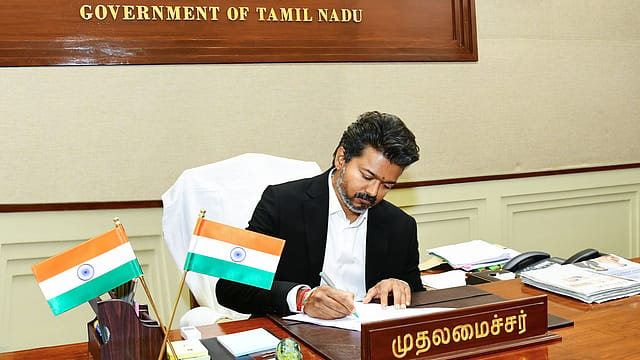
At ten o’clock on the morning of Sunday, May 10, 2026, a man who had spent 35 years playing heroes on screen walked into the Jawaharlal Nehru Indoor Stadium in Chennai and became, in the space of a few spoken sentences, the Chief Minister of Tamil Nadu. The crowd roared. Vijay had memorised the oath. He stood before Governor Rajendra Vishwanath Arlekar in his black jacket and white shirt, and delivered the oaths of office and secrecy with the projection of someone who had been performing to large rooms since the age of 19. White—the white veshti, the white shirt, the white angavastram—has been the uniform of Dravidian political identity since 1967. It signals simplicity, accessibility, the identification of the leader with the led. It has also signalled the extraordinary comfort with which the men who wore it had come to inhabit power. Vijay wore the black of cinema, of Periyar, of a generation’s aesthetic, of a man who had decided that the cleanest way to announce the end of one political tradition was to refuse, at the moment of its ending, to dress like it.
The week that preceded it had been the most dramatic in Tamil Nadu’s recent political memory. The election had delivered its verdict on May 4. What it had not delivered was clarity on whether that verdict could be honoured. TVK’s 108 seats—won on 34.92 percent of the vote, a share higher than MGR managed in his own landmark 1977 debut—fell 10 short of the majority mark in the 234-seat Assembly. What followed was six days of backroom manoeuvre that at several points appeared to be moving in entirely the wrong direction for Vijay. Television channels ran continuous speculation that the DMK and AIADMK were holding secret talks to form a combined government. The reports gained uncomfortable credibility when AIADMK general secretary Edappadi K. Palaniswami assembled his 47 freshly elected MLAs in Chennai, officially ruled out supporting Vijay, and then asked them to remain in the city. AIADMK MLAs were subsequently moved to a resort in Puducherry on the night of May 8, then shifted again to another resort. A section of AIADMK MLAs, led by CV Shanmugam, SP Velumani, and Vijayabaskar, three of the party’s most senior legislators, has now reportedly decided to support Vijay’s government during the confidence vote, breaking from Palaniswami’s official position.

Open Minds 2026
26 Jun 2026 - Vol 05 | Issue 26
The power of ideas and arguments in 50 portraits
The Congress had moved with the greatest speed and the least ambiguity. With five MLAs, the party held national and state level meetings before summarily severing ties with DMK, taking TVK’s combined tally to 112 seats. The Left parties were the last piece and the most complicated. VCK chief Thol Thirumavalavan visited Stalin’s residence, adding to the tension. The Left parties convened executive committee meetings on Friday. Their conclusion was unconditional support for TVK, with the explicit clarification that they were not joining the government, that their political alignment with the DMK remained unchanged, and that their decision was made to prevent a constitutional crisis and ensure Tamil Nadu had an elected government before May 10. Behind the scenes, TVK general secretary Arunraj had been in direct talks with Thirumavalavan throughout the week, finally taking TVK’s tally to 120. By Saturday evening, Vijay walked into Lok Bhavan carrying letters from Congress, CPI, CPI(M), VCK, and IUML. The Governor appointed him Chief Minister and asked him to prove his majority in the assembly by May 13.
The ceremony the following morning was attended by Congress leader Rahul Gandhi. Actor Trisha Krishnan was in the stands. Vijay’s parents, former assistant director SA Chandrasekhar whose modest career would figure prominently in the actor’s speech, and his mother Shoba sat together and watched. Nine ministers were sworn in immediately after Vijay. TVK General Secretary N Anand aka Bussy Anand, 61 years old, widely regarded as Vijay’s closest political confidant, was sworn in first, followed by Aadhav Arjuna and Dr KG Arunraj. Then it was KA Sengottaiyan, the nine-time former AIADMK MLA, 78 years old, who had crossed over to TVK last year. When Sengottaiyan took oath, Vijay pinched the old man’s cheek and embraced him in a rare display of affection on the podium. P Venkataramanan, the candidate who had won Mylapore, was sworn in. CTR Nirmalkumar, Rajmohan Arumugam and KT Prabhu, a dentist from Karaikudi, followed. S Keerthana, the sole woman in the inaugural council, and the youngest at 30 years of age, took a happy bow.
Vijay retained for himself the portfolios of Home and Public Administration. Shortly before noon he arrived at Fort St. George to take charge. The first documents he signed as Chief Minister formalised three poll promises: 200 units of free electricity, a special rapid response force for women’s safety and a zero-tolerance task force on drugs. He also attacked the outgoing government’s finances. The previous administration had borrowed more than Rs 10 lakh crore and emptied the treasury before leaving, he said. He announced a white paper on the state’s finances covering the full 2021–2026 period of DMK rule. “I want to run a transparent government. Whatever I do, I will do openly,” he declared. MK Stalin, still in possession of his dignity even if not his office, responded within the hour on X. He congratulated Vijay, welcomed the welfare announcements, and said: “Don’t start saying right away that the government has no money. The funds are there. What is needed is the will and ability to govern.” He added that Vijay had only now entered administration and would soon learn the nuances of fulfilling promises made to the people.
Stalin was right—governance is a different country from campaigning, and Vijay has not yet had his passport stamped—but those dismissing the oath ceremony as cinematic might consider that the Dravidian parties had been delivering their own lines, from memory, for six decades, and that the difference between a political speech and a film dialogue is, in the end, only whether anyone still believes it.
For the better part of two years, criticism of Vijay had a quality of studied contempt that revealed more about those making it than the man it was directed at. He was delivering film dialogues, they said, as a political novice who had confused the cheering of a stadium with the consent of a democracy. Former Governor Tamilisai Soundararajan, speaking after his Madurai conference in August 2025, called his address “a one-day film show” and suggested he was reading scripted lines without political understanding. BJP leader R Sarath Kumar called him a political novice who did not grasp key concepts. The DMK’s municipal administration minister, offended by Vijay’s habit of addressing Chief Minister Stalin as “uncle”, declared that he had “stooped to a low standard”. An AIADMK spokesman predicted that Vijay and TVK would fade after the 2026 elections. They had all looked at a man who understood how to move a crowd and concluded that this was a lesser skill than the one they possessed: the skill of knowing which room to be in, which alliance to broker, which community leader to cultivate with what specific promise. But they had all failed to understand that the crowd itself had changed.