Siddaramaiah: The Long Goodbye
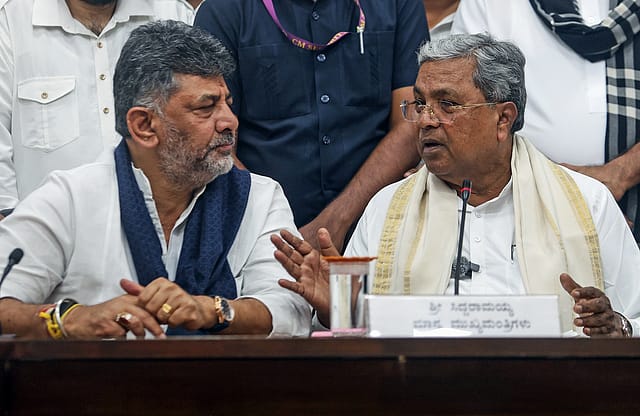
The resignation that was three years in the making took less than ten minutes.
Addressing the media after quitting as Chief Minister this afternoon, Siddaramaiah thanked the high command for giving him the opportunity to serve Karnataka—twice as Chief Minister, twice as Leader of the Opposition. “Constitution is our Dharma, and voters our deities,” he said, bowing out with grace. He was flanked by DK Shivakumar, who is set to take the top job pending formal confirmation, and Home Minister G Parameshwara. The move was in accordance with the Congress high command’s instructions, Siddaramaiah said. Earlier, he had submitted his letter to Prabhu Shankar, Special Secretary to Governor Thaawarchand Gehlot, who was out of state. “The Congress has 136 legislators. We have complete majority,” Siddaramaiah said, as the two leaders posed together for the cameras, offering a carefully staged image of continuity: one stoic as he relinquished the chair, the other giving nothing away after three years as deputy. Shivakumar had waited through an arrest, through bail, and through the daily proximity of power without being able to exercise it. Whatever he felt standing there, he did not show it.
The day had begun at Kaveri, the Chief Minister’s official residence on Race Course Road, where Siddaramaiah had invited his colleagues to breakfast over kaara bath, vada and masala dosa, and announced his decision. At 77 years old, with a berth reportedly assured for his son Yathindra in the Shivakumar cabinet, he ought to have few regrets. He is said to have declined a Rajya Sabha seat and a larger role in Delhi. On X, after the resignation, he posted in Kannada: “Born and raised in a village, I never even dreamed that one day I would become an elected representative, minister, leader of the opposition, and twice the Chief Minister of this state. The fulfillment of such a grand dream is thanks to Baba Saheb Ambedkar’s Constitution.”

The Health and Wellness Issue
25 Sep 2026 - Vol 05 | Issue 39
In his 20 years with the Congress, Siddaramaiah’s record was difficult to argue with. When he joined in 2006, the party held 35 percent of Karnataka’s vote share. It rose to 37 percent under his first Chief Ministership in 2013, held at 38 percent even when he lost power in 2018, and surged to 43 percent when he returned in 2023. Every election he fought for Congress, the party did better than before he arrived. In his 20 years with the Congress, the AHINDA politics he built—the deliberately constructed coalition of minorities, backward classes, and Dalits, the majority that had been politically minoritised—became a form of social arithmetic that used caste as its unit of account while officially disavowing casteism.
On the eve of his resignation, to further seal his legacy, he accepted the caste census report, or the 2025 Social and Educational Survey of Karnataka, conducted by the State Backward Classes Commission under chairman Madhusudhan R Naik, covering some 5.9 crore people at a cost of Rs 635 crore. It was a fresh survey, ordered during his second term after the earlier 2015 commission report he had originally commissioned faced legal challenges and community opposition. Three successive governments between his two tenures had declined to receive that earlier version. “I have accepted the report with great satisfaction. I hope that in the coming days, this report will serve as a guide for the implementation of social justice,” he posted. Reported findings from the survey suggest Muslims are the state’s largest social group at around 14 percent, Veerashaiva-Lingayats at 11 percent, Vokkaligas at 10 percent, and Kurubas, Siddaramaiah’s own community, fourth at roughly 8 percent. These figures, if confirmed when the report is made public, would establish that neither the Lingayat nor the Vokkaliga community is as numerically preponderant as their political weight has long implied.
Shivakumar, whose political base is the Vokkaliga community, and who was himself a signatory years ago to a Vokkaliga Association memorandum demanding an earlier version of the report be junked, now inherits it along with the Chief Minister’s office. The caste census sits on his new desk like an open question with his name on it.
Several MLAs say what Siddaramaiah gave them, beyond portfolios and patronage, was something they will miss a lot more. He addressed every legislator (and often their staff) by name, cleared constituency files without delay, and remained accessible regardless of workload. These qualities, colleagues say, had earned him a reverence within the cabinet that was separate from his policies. Labour Minister Santhosh Lad, who wept on camera, told Open that Siddaramaiah would always be his leader. “There will never be another like him. His charisma and goodwill will keep the Congress in good stead for a long time to come.”