Shiv Sena: End of the Roar
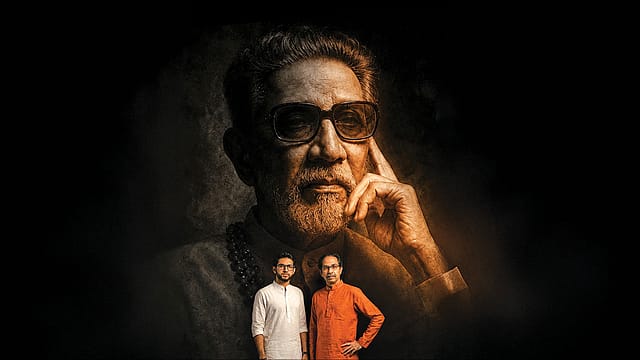
AS THE WEATHER in Mumbai turned apoplectic, the city witnessing one of the heaviest showers in years, when trees fell and houses collapsed, and the city’s municipal body advised against unnecessary travel, on July 5, a grim Uddhav Thackeray, dressed in a saffron kurta, stood on a small but crowded podium outside the Hanuman temple in Dadar. Stepping outside in such poor weather may have been against the government advisory, but Thackeray, given the recent setbacks, arguably had absolutely essential work.
“We are staunch Hindus who take pride in our country,” he said into a microphone. “We are innocent and naïve but not fools.”
By this time, a fairly large group had gathered on the podium beside him. Some wore raincoats, others were wiping the moisture out of their glasses, and at least one individual carried a mace to emphasise the role the gathering seemed to want to project. Right in front of Thackeray, on the road below the dais, a large crowd of men, most of them party workers, wearing saffron caps emblazoned with the words ‘Jai Shri Ram’ and ‘Garv se kaho hum Hindu hain’, were applauding every sentence.
“Now Hindus will not spare you if our Hindutva is misused to loot a temple…,” Thackeray went on. And then invoking an old slogan of former Prime Minister Atal Bihari Vajpayee (‘Ab Hindu maar nahin khayega’ or ‘Hindus will not be hurt anymore’), he said, “Now, I want to say, ‘Ab Hindu maaf nahin karega (Now, Hindus will no longer forgive)’.”
Thackeray was launching what he called the ‘Ram Raksha Andolan’, a campaign meant to capitalise on the discovery of donations being stolen from the Ram Temple in Ayodhya. The purpose of this protest might ostensibly have been to turn people’s eyes to the case in Ayodhya, perhaps even to relaunch Thackeray as a Hindutva figure, but watching him on the podium, with just the two or three members of Parliament (MPs) still left with him and only a few other identifiable figures, and a group of people on the road clutching on to his words amidst unrelenting rain, it appeared its true purpose may have been to reassure a party reeling under defections about its own future.
“Uddhav Thackeray’s Sena is today facing an existential crisis,” says Surendra Jondhale, a political commentator and professor of political science at the University of Mumbai. “As more leaders are abandoning him, he desperately needs to find a way to reassure his party members and to consolidate his reputation. But so far, he’s not doing that. He is responding by trying to tap into the Hindutva narrative [through his Ram Raksha Andolan], but that is unlikely to help him. He’s already been marginalised in that conversation [by the BJP].” Sure enough, by evening, Maharashtra’s Chief Minister Devendra Fadnavis seemed to be cocking a snook, sarcastically responding that he was glad to hear Thackeray had remembered Ram.

The current crisis in Thackeray’s party, Shiv Sena (UBT), was triggered when six of the party’s nine MPs defected to the Eknath Shinde-controlled Shiv Sena, the latest round in a series of eviscerations. The news was not unexpected. Rumours about these leaders considering a switch had been swirling around for weeks before it finally happened. But what came as a shock, just days after the defection of the MPs, was the departure of Sachin Ahir, a member of the Legislative Council (MLC), who was seen as a close confidant of Thackeray’s son, Aaditya. Ahir, who has considerable clout in the Worli area of Mumbai—Aaditya’s constituency—had moved from the undivided Nationalist Congress Party (NCP) to Thackeray’s original party ahead of the state elections in 2019 to help Aaditya win the constituency. According to some rumours, while he appeared to remain close to the Thackerays as the drama over the MPs’ defection was unfolding, even taking the lead in trying to talk some of them out of such a move, Ahir was secretly trying to engineer the very thing he claimed he was attempting to stop. The ramifications of Ahir’s departure—now sworn-in as the deputy chairman of the Maharashtra Legislative Council (MLC)—might run deep, with many speculating that he may either be propped up against Aaditya, when the latter contests from Worli in 2029, or will be used to support whoever stands against the Thackeray scion.
No sooner had these exits happened than the names of others who are believed to be considering a switch, because either the party does not have the numbers to ensure they will be safely re-elected to the state’s upper house in a few years or they are known to be close to Ahir, began to swirl over the next few days. These leaders may have denied these rumours, but a sense of panic has gripped the party, with its members constantly looking over their shoulders. “It’s quite evident that the leaders within UBT Sena are unhappy with how things have been going. They are unable to work, unable to get access to the party’s top leadership. Why won’t those there want to leave,” says Shaina NC, a spokesperson with the Shiv Sena. Anand Dubey, a spokesperson with Shiv Sena (UBT), admits that the recent departure has created much disappointment within the rank and file of the party. “To anyone who may be considering leaving, ‘Yes, this is a bad time. But bad times turn’. The Sena has always turned things around.”
That is not strictly true. For a long time, even towards the end of the life of Bal Thackeray, the founder of the party, the Sena had been riven with dissensions and splits because Uddhav had been anointed his successor. The idea of the Sena as the voice of Maharashtrians was being challenged by everyone who split from it.
SHIV SENA, AFTER its beginning in a small room of Bal Thackeray’s house in Dadar, gradually intertwined into the fabric of first Mumbai and then the state at every level. For instance, at a housing society in North Mumbai, a couple of years ago, a contractor appointed to do repairs inflated his price after starting work. When the society refused, he started harassing the members of the committee, once even turning up with an off-duty policeman. The society turned for help to the local Shiv Sena Shakha Pramukh. He immediately came and told them, “Next time the contractor comes, just give me a ring.” Stories like these are common. The society didn’t use the option but that Shiv Sena was considered as a solution is because of the appeal that the party thrived on as protector. Its presence loomed in every social, cultural and political arena of the state. It was unapologetic about its aggression.
There was a time when the Sena would call a bandh, Mumbai would come to a standstill. When riots started in the city in 1992 post the Babri Masjid demolition, its members grouped and began to target Muslims and Bal Thackeray had no qualms later over a television show saying that the Sena’s “hand was not involved, its legs were.” Meanwhile, if you go to hospitals, there will be ambulances outside with Shiv Sena written on them. The party functionaries are umbilically tied to real estate because it’s an area where big money is made, both officially and unofficially. Former chief minister, the late Manohar Joshi, was a teacher when he became a Shiv Sainik; now, in central Mumbai, there is a high rise that his family company once built. When Michael Jackson came to India on his only visit, in Mumbai, it was at Bal Thackeray’s home ‘Matoshree’ that he made his first pitstop. Cheap jhunka bhakar stalls, where a portion of food could be had for `1, were initiated as soon as the Sena first came to power in 1995, and they served another purpose: rewarding its members with a livelihood on public land using public funds.
Bal Thackeray was that rare politician in India who had the oratory to gather mass followers but also organisational genius. The Sena first dominated Mumbai because of the carefully chosen targeting of South Indians, who the senior Thackeray said were denying jobs to Marathi youths. When that issue was running out of steam, he pivoted to Hindutva and Muslims were now the new threat. But it wasn’t just about touching the chord, he created a party network across the state. In Bal Thackeray & The Rise of the Shiv Sena, Vaibhav Purandare writes about how he made the shakha a fulcrum of the lives of Maratha youths: “The Sena shakha functioned almost as an extension of the family for many Mumbaikars: it placed a premium on cultural activities, sport, educational establishments for the underprivileged, ambulance service, assistance to the disabled, improvement of living conditions, opening of employment channels to the unemployed and several other social tasks. The handling of such things was as valued in the Sena scheme of things as the ‘fight against injustice’, and these responsibilities almost entirely occupied young Sena workers, giving them an otherwise hard-to-find sense of commitment. There were many Sena shakhas, for instance, which kept employment registers in which job-seekers wrote down their names, qualifications and the posts desired.”
Bal Thackeray based his organisational genius on human contact. In Matoshree, his residence, Sainiks from across the state would line up and he knew all of them by their names and made them achieve their political potential. Narayan Rane, for instance, who had little education, became a loyalist after listening to the senior Thackeray. He spread Shiv Sena into the Konkan region, building the party while also being the muscle for the violence that the party portrayed in its heyday. He eventually rebelled against Uddhav Thackeray in the name of the senior Thackeray just as Eknath Shinde still uses the image of his former leader to claim that his is the real Sena.
In his autobiography, No Holds Barred: My Years in Politics, Rane wrote about the difference between Bal and Uddhav Thackeray in terms of mass connect. He said, “In my view, Uddhavji is so high up in his ivory tower that he cannot connect with the people on the ground. To be honest, I don’t think he wishes to either. Take, for instance, the time when, soon after Uddhavji was made the party’s executive president, Saheb advised him that to be able to connect with the grassroots workers, he must make himself available to the masses every Tuesday at Sena Bhavan at a fixed time. Uddhavji diligently followed Saheb’s instructions for about two weeks! When Saheb reprimanded him for stopping a necessary tradition, he argued that the two times he went, the same man came to him with the same problem, so he didn’t see the point in continuing.”
Kiran Pawaskar, who rose up the ranks of the undivided Sena as a firebrand trade union leader, going on to become an MLC, points to this period in the 2000s, when Uddhav Thackeray began to assert control over the party, as the time when the party began to change for the worse. “It started changing completely after that. Decisions were being taken by Uddhav and a small circle close to him. They started interfering in everything,” Pawaskar, who is now part of the Shinde-controlled Sena, says. Since Pawaskar was part of and controlled many trade unions in Mumbai, especially those connected to the aviation and the five-star hotel industries, he alleges, this small coterie of people close to Uddhav Thackeray began to interfere excessively in the workings of these unions to raise large sums as bribes. “Narayan Rane rebelled against the party and spoke about the corruption within the party, how money used to be taken for distributing tickets to candidates for elections. All of that is true,” he says.
PAWASKAR, WHO HAD joined the party’s trade unions as a 20-something leader in the 1980s, continued working under these new conditions, until things got so out of hand, he says, that he switched over to NCP in 2011. “I was the first MLC in the Sena, who despite being an MLC, switched to another party,” he says.
He says leaving the party wasn’t particularly hard because it had ceased to exist as it had been originally under Bal Thackeray. “You have to realise why those who leave the party always talk about how inaccessible Uddhav is. You have to remember Balasaheb made the party. Uddhav Thackeray simply inherited it. Why is it that no other big Sena leader’s children entered or ever made it in the party? That’s because there was never going to be space for anyone beyond Uddhav and his son,” Pawaskar says.
In Dadar, the epicentre of Shiv Sena’s politics, another Sena old-timer, Sada Sarvankar, who switched over to the Shinde-controlled faction when the party first split, admits to these issues within the party. But, according to him, the seeds of the crisis Thackeray now finds himself in were sown when he formed an alliance with NCP and Congress to become chief minister. “There were so many reasons why we all moved. But many of these could have been worked out. But the main reason was Uddhav’s big mistake in aligning the party with Congress and NCP,” Sarvankar says.
Sarvankar recalls gathering along with others as a 10-year-old on the road, galvanised listening to Bal Thackeray’s speeches and heeding his call for a party meant for the Marathi Manoos. He would join the party not long after, and would work his way up, serving as a corporator in the Brihanmumbai Municipal Corporation for many years, before being elected to the state legislature for three terms. “We had a Hindutva base. That’s how Balasaheb founded this party. And now suddenly we were told, to leave that and to work with Congress and NCP. How was that ever going to sit easy with us?” Sarvankar says.
Politics does make strange bedfellows. But such an alliance, according to him, stretched the possibilities of even that idiom. The whole party, Sarvankar claims, was unhappy over that decision to break away from BJP and to ally with Congress and NCP. “Speaking in favour of Article 370, something Balasaheb was against [when the BJP government revoked the article that granted Jammu & Kashmir special autonomous status], bowing to Sonia and Rahul Gandhi, telling us to go against Narendra Modi and BJP, when we were ideologically naturally aligned. All of this never went down well with party leaders,” he says.
Pawaskar has still maintained the party membership form that was first granted to him as a 20-something-year-old new recruit when he joined the original Sena. “Balasaheb in those days used to sign the form,” he says. “I still keep it. And some days back, I carried it to show it to reporters and to emphasise how much he still means to us.”
“The thing is we still believe in Balasaheb, still follow his ideals. Uddhav keeps hiding behind the image of Balasaheb and calls us traitors. When it is he who has betrayed him,” Pawaskar says. “If only he would introspect, he would know what is true.”
The decline is not just because of Uddhav alone. The conditions that created and sustained the original Sena no longer exist. Maratha youths, the driver of the Sena, are no longer insecure or riven by unemployment. The Sena just isn’t a magnet to them anymore. BJP, since Modi took office, has become the voice of Hindutva. It was the bigger partner in terms of seats and had no intention of playing second fiddle as it used to. What could the Sena under Uddhav change its identity to now, in the way the party under his father had once done towards Hindutva? The party currently has ended up as just another in the field of Maharashtra’s crowded politics. The Thackeray brand still has command, but the organisation is withering and there are no reimaginings on the horizon.