Modi’s Grand Design for Reform During Monsoon Session
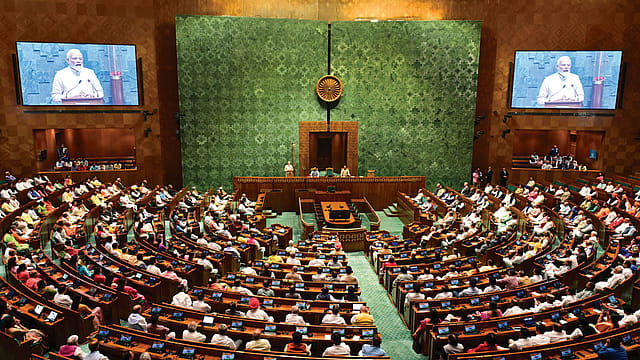
ON THE EVENING OF APRIL 17, SOON AFTER THE Constitution (131st Amendment) Bill was defeated in Lok Sabha, the sense of triumph in the I.N.D.I.A. bloc was plainly evident. Congress leader Rahul Gandhi appeared pleased with his speech on the lessons his grandmother, Indira Gandhi, taught him about conquering inner fears. The Dravida Munnetra Kazhagam (DMK) group looked relieved with seniors Kanimozhi and Dayanidhi Maran chatting with party MPs. Rashtriya Loktantrik Party’s Hanuman Beniwal and Bharat Adivasi Party’s Rajkumar Roat—strongly aligned against BJP—were in a celebratory mood. Trinamool Congress’ Mahua Moitra could be seen animatedly talking to Rahul and Priyanka Gandhi.
The mood in the BJP benches was more thoughtful. This was the first time, since the National Democratic Alliance (NDA) government assumed office in 2014, that a legislation had fallen in Parliament. Was the decision to force a vote on the ambitious plan to link the rollout of 33 per cent reservation for women in legislatures with a delimitation exercise based on the 2011 Census to raise Lok Sabha’s strength to a maximum of 850 a miscalculation? BJP MPs pondered whether the failure of the Constitution amendment to secure the support of two-thirds of the House present and voting exposed the limits of the party’s numbers in the 18th Lok Sabha. The decision of DMK and Trinamool to oppose the proposals was certainly driven by electoral considerations, as Tamil Nadu and West Bengal were due to vote soon. But they were also propelled by a strident opposition to BJP, and in the case of DMK, also by a close alliance with Congress. Opposing the Centre, privileging regional identity and attacking BJP’s advocacy of Hindutva was a core mantra.
DMK leader MK Stalin warned BJP not to “play with fire” and symbolically burnt a copy of the Constitution Amendment Bill. If DMK and Trinamool felt it was important to deny BJP a major “victory” ahead of voting, things did not go as per plan. It is clear that voting against the proposals did them no good at all. Trinamool Congress was voted out by a saffron tsunami, ending 15 years in office and in Tamil Nadu, actor Joseph Vijay inflicted a humiliating loss on DMK and reduced the All-India Anna Dravida Munnetra Kazhagam (AIADMK) to an inconsequential sideshow. The electoral results of May 4 delivered major gains to BJP, which retained Assam and Puducherry and wrested West Bengal, reinforcing its status as India’s premier political force. The results further wiped out the deficit of a subpar 2024 Lok Sabha score. BJP well and truly turned the corner, and the I.N.D.I.A. bloc stood seriously weakened as Trinamool and DMK, along with Samajwadi Party, had been the core of the vocal numerical resistance to BJP in Parliament. In a matter of weeks, the heated debate on whether the gambit of calling a special session of Parliament in the midst of state elections was a good call or not was decisively settled.
The changed situation has emboldened the Modi government to plan another stab at the political reforms that are at the dead centre of its 2029 Lok Sabha elections. The Constitution amendment aims to delink the delimitation exercise from the delayed Census currently in progress. This is crucial to roll out the Nari Shakti Vandan Adhiniyam Act passed in September 2023—the first legislation to be voted on in the new Parliament. The long-delayed legislation had been deeply opposed by male MPs across parties as they feared their constituencies could become “reserved” for women in a lottery draw. The Modi government’s proposal seeks to protect the existing number of “general” seats and raise the strength of Lok Sabha to 816. This would add seats to be set aside for women and also, as per the calculation, ensure at least a 50 per cent increase for all states. The 50 per cent clause, as Home Minister Amit Shah explained during the special session, was not plucked out of thin air. It was intended to quieten concerns that South Indian states would be ‘losers’ as they have registered a steeper fall in fertility rates and would be effectively punished for achieving family planning goals. The formulation offered the best possible deal for southern states as the current Census will almost certainly confirm the trend of a declining population ratio vis-à-vis North India.

In April, NDA fell short by 54 votes with 528 MPs present in the House. The current strength of Lok Sabha is 540—there are three vacancies— and this sets the two-third vote required to pass a Constitution amendment at 360. That is the magic number NDA managers have been working on achieving almost since the May 4 Assembly results were announced. In the past, the stratagem of non-BJP MLAs resigning to reduce the majority mark was resorted to in Karnataka, where BJP ended just seven short of a majority after the 2018 state polls, but to its chagrin found itself in the
opposition with second and third finishers, Congress and Janata Dal (U) joining hands to form the government. This tactic earned the moniker ‘Operation Lotus’ and was replicated elsewhere as well. A version of this was evident after the Tamil Nadu election, with some AIADMK legislators resigning their seats to presumably contest as ruling Tamilaga Vettri Kazhagam (TVK) nominees. The tactic was in play in the recent Rajya Sabha elections as well, with three Trinamool Congress MPs quitting their seats and being promptly re-nominated as BJP candidates. BJP managers are not banking on such calculations in the Lok Sabha where a bold plan appears to have placed the two-thirds mark within their reach. The operation revolves around the altered composition and dynamics of Lok Sabha where 20 of 28 Trinamool MPs have broken away to claim merger with what was, till a few weeks ago, an obscure party called the Nationalist Citizens Party of India (NCPI), and which has sought separate seating arrangements in the House. The tremors of the splits in Trinamool both at the state and in Parliament were further amplified with six of nine Shiv Sena (Uddhav Thackeray) MPs jumping ship and joining the Shiv Sena led by Maharashtra Deputy Chief Minister Eknath Shinde. The rapid developments were crushing blows for Mamata Banerjee and Uddhav Thackeray, but also exposed the rifts wracking the I.N.D.I.A. bloc.
The numbers in Lok Sabha are what matter the most, and these are looking more and more propitious for BJP. After the Trinamool and Uddhav Sena splits, the NDA can count on 324 MPs, which include four from Jaganmohan Reddy’s YSR Congress Party— which had supported the government Bills previously too—and the Zoram People’s Movement’s one MP. While a few strategic abstentions can help, they will not suffice, as the possibility of a large number of MPs going AWOL is not only remote but a risky gamble to boot. DMK leaders have indicated they will like to see assurances that concerns over southern representation and policies like the implementation of the National Education Policy (NEP) three-language formula are being addressed. If DMK abstains, the two-third mark drops to 346, but this is still a bridge too far for NDA. There are strong indications that Nationalist Congress Party (Sharad Pawar) might be closing the gap with BJP on the legislation, but even adding the party’s eight MPs takes the NDA total to 332. Again, banking on a dozen or more abstentions is not a sound plan. The one thing the Modi government cannot afford is another setback, and it will move the Delimitation Bill only if it is confident about its passage.
That confidence and surety is increasingly evident with BJP managers asserting that NDA has the numbers even without having to depend on absentee MPs. “We have the support of 362 MPs,” said a senior ruling party MP, agreeing that NDA needed DMK and NCP(SP) to vote in favour of the legislation. With NCP(SP)’s eight MPs and DMK’s 22 in the bag, the NDA tally reaches 354, and the assertions of BJP leaders become more believable. BJP, in its current avatar, has proved an adroit manager of House arithmetic and has made a habit of winning close Rajya Sabha elections, mainly at the cost of Congress, and this has incrementally added to its numbers in the Upper House too. BJP is no longer recognisable as the party that lost the Vajpayee government’s 1999 trust vote by a margin of one. The 270-269 vote incidentally also took place on April 17, the day the Constitution amendment fell this year. A senior BJP leader, while admitting that Sharad Pawar was often inscrutable, said the veteran leader has reasons to consider supporting the Delimitation Bill. His recent meeting with Shinde was seen as incidental. His priority remains installing his daughter, Supriya Sule, as his political successor and leader of his party. The project took a severe hit when nephew Ajit Pawar and close lieutenants like Praful Patel and Sunil Tatkare left with a majority of party MLAs to ally with BJP. He would not be unaware that the NCP(SP) tally of eight MPs might be vulnerable, and MPs and MLAs alike are anxious about their prospects in the next election, worried that hostility with BJP will impact their ability to get work done in their constituencies. Sule’s post on X thanking Uttar Pradesh Chief Minister Yogi Adityanath for hosting a joint committee of Parliament in Lucknow and an accompanying photo with the leader was another straw in the wind. A day later, she said a written guarantee on the legislation that there will be a 50 per cent increase in seats in all states will be welcome. Sule has been critical of BJP in the past, and uncle Ajit Pawar’s alliance with BJP did not improve matters. But a suggestion that things might be changing came when Sule led one of the seven all-party delegations that visited foreign capitals to explain India’s case after the May 7-10 Operation Sindoor launched by Indian armed forces against Pakistan.
During the early part of Modi 1.0, a lack of majority in Rajya Sabha forced BJP to adopt constitutional stratagem to get legislation such as the Aadhaar (targeted delivery of financial and other subsidies, benefits and services) Act passed as a money Bill to neutralise the veto. The situation improved subsequently during Modi 2.0, and BJP is set to have 117 MPs once three former Trinamool MPs who quit to join the party are elected to the House on July 24. The NDA strength in a House of 242 will then be 149, with the two-thirds mark set at 162 MPs. The gap is not hard to bridge. YSRCP has supported the Bill, and its four MPs take the tally to 153. If, as is being negotiated, DMK and NCP(SP) are on-boarded, NDA numbers will swell to 162, the exact number needed to pass the Constitution amendment. The task of adding a few votes to this tally while strategic abstentions lower the two-thirds majority mark is very much within the realm of possibility. In fact, Rajya Sabha is an easier task for BJP floor managers looking to mop up support for the women’s reservation and delimitation proposals. Biju Janata Dal (BJD) has no presence in Lok Sabha but has five MPs in the Upper House, and while it has vehemently opposed the Delimitation Bill, it is unclear if its stance remains unchanged. A recent Rajya Sabha election in Odisha revealed serious cracks in BJD supremo Naveen Patnaik’s control of the party, with cross-voting leading to the defeat of the official candidate while the BJP nominee won. This might have hardened the hostilities, but could also lead to more pragmatic considerations prevailing. In the past, BJD has, on more than one occasion, helped BJP overcome its deficit in Rajya Sabha.
Sources in a section of the opposition say they are preparing for a combative Monsoon Session. At least two leaders said the I.N.D.I.A. bloc is “drawing up” a “coordinated strategy” to challenge the Modi government on a raft of issues, which include stalling key legislations. At the heart of the strategy, a leader told Open, is the bid to block what the grouping describes as “contentious” constitutional and electoral reforms and said leaders have been coordinating floor strategy ahead of the session to forge a united front against the Centre’s expanded legislative agenda. The proposed 130th Constitution Amendment Bill, which seeks to mandate automatic removal of holders of public office on being in judicial custody for more than 30 days, is also one of the Bills they plan to oppose. The joint committee of Parliament (JPC) examining the Bill is likely to adopt its report on July 17 before submitting it. Opposition parties are of the view that the proposal raises serious constitutional concerns. They are also preparing to fight the bid to revive the delimitation proposals, contending that changes in representation could adversely affect the interests of several states and ‘weaken’ India’s federal structure. While some I.N.D.I.A. bloc constituents are concerned about the government’s plans, the situation in Congress is not encouraging. An I.N.D.I.A. bloc MP said there had been only sporadic discussions, and the revolt in the Punjab unit of Congress against the decisions approved by Rahul Gandhi was worrying. The splits in major regional parties have led to anxiety in the opposition ranks, and the leader who spoke to Open said the rift in Congress in Punjab could widen. “The role of BJP in encouraging the rebels cannot be ruled out. There is uncertainty about these differences surfacing in Parliament,” the MP said.
The opposition also intends to raise other issues that have dominated national discourse in recent months. The National Eligibility-cum-Entrance Test (NEET UG) paper leak controversy is likely to be a flashpoint with parties keen to tap into the resentment and anger among lakhs of students who had to take the exam again. Opposition parties are likely to demand a detailed debate in both Houses and insist on greater accountability over alleged examination paper leaks and what they describe as systemic failures in the entrance examination mechanism. Opposition leaders said they will raise the shocking revelations about the theft of donations at the Ayodhya Ram Mandir and the role of Vishva Hindu Parishad leader Champat Rai in supervising arrangements at the temple. After the last I.N.D.I.A. bloc meeting in New Delhi, the parties submitted a petition to the chief justice of India raising several objections to the Election Commission’s special intensive revision of electoral rolls. However, the meeting of opposition leaders was marred by sharp exchanges between Left leaders and Rahul Gandhi over differences that arose during the Kerala Assembly polls, which the Congress-led United Development Front won.
Congress has submitted a breach of privilege notice against Defence Minister Rajnath Singh over his statement relating to military casualties during Operation Sindoor, claiming that the senior politician “misled” Parliament. Similarly, economic concerns will also feature in the opposition’s campaign in both Houses. Leaders are expected to target the government over inflation, job scenario and the state of the economy, arguing that ordinary citizens are struggling with the high cost of living. A Left party leader said they will raise the issue of what exactly is a proof of citizenship in India and also about the alleged clampdown on protests, affirming that it is a fundamental right. The start of the Monsoon Session next week will undoubtedly witness disruptions in both Houses, as has now become the norm. But until the last session, BJP’s diminished tally and the assertive stance of regional parties, which have been more effective in countering the saffron party in their turfs, had delivered a vocal punch to the opposition in Parliament. The aggression is likely to have lost a bit of sting with some of the chief hecklers being part of the Trinamool rebel setup, now committed to supporting NDA in Parliament. A few instances of cross-voting and some abstentions will add to the comfort level of the NDA benches.
The Delimitation Bill the Centre is considering is expected to include a clause assuring a 50 per cent increase in seats for all states that Home Minister Amit Shah had assured the House while responding to the opposition. He had, however, point-blank refused to accede to the demand that the government withdraw the clause de-linking the delimitation exercise to the first Census after 2026 as provided for by a 2002 amendment. The negotiations with DMK are in progress, but BJP sources are confident that an understanding will be reached soon. Though DMK signed the letter raising objections to the special intensive revision submitted to the chief justice of India, it will be accorded separate seating in Parliament, and the bitterness in the Dravidian outfit over Congress’ haste in parting ways and jumping onto the TVK bandwagon is weighing on its decisions. BJP leaders reminded DMK MPs that they had often questioned the utility of Stalin’s proximity with Congress and recalled that Rahul Gandhi did not agree to even one joint rally during the Tamil Nadu campaign. The opportunistic behaviour of other allies, such as Marumalarchi Dravida Munnetra Kazhagam (MDMK) leader Vaiko, Viduthalai Chiruthaigal Katchi’s (VCK) Thol Thirumavalavan, the Indian Union Muslim League (IUML) and the Left leaders has incensed DMK leaders. Thirumavalavan’s claim that DMK should have been more accommodating of allies and that this might have helped avoid electoral defeat has left party leaders gobsmacked.
The Monsoon Session is shaping up to be a keen test of political resolve and strategy, and BJP is ahead in terms of thinking through its options. It might well prove to be a turning point in the 18th Lok Sabha, which began with the I.N.D.I.A. bloc making gains. BJP’s success in forming the government for the third time running and the relentless 24/7 politics of its leadership has seen it claw back the advantage. The moment of reckoning is now at hand.