Tamil Nadu Assembly Election 2026: The Fall of the House of Stalin
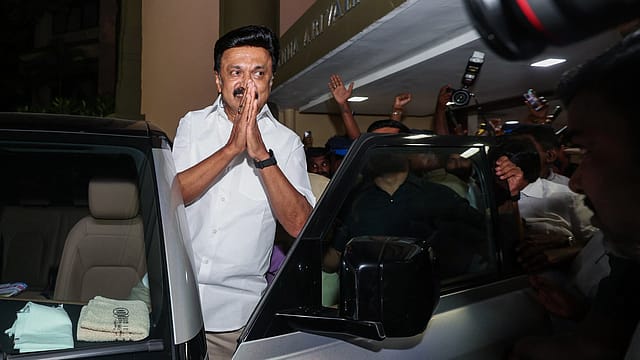
The numbers, as of 8pm, are these: Tamilaga Vettri Kazhagam leading in or having won 107 seats, Dravida Munnetra Kazhagam at 60, and All India Anna Dravida Munnetra Kazhagam at 47. The majority mark is 118. Vijay is within reach of it. The DMK is not within reach of anything except the business of explaining itself.
Tamil Nadu has done this before. Since MG Ramachandran’s last victory in 1984, no incumbent government has been returned to office—save Jayalalithaa’s in 2016, and she died within months of the count. In 2001, 15 of Karunanidhi’s ministers were defeated at the constituency level. In 2011, 16. The state does not merely vote governments out; it dismantles them, minister by minister, as a matter of public hygiene. Today belongs to that tradition and, when the final tally is certified, will almost certainly surpass it.

Zeroing In on ECI
09 Oct 2026 - Vol 05 | Issue 41
Constitutional legitimacy versus political opportunism
The Chief Minister has lost his own seat. MK Stalin, nine times a legislator, polled 72,988 votes in Kolathur. VS Babu of TVK polled 88,180. Around Stalin, the cabinet has been stripped. Ma Subramanian lost Saidapet. TRB Rajaa was evicted from Mannargudi. Palanivel Thiaga Rajan, the IT minister and the party’s modernising conscience, was overtaken in Madurai Central. P Moorthy lost Madurai East. At least a dozen other ministers were trailing.
One member of the family survived. Udhayanidhi Stalin, the Deputy Chief Minister, held Chepauk-Thiruvallikeni with 62,992 votes against TVK’s Selvam D, margin 7,140. This is the dynasty’s entire salvage from a city it has governed and patronised for decades. Of Chennai’s 16 Assembly seats, the DMK kept two, Chepauk and Harbour, the latter won by PK Sekar Babu. The other 14 went to TVK. Vijay himself won Perambur. His deputy Aadhav Arjuna won Villivakkam. The fortress thesis was always more useful to the DMK press office than to anyone attempting to read the actual returns. Chennai is salaried, networked, dependent on institutions the party had been colonising for five years. What it tolerated in good times—the dynasty, the cabinet built around a son, the state functioning as a household arrangement—it declined to accommodate when the quality of governance became the point.
TVK has taken over 38 percent of the votes cast, the DMK has taken 24 percent, the AIADMK 21. Between them, the two Dravidian parties that have governed this state since 1967 polled less than the newcomer by 14 points. Many exit polls had placed TVK at 10 to 30 seats. The electorate has placed it at the threshold of government. The gap between the prediction and the result reflects the insularity of the political class, on the refusal to read a room that had been rearranging itself.
The DMK’s surviving seats, when one looks at the map, are a portrait of retreat. The first calls of the day were the Nilgiri hills, tea-country seats with their own particular loyalties. Beyond them, the DMK holds scattered positions in the Cauvery delta, parts of the deep south where caste arithmetic still ran through the old channels. It is the map of a party reduced to its hereditary footholds, stripped of everything it had accumulated.
How this happened requires less analysis than people will supply. Vijay founded his party in February 2024 and spent two years making one argument: that the DMK and AIADMK are not rivals but alternates, serving the same clientele on a five-year rotation. He had a film career’s worth of organisation, a clean record for the simple reason that he had no record, and, eventually, the assistance of his opponents. When the government’s handling of the Karur stampede, which killed 41 of his supporters in September 2025, was perceived as the response of an administration more concerned with its own embarrassment than with the dead, the argument was made for him.
Stalin made his son Deputy Chief Minister in September 2024. The party apparatus had been built, over five years, around protecting that succession. The freebies continued. The welfare schemes continued. And the perception deepened, among voters who receive welfare schemes and are not therefore obligated to be grateful for them, that the state had become a family business in which they were customers rather than citizens. Tamil Nadu has produced this verdict before—in 1977, in 1989, in 1996, in 2001, in 2006, in 2011, in 2021. The DMK’s error was to believe that the pattern, from which it had benefited several times, was a law of physics that only applied to others.
If Stalin’s party closes with around 65 seats, this would mean that no ruling DMK government has ever been so comprehensively dismantled. As an opposition party, the DMK has known worse numbers. In 1984, riding the sympathy wave that followed Indira Gandhi’s assassination, it was reduced to 23 seats. In 1991, after the killing of Rajiv Gandhi and the collapse of its government, it returned just two. But those were defeats from opposition, the party out of power, stripped of the machinery of incumbency. What happened today is a different category of event entirely. The DMK entered this election as a ruling government with 133 seats (159 including those of its alliance partners), a full cabinet, five years of welfare spending, and every structural advantage the state could offer an incumbent. The 2011 defeat that Karunanidhi absorbed came after the 2G scandal had consumed the party’s credibility for two years. Stalin’s government had no single catastrophe of that scale. What it had was more lethal: the accumulated perception that governance had become a private arrangement, conducted for the benefit of a family rather than a state.
Now the DMK leaves without the consolation that its earlier defeats carried: a known, established second party on the other side. The dynasty has been beaten not by its hereditary rival but by an actor with a two-year-old party. That is the complete Tamil Nadu story.