Amit Shah’s Report Card Shows Why Justifying Maoism is a Red Herring
It has been a predictable trope to dismiss police recoveries of banned literature from persons accused of Maoist crimes on the grounds that the published works of Karl Marx or “pamphlets” cannot be evidence of “anti-national” or seditious activity. It was an effective way of belittling investigative agencies and undermining cases against persons who often used the cover of academia or activism to organize funds, legal aide, recruit cadres and, most importantly, provide ideological legitimacy to the Communist Party of India (Maoist)’s violent agenda.
The criticism of police recoveries found ready acceptance in the media in keeping with a fashionable distrust of the “state” and the liberal leanings of many commentators. This suspicion of the “state” predates installation of the Modi government but became sharper and more pronounced thereafter driven by the liberal establishment’s animosity towards the Bharatiya Janata Party (BJP) and its leader. In the process, a dispassionate survey of “evidence” – whether the “pamphlets” in question make case for an armed overthrow of the state – took a back seat. As did other evidences by way of hard disks, mobiles and witnesses.

Zeroing In on ECI
09 Oct 2026 - Vol 05 | Issue 41
Constitutional legitimacy versus political opportunism
Shah draw a line
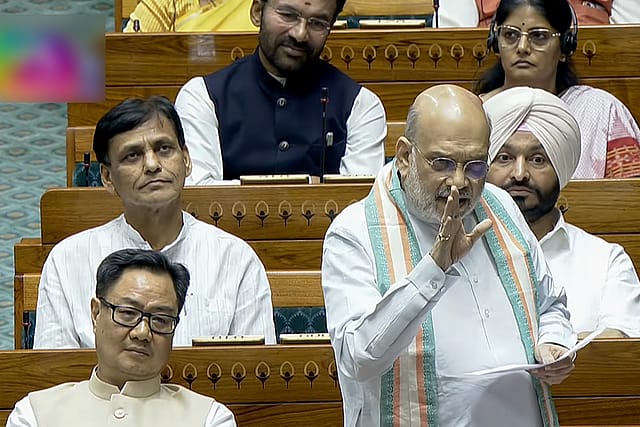
In his 85-minute speech in Lok Sabha on March 27, home minister Amit Shah spent some time on “urban naxals” as he questioned the justification of the Maoist insurgency on the grounds that it was a result of state failure and a quest for justice. Did the Maoists – there is no other appropriate description – academics in public-funded universities, activists who organized seminars deceptively themed on “human rights,” an international circuit devoted to promoting narratives of “democratic failure” and sundry fellow travelers ever consider the fact that the CPI(Maoist) is committed to a violent overthrow of the state?
Those who indoctrinated university students and sent them to near certain death in the jungles of Bastar and Gadchiroli were aware Maoists did not consider talks with the state as anything more than strategic pauses to recover and re-arm. The “people’s war” would not end until the authority of the state was toppled. The Constitution and legislatures were instruments of oppression controlled by the class enemy and Maoist thought provided a seamless vision of creaseless revolution. The connection between the “urban naxals” and commanders and cadres operating in the remote parts of central India was a seamless two-way pipeline, helping and sustaining all parts of a well-oiled coercive machine forged with subversive intent.
Lessons from the Sai Baba case
The trial court verdict convicting the late Delhi university academic G N Sai Baba was overturned by the Nagpur Bench of Bombay high court on the grounds of procedural irregularities. The HC held such lacunae are unacceptable when the stringent anti-terror UAPA (Unlawful Activities Prevention Act) is applied. But a reading of the sessions court’s 827-page ruling is instructive. Two of the main accused retracted confessions they made but the court held that even so the corroborative evidence by other means including electronic records was revealing. The “evidence” of the foot soldiers tells a story, of just how pervasive the hold of Maoists was on the daily lives of tribals living in hundreds of villages under Naxal rule.
One of the accused who recorded a confession said he grew up in the village of Murewada in Gadchiroli and had studied up to the 8th standard. Naxals had free access to Murewada and it was common for them to ask residents to arrange food and shelter. In their interaction with villagers, Maoists discouraged them from leaving the village, warning families of such persons would be beaten and expelled. They directed villagers to oppose government activity and asked for information on police patrols. Local Naxal leaders Narmadakka, Ramko, Bhaskar and Sinnu were frequent visitors and at times entertainment was organised for them. Working for Maoists was not a choice. The woman leader Narmadakka (sister Narmada) instructed the accused to go to a railway station to meet a person identifiable by a Marathi newspaper, hat, bottle while they carried a particular fruit and a similar newspaper.
A city-to-jungle link
A similar statement by another accused in the case confirmed the hand over of Rs 5 lakh to a “visitor” from Delhi. A 16 GB memory card recovered from one of the Delhi contacts contained communication from Sai Baba under the alias of “Prakash” and there were demands for funds, advice on the need to await “higher” instructions and communication with a fraternal international organisation sharing the same goals of “struggle.” Though the high court set aside the case against Sai Baba and other accused, the sessions court provided detailed reasoning on the link between the conduit, the Naxals in Gadchiroli and the Delhi university professor. The trial court’s examination of evidence and statements of various accused and witnesses show how the ideological font of Maoism and the grass roots insurgency worked in perfect unison and left those in “liberated” zones no option but to accept the diktat of the Red commanders.
Subversive Causes
Apart from dwelling on the “urban naxals” or the overground segment of the Maoist movement that hid in plain sight, the home minister detailed the birth of the communist parties in India soon after the October revolution in Russia and their organic links with the CPI(Maoist). On the face of it, Left parties do not support the Maoists’ use of violence, but this is a thin fig leaf. The Left fully endorses arguments put forward to justify Left Wing Extremism (LWE) such the alleged exploitation of tribals by the state and corporates by wat of “land-grabbing” and usurpation of forest rights. They unhesitatingly back separatist demonstrations by activist students in universities such as the 2016 Jawaharlal Nehru University (JNU) protest in favour of Parliament attack convict Afzal Guru. Left leaders are incensed by instances of caste violence such as the Khairlangi killings in Maharashtra in 2006 but look the other way when it comes to the brutal Kangaroo courts conducted by Maoists as part of the “Jantana Sarkar.” In his description of Maoism as an ideologically driven movement that rejects any form of democratic representation, Shah brought out the fallacies of viewing Naxalism as a fight against state oppression.
The home minister’s critique of Congress for its faltering response to Maoism finds validation in the war against LWE gaining momentum and reaching a tipping point after a Bharatiya Janata Party (BJP) government was installed in Chhattisgarh in December, 2023. The progress thereafter has been swift. One of the first things the Congress government that replaced BJP in 2018 did almost immediately was to withdraw cases against pro-Maoist activists. The playbook was simple enough. The subterfuge of working in the field of legal aid, forest rights, sociological research and land reform was adequate reason for outsiders to insert themselves in the region. Despite then Prime Minister Manmohan Singh acknowledging Maoism as a major national security threat, the eco-system that had access to the Congress leadership ensured the hand of the security forces was held back.
Congress and the Red Corridor
As home minister in the United Progressive Alliance (UPA) government, Shivraj Patil would bristle at the mention of a “Red Corridor,” the description of a near-continuous zone from Tirupati in Andhra Pradesh to Pashupatinath in Nepal. He was angered by the suggestion that such a large tract was affected by extremism. His successor P Chidambaram was more unsentimental and recognized the threat Maoists posed to civil society and the state. But the Congress-led government’s calls for talks were read as signs of weakness and Maoists counted on their sympathizers in the ruling party’s supporting cast to keep armed struggle alive. A document recovered from an accused the Elgar Parishad case in 2018 spoke of a plot to kill Prime Minister Narendra Modi in a “Rajiv Gandhi type” attack. The communication revealed that Maoists understood the threat the Modi government posed to their plans. Irrespective of whether the plot was largely a paper idea, it made it clear that Maoists certainly did not believe in electoral democracy.
A post script on Narmadakka. She passed away unsung in a civic hospital in Mumbai on April 9, 2022 due to cancer. She was arrested in 2019 along with her husband Kiran. Named in dozens of cases including a land mine blast that killed 15 cops, the senior woman Maoist died in a hospital bed. Many others were less fortunate.