Vijay: Great Expectations
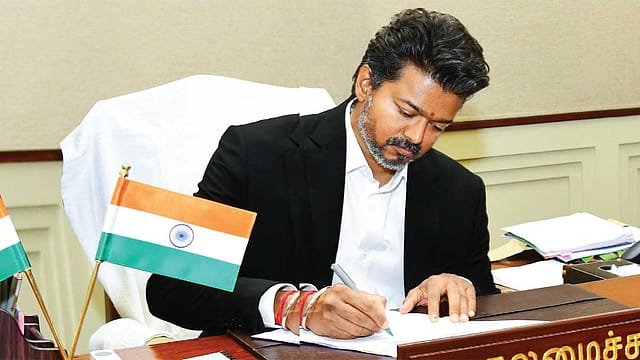
CHANDRASEKHARAN JOSEPH VIJAY SET the political stage in a white shirt and black blazer. Abandoning the white veshti, the formal attire of Tamil Nadu’s politicians, he took oath as chief minister at Chennai’s Jawaharlal Nehru Indoor Stadium before thousands of people, heralding change after six decades of Dravidian rule.
Two days later, however, his Tamilaga Vettri Kazhagam (TVK) got the backing of a section of one of the Dravidian parties—the All India Anna Dravida Munnetra Kazhagam (AIADMK)—shoring up the numbers for his alliance. A day before the floor test, AIADMK, which has suffered a series of defeats at the hands of its rival Dravida Munnetra Kazhagam (DMK), split vertically with a majority of its MLAs, led by senior leaders CV Shanmugam and SP Velumani, supporting TVK. DMK decided to abstain from the confidence vote, saying it did not want to come in the way government formation. The Vijay-led alliance ended up with the support of 144 MLAs out of 171 present and voting, with DMK walking out and 25 AIADMK MLAs voting for him, defying party general secretary Edappadi K Palaniswami (EPS).
That it came to this— a hung Assembly, a fractured AIADMK, DMK allies backing a government that has accused the MK Stalin administration of emptying the treasury—is a denouement the Dravidian establishment never thought to write into the script. Vijay must now contend with the fact that he has allied with the same Dravidian forces he had set out to oppose.
TVK’s emergence as the single-largest party upset both sides. Initially, running short of a majority by 11 seats, Vijay got the support of Congress and the Left which snapped ties with DMK, rupturing the Stalin-led alliance in the state and creating a chasm in the I.N.D.I.A. bloc at the Centre. AIADMK rebel Shanmugam argued that a proposal by EPS to ally with DMK contradicted AIADMK’s fundamental principles.
Vijay had launched a scathing attack on the Stalin government at his oath-taking ceremony where Congress leader Rahul Gandhi sat next to him—optics that could widen the rift between the old allies. While Vijay targeted DMK, promising to release a white paper related to its finances, he has identified BJP as TVK’s ideological rival. “This is a new beginning. A new era of real, secular, social justice starts now,” he said.
He took oath in the name of God, breaking with Dravidian codes, but indicated his rejection of BJP’s Hindutva politics without naming the party. “You can trust Vijay 100 per cent. I belong to Hindus, Muslims, and Christians,” he said. After assuming office, he headed to the Periyar memorial to pay tributes to social reformer ‘Periyar’ EV Ramasamy. A day later, Vijay went to Stalin’s residence to meet him and his son Udhayanidhi, a visit described as a “courtesy call”.
VIJAY DESISTED FROM taking an outright confrontationist approach towards the Centre, an indication that he may not want to emulate his predecessor’s acrimonious relationship with the Modi government. After Prime Minister Narendra Modi congratulated him saying the Union government would keep working with the Tamil Nadu government to improve people’s lives, Vijay expressed his “sincere gratitude” and said “our sole objective is the welfare and progress of our people. We look forward to the active support and cooperation of the Union government for the continued growth of Tamil Nadu.”
Vijay is likely to be tested on each of his promises made in the run-up to the elections. In the first 48 hours after taking charge, he executed some of his pre-poll assurances—200 units of free electricity, special task force for women’s safety, anti-drug units across the state, and shutting 717 state-run TASMAC liquor shops within 500 metres of schools, colleges, places of worship, and bus stands.
Seen as a tenderfoot in statecraft, Vijay’s every move will go under the scanner. He withdrew his decision to appoint his astrologer Radhan Pandit Vettrivel, who had predicted his victory, as his Officer on Special Duty (Political), after facing criticism. That same day, another decision—on Tamil Nadu’s banner culture—had come in for praise. He told his cadres to stop putting up posters and giant cutouts in public spaces to avoid blocking footpaths.
The nine ministers he has inducted are a blend of experience, youthful energy, strategy, and professionalism. “Even before we went to polls many AIADMK leaders were ready to join us. As you can see now, TVK is here to stay,” KA Sengottaiyan, a ten-time legislator with a 50-year career, told Open.
Vijay has, so far, kept his family away from the party and government and pledged to ensure a transparent administration, spelling out that he will be the only power centre.
Analysts attribute Vijay’s appeal more to a promise of change than a meticulous ideology. As fatigue with the Dravidian parties brewed, particularly after the death of J Jayalalithaa and M Karunanidhi, with no face to fill the vacuum, Vijay became the new political hero. Can he be a trailblazer like MGR and Jayalalithaa?