When India Took Its Freedom Fight to the Sky: The Kite’s Remarkable Journey From ‘Simon Go Back’ to August 15
The kite went up. Higher than the houses. Higher than the policemen on the street. High enough for people some distance away to see what had been written across it.
SIMON GO BACK. It was 1928. India was still 19 years away from Independence, and the Simon Commission had arrived to consider constitutional reforms for a country whose people had been excluded from the commission itself.
Indians were furious. “Simon Go Back” became the cry of the protests that followed. It was shouted in the streets. Printed on placards. Carried through demonstrations. And, according to accounts that have become part of India's kite-flying lore, it went airborne.
Kites carrying the slogan appeared in the sky. Think about the ingenuity of that for a moment. A kite needed no permission to march. It could rise above a crowd. It could travel beyond a barricade. You could stop a protester. How do you arrest the sky?

The Health and Wellness Issue
25 Sep 2026 - Vol 05 | Issue 39
Almost a century later, on another August 15, India's skies are crowded with kites again. Except the message has changed. The British are gone. The Simon Commission is history. And the kite that once carried an act of defiance has become, for generations of Indians, something much simpler and perhaps equally powerful. A celebration of being free.
The morning the rooftops come alive
Look up in parts of India on Independence Day and the action isn't only at the Red Fort. It is on the roofs. A child is running backwards, eyes fixed on the sky, while someone screams instructions that are mostly being ignored. A father is holding the firki. Someone has already tangled the string. Someone else is convinced the neighbour cheated. Then two kites collide high above the buildings. Strings tighten. Hands move furiously. One kite suddenly breaks free. And from a rooftop comes the triumphant roar. “Woh kaata!” Another kite has been cut. Another child is already running after it. Across terraces, balconies and open grounds, the Independence Day sky becomes a playground. The kites come in red, green, yellow, blue and increasingly, saffron, white and green. Some carry patriotic slogans. Some bear portraits. Some are cartoons. Others need no message at all. They simply fly. And perhaps that is why the kite and Independence Day found each other so naturally.
What could look more like freedom?
There is something wonderfully literal about it. A small piece of paper tied to string fights gravity, catches the wind and rises into an enormous open sky. You control it. But never completely. Pull too hard and you can lose it. Give it too much freedom and you can lose it again. The pleasure lies somewhere between holding on and letting go.
Long before August 15 became associated with kite flying, India already had a rich culture built around the sport. Gujarat's Uttarayan, for instance, turned kite flying into a spectacular annual ritual, with terraces packed with families and the sky transformed by thousands of competing colours. But Independence Day gave the kite another layer of meaning. After 1947, an object associated in popular memory with resistance could now be flown in celebration. The protest had become a party.
From ‘Simon Go Back’ to the Tricolour
The symbolism is difficult to miss. In 1928, the slogan on the kite demanded that representatives of the British establishment leave. In 2026, the colours increasingly found on Independence Day kites belong to India. Saffron. White. Green. The transformation didn't happen through some government decree declaring the kite an Independence Day symbol. Traditions rarely work that neatly. It happened through repetition.
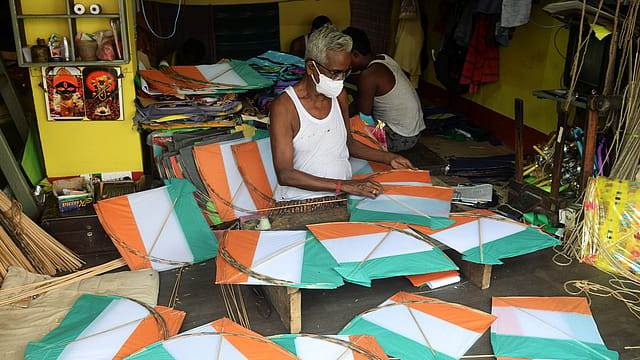
Families went to rooftops. Children grew up and took their children. Kite sellers prepared for August 15. Markets filled with paper, bamboo and string. An ordinary pastime slowly became part of the visual language of the day. Delhi Tourism today lists kite flying among the attractions associated with Independence Day celebrations. And the wider culture of kite flying continues to thrive. Earlier this year, Prime Minister Narendra Modi inaugurated the International Kite Festival at Ahmedabad's Sabarmati Riverfront, another reminder of how deeply the kite is embedded in India's cultural landscape.
There is another India underneath the kite
Follow a kite backwards from the sky and eventually you reach a pair of hands. Someone made it. Before the rooftop celebrations come the kite markets and the people whose livelihoods depend upon them. Paper must be cut. Bamboo splints shaped. Frames constructed. Designs chosen. Kites bundled and transported. Then comes the customer. Children inspect colours. Parents negotiate prices. Enthusiasts obsess over balance, paper and string. And every August, an old, inexpensive object finds a new generation willing to fall in love with it. That may be the most charming part of the tradition. India's Independence Day has acquired ever more sophisticated ways of celebrating itself: LED displays, drone shows, elaborate social-media campaigns and enormous televised ceremonies. And yet somewhere, a child is still perfectly happy with paper, bamboo, string and wind.
But the string has a darker side. The romance has its dangers. Sharp and hazardous kite strings can cause severe injuries to pedestrians, motorcyclists, birds and other animals. Flying around electricity lines creates another serious risk. Authorities repeatedly warn enthusiasts to use safe string and choose appropriate locations. Freedom in the sky still requires responsibility on the ground.
By afternoon, the sky has changed. Some kites are still fighting. Others hang from trees and electricity poles, evidence of battles already lost. And every few minutes, somewhere above the city, a string snaps. The kite wobbles. For a few seconds, it seems unsure of what has happened. Then the wind catches it. Children begin running below. And the kite floats away, belonging to nobody. Perhaps that is the image worth holding on to this Independence Day.
Almost a hundred years ago, a kite rose into a colonised Indian sky carrying three English words: Simon Go Back. Today, another generation looks upward at a very different sky. The kite is still there. Only now, it flies over a country that is free.
(With inputs from ANI)