What is Delhi’s Pink Force? The Women Officers Behind the Deployment
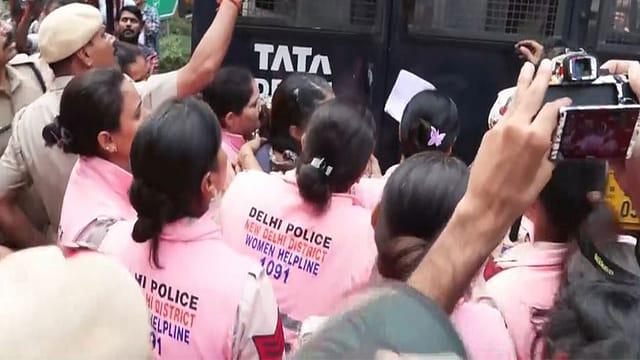
Delhi’s security preparations for Saturday’s Jantar Mantar demonstration have brought an unfamiliar name into the headlines: Pink Force.
The all-women contingent is part of a much larger deployment of police and paramilitary personnel. Its deployment follows reported incidents of misbehaviour towards women police officers.
But the idea behind Delhi’s Pink Force predates this protest. In September, the Lieutenant Governor called for a dedicated women’s patrol unit modelled on Goa’s initiative, with a focus on schools, colleges, Metro stations and vulnerable public spaces.
Its appearance at a demonstration raises several questions: What was the force created to do? How does it differ from other police units? And what can comparable initiatives elsewhere tell us?
WHAT EXACTLY IS DELHI’S PINK FORCE?
Pink Force refers to a women-led policing initiative intended to make trained women personnel more visible and accessible in public places.

The Modi Years
02 Oct 2026 - Vol 05 | Issue 40
A Nation Rebuilt
According to September media reports, Lieutenant Governor TS Sandhu directed Delhi Police to establish a dedicated force for high-visibility patrols around educational institutions, transport hubs and other vulnerable locations. The proposed model combined deterrence with rapid response, particularly during hours when women could be more vulnerable to harassment.
That gives the initiative a broader purpose than its deployment at Saturday’s demonstration. Its intended everyday work concerns safety in the places where people study, commute and spend time.
The available reports do not establish the unit’s sanctioned strength, detailed command structure or a separate set of powers. Those details should not be inferred from the name.
WHY HAS IT BEEN DEPLOYED FOR THE PROTEST?
The deployment follows recent incidents of misbehaviour with women police personnel. It comes amid heightened security for a proposed demonstration over electoral rolls and demands for Chief Election Commissioner Gyanesh Kumar’s removal.
Women officers can have several practical roles at a large gathering, including communicating with women participants, assisting people in distress and handling situations that require women personnel. The precise duties assigned to this contingent have not been publicly detailed in the supplied report.
The figure of more than 35,000 personnel refers to the overall police and paramilitary deployment across Delhi. It is not the size of Pink Force.
Similarly, the Rapid Action Force’s flag march is a separate part of the security operation. The two names should not be used interchangeably.
DID DELHI INVENT THE IDEA?
No. Goa is the explicit reference point for Delhi’s proposed model.
Goa launched its Pink Force in December 2021 to help prevent crimes against women and children. The state’s official tourism department identifies the all-women force as part of its wider safety network, alongside regular police, tourist police and night patrols.
Kerala also has a longer-running Pink Police Patrol initiative. Kochi City Police records the establishment of its Pink Police Control Room on November 25, 2016, to make women police assistance available for the safety and protection of women and children.
These programmes share an emphasis on accessible policing and women’s safety. They are separate local initiatives, with their own arrangements, rather than branches of a single nationwide Pink Force.
WHY CREATE A DEDICATED WOMEN’S UNIT?
One reason is accessibility. A person reporting harassment or sexual violence may feel more comfortable speaking to a woman officer. A visible patrol can also make it easier to seek help before a situation escalates.
International experience offers examples of that approach. The UN mission in Haiti reported that women and children found its women police officers approachable, an advantage when officers needed to understand community concerns and respond to insecurity.
There is also a staffing argument: dedicated units create operational opportunities for women in a profession historically dominated by men.
Their value, however, depends on what officers are trained and authorised to do. A patrol needs a functioning route from receiving a complaint to arranging protection, recording the case and securing follow-up action.
ARE THERE GLOBAL PARALLELS?
Yes, although the closest comparisons involve different models.
One is the deployment of organised women police units on security operations. India sent the UN’s first all-female formed police unit to Liberia in January 2007. The UN describes its contribution as both critical policing support and an example for women considering police careers.
Bangladesh subsequently sent a female formed police contingent to Haiti in May 2010. The UN mission records its work in the aftermath of the earthquake and highlights the contribution of women officers to engagement with women and children.
These were international peacekeeping deployments under UN mandates. They demonstrate women’s capacity to perform demanding security duties, but their missions and operating conditions were different from policing a demonstration in Delhi.
WHAT ABOUT WOMEN’S POLICE STATIONS ABROAD?
Brazil and Argentina offer another comparison: specialist police stations dealing with violence against women.
Research published in the Brazilian Journal of Public Policy traces the emergence of these stations to Brazil in 1985 and Argentina in 1988. It examines their potential to improve the police response to gender-based violence.
Brazil has also legislated for uninterrupted operation of its specialised police stations for women, according to UN Women’s database.
The distinction is important. A patrol takes officers into public spaces. A specialist station provides a place to report abuse and pursue a case. A formed police unit carries out coordinated security tasks. All can expand women’s role in policing, but they answer different needs.
DO WOMEN OFFICERS AUTOMATICALLY MAKE CROWD CONTROL LESS CONFRONTATIONAL?
That conclusion cannot be drawn from an all-women deployment alone.
Training, leadership, communication, equipment and operational instructions all influence how an encounter develops. Women officers also need protection from assault and harassment, just as participants need clear instructions and accountable policing.
The meaningful questions concern conduct: Were officers able to communicate effectively? Were people in distress assisted? Were confrontations reduced? Were complaints investigated?
The presence of women officers is an important part of the deployment. It is not, by itself, evidence of its outcome.
WHERE DO BODY CAMERAS FIT IN?
ANI reports that officers on duty have been equipped with uniform-mounted cameras capable of recording in low light. An officer told the agency that footage could help establish what happened when allegations of manhandling arose.
That is a potential evidentiary benefit. Cameras may record exchanges that would otherwise depend on conflicting accounts.
Research does not support treating cameras as an automatic solution to confrontation. A large randomised study of police body cameras in Washington, DC, found no statistically significant effects on the outcomes it examined, including use of force and civilian complaints.
For Delhi, useful questions include when recording begins, how footage is preserved and who can review it when an incident is disputed. Saturday’s report does not spell out those arrangements.
HOW SHOULD DELHI JUDGE WHETHER PINK FORCE WORKS?
The everyday test extends beyond a single protest.
For the patrol role envisaged in September, useful measures would include response times, coverage of vulnerable locations, women’s willingness to seek help and the action taken after complaints. For a protest deployment, the assessment would include assistance provided, injuries, complaints and the handling of confrontations.
The Goa, Kerala and international examples offer ideas for organisation and training. They cannot establish how Delhi’s unit will perform.
That will become clearer when its duties, staffing and results are made public, and when women who encounter its officers can say whether getting help has become easier.
With inputs from ANI