Rahul Gandhi faces traders’ ire over Delhi rallies as CAIT announces ‘Dhikkar Diwas’
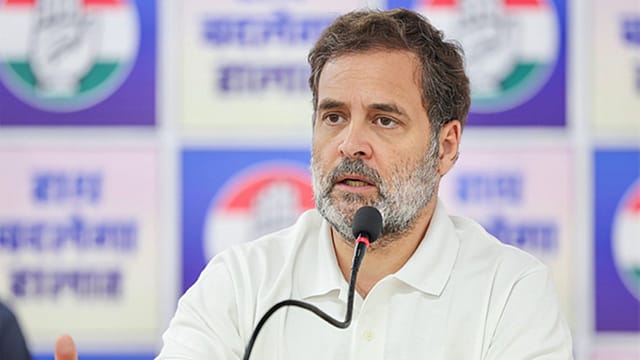
A political rally may last a few hours. For businesses around its venue, however, the impact can stretch much further. That is the concern now being raised by the Confederation of All India Traders (CAIT), which has written to Lok Sabha Leader of Opposition Rahul Gandhi over repeated disruptions to commercial activity in Delhi.
In its latest letter, CAIT National President B C Bhartia questioned the Congress-led INDIA bloc rally held at Ramlila Maidan on November 1, as well as the support extended by political parties to demonstrations in the capital over the past month. The traders’ body says traffic restrictions, road closures and the difficulty of reaching markets have affected businesses during an important festive and wedding shopping period.

The Era of Forever Wars
30 Oct 2026 - Vol 05 | Issue 44
Coping with an explosive Middle East
The organisation has announced that it will wait for Gandhi’s response before convening a national-level meeting of Delhi traders and trade leaders from other states after Diwali. That meeting will decide its next steps, including the date of a proposed nationwide ‘Dhikkar Diwas’, or Day of Condemnation.
Why are traders angry over Rahul Gandhi’s November 1 rally?
The immediate flashpoint was the INDIA bloc’s gathering at Ramlila Maidan, where opposition leaders protested against alleged irregularities in the revision of electoral rolls and demanded the resignation of Chief Election Commissioner Gyanesh Kumar.
The rally followed weeks of political demonstrations in Delhi. The Delhi Traffic Police had issued an advisory warning of restrictions and diversions in central Delhi between 10 am and 5 pm on November 1.
Traders had raised objections even before the event. The Chamber of Trade and Industry (CTI), in earlier representations to Gandhi, warned that the gathering could affect access to around 20 major markets near Ramlila Maidan. It estimated that daily festive-season trade worth Rs 10,000-12,000 crore could be at risk. These were the association’s projections, not independently verified losses.
Gandhi had appealed to rally participants to support local businesses by shopping in Delhi after attending the protest. CAIT now says this message sits uneasily with the disruption it alleges the gathering caused.
What has CAIT asked Rahul Gandhi to explain?
Bhartia argued that political leaders cannot invoke the constitutional right to protest while ignoring the rights of traders and workers to earn a livelihood. “Does Rahul Gandhi believe that the Right to Protest is superior to the Right to Trade and Earn a Livelihood?” he asked.
The letter also raises questions about who should compensate traders for losses caused by demonstrations and whether political parties accept responsibility for the economic consequences of rallies they support.
Bhartia said, “Rahul Gandhi cannot hold two contradictory positions simultaneously. On one hand, he appeals to people to purchase from local markets, while on the other, he supports political activities and demonstrations that prevent customers from reaching those very markets. This is not merely political inconsistency; it is a glaring contradiction that directly hurts the livelihoods of ordinary traders.”
What is the constitutional argument behind the traders’ protest?
CAIT has cited two constitutional provisions: Article 19(1)(a), which protects freedom of speech and expression, and Article 19(1)(g), which guarantees the right to practise a profession or carry on a trade or business.
The organisation maintains that both rights must be protected. It has clarified that it is not opposing peaceful demonstrations, but objects to protests that prevent customers, workers and goods from reaching commercial areas.
Its position echoes an earlier appeal to Delhi Lieutenant Governor Taranjit Singh Sandhu to designate suitable protest sites, preferably on the outskirts of the capital, so demonstrations can take place without repeatedly disrupting markets.
Will the dispute spread beyond Delhi?
CAIT says the issue is no longer confined to the national capital. Its proposed nationwide Dhikkar Diwas is intended to bring traders from different states into the campaign.
For now, the organisation is awaiting Gandhi’s reply. The larger question is whether political parties and city authorities can find a way to protect the right to demonstrate without making ordinary businesses bear the cost of political mobilisation.
(With inputs from ANI)