Delhi air turns toxic again: AQI nears 500 as pollution grips capital
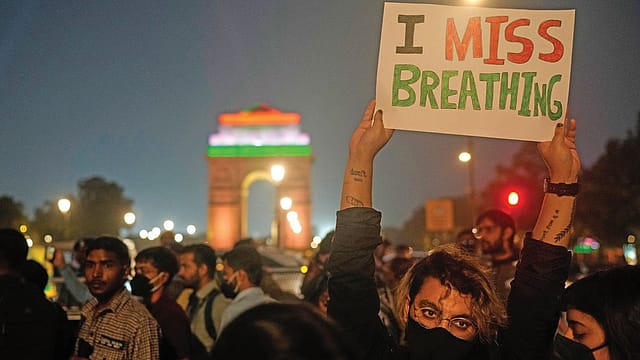
The morning haze is becoming harder to ignore. Delhi’s overall Air Quality Index (AQI) stood at 482 at 8.01 am on Thursday, placing the national capital in the severe category, according to Central Pollution Control Board (CPCB) data.
Seven monitoring stations recorded readings above 400. Punjabi Bagh was the worst affected, with an AQI of 446, followed by Narela at 434, Rohini at 431, RK Puram at 416, Bawana at 412, North Campus of Delhi University at 408 and Patparganj at 405.
The situation was not much better elsewhere. Okhla Phase-2 and India Gate both recorded 399, while ITO stood at 397 and Dwarka Sector 8 at 396. Chandni Chowk reported 356 and Vasundhara Enclave 330, placing them in the very poor category. Anand Vihar recorded 293 and IMD Lodhi Road 268, both in the poor category.

The Era of Forever Wars
30 Oct 2026 - Vol 05 | Issue 44
Coping with an explosive Middle East
The CPCB classifies AQI readings between 401 and 500 as severe. At these levels, pollution can affect healthy people and seriously impact those with existing respiratory or cardiovascular conditions.
Delhi’s pollution rises despite decline in stubble-burning incidents
The latest spike comes amid a familiar winter debate: how much of Delhi’s pollution is linked to crop-residue burning in neighbouring states, and how much comes from sources within the city?
Union Environment Minister Bhupender Yadav said on Tuesday that around 40 per cent of paddy stubble had been put to alternative use through ex-situ management, which involves removing crop residue from fields for purposes such as fuel and industrial use.
Asked why Delhi’s air remained severely polluted despite fewer reported farm fires, Yadav said the Commission for Air Quality Management (CAQM) was tracking weather conditions closely. “CAQM is continuously monitoring meteorological conditions, including wind direction, wind speed and the movement of air. Based on these assessments, the necessary steps are being taken,” he said.
However, the latest figures suggest that stubble burning remains part of the problem. The Indian Express reported that satellite data detected 467 active paddy-residue fires across six states on November 4. Punjab accounted for 151, Madhya Pradesh 157 and Rajasthan 111. Punjab recorded 2,347 farm fires between September 15 and November 4, lower than the 2,839 reported during the corresponding period in 2025.
CAQM steps up action as construction curbs begin
The CAQM has also intensified enforcement. On Wednesday, it issued show-cause notices to deputy commissioners and senior police officials in five Punjab districts over their failure to contain stubble-burning incidents. This followed similar action in four other districts earlier in the week, taking the total to nine.
Separately, construction and demolition activities across Delhi-NCR are facing restrictions from November 5 to November 20 under an advance advisory announced by Yadav. The Centre has also pointed to monitoring of industrial emissions, vehicle pollution and road dust as part of its wider response.
The immediate concern is the weather. The Indian Express, citing forecasts from the India Meteorological Department and the Indian Institute of Tropical Meteorology, reported that Delhi’s air could deteriorate further, with severe conditions likely over the following days.
For residents, the numbers are no longer just a winter headline. They are a warning that cleaner air will require action on several fronts, not just a reduction in farm fires.
(With inputs from ANI)