‘Close schools, open liquor bars’: Sonam Wangchuk hits out at Ladakh administration
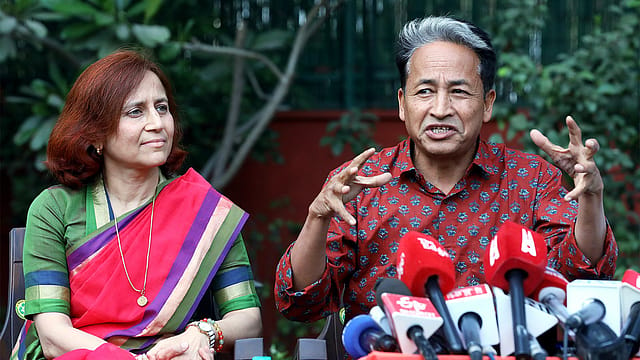
Can a school built around alternative education be asked to stop functioning while a legal dispute over its parent institution’s land remains unresolved? That is the question at the centre of the latest confrontation between climate activist Sonam Wangchuk and the Ladakh administration.
On November 1, the Tehsildar’s office in Leh issued a notice to Gitanjali J Angmo, co-founder and CEO of the Himalayan Institute of Alternatives (HIAL), asking the institute not to undertake further activities at Desert Flower School in Phyang until the High Court of Jammu and Kashmir and Ladakh decides the matter or issues fresh directions.
Wangchuk responded on Wednesday, describing the notice as a “shahi farmaan”. In a post on X, he questioned the administration’s priorities with the remark: “Close schools and open liquor bars”. He also urged media organisations that had reported the administration’s position to carry HIAL’s response.
Why has the Ladakh administration asked Desert Flower School to stop activities?
The notice alleges that classes and other activities had begun at Desert Flower School without the necessary consent, clearances or approvals from the relevant authorities.

The Era of Forever Wars
30 Oct 2026 - Vol 05 | Issue 44
Coping with an explosive Middle East
It refers to a September 22 letter in which Angmo sought a no-objection certificate or clearance for the proposed members of the school’s managing committee. The administration says activities had commenced despite the required approvals not being obtained. It has therefore advised HIAL to maintain the status quo and avoid any steps that could affect the case pending before the High Court.
The direction is linked to a much larger dispute: the cancellation of land allotted to HIAL at Phyang Thang.
What is the HIAL land dispute, and why was the allotment cancelled?
The controversy dates back to May 2018, when HIAL was allotted 1,076 kanals and one marla of land for a proposed 40-year lease to establish an alternative university focused on the Himalayan region.
On August 21, 2025, the Ladakh administration cancelled the allotment. It argued that the institute had failed to execute the lease deed, pay the required land premium and ground rent, or establish the university for which the land had been allotted.
HIAL challenged the cancellation in the High Court. In September 2026, the court restrained the administration from creating third-party rights over the disputed land while the case was being heard. That interim protection did not, however, overturn the cancellation itself.
The dispute intensified in October when the administration filed a 136-page affidavit defending its decision. According to The Indian Express and Hindustan Times, it argued that the allotment had lapsed in May 2019 because the lease conditions were not fulfilled within the stipulated period. HIAL CEO Angmo has disputed the administration’s claims.
What has Sonam Wangchuk said in defence of HIAL?
Wangchuk has defended the institute’s educational work and questioned why its school should face restrictions. In his November 4 post, he cited recognition from India's Parliamentary Committee on Education, a permanent display at London's Victoria and Albert Museum and the inclusion of HIAL projects in TIME magazine's TIME 100 Climate Solutions.
These are credentials Wangchuk has invoked to underline the institute’s work. But the administration has argued that such recognition does not resolve the legal question of whether the conditions attached to the land allotment were fulfilled.
Why does the school dispute matter beyond one institution?
HIAL promotes alternative, environment-focused education rooted in the challenges of life in the Himalayas. Wangchuk is also a prominent voice in Ladakh’s demands for statehood and constitutional safeguards under the Sixth Schedule.
His activism has brought him into conflict with the authorities before. He was detained under the National Security Act in September 2025 following violence in Leh during protests over Ladakh’s political demands. The Union government revoked his detention in March 2026.
The school notice now adds an education and land-use dispute to an already fraught relationship. For the moment, the decisive question is what the High Court will say about HIAL’s land allotment and the activities linked to it. Until then, the administration’s notice places the proposed functioning of Desert Flower School under a cloud of legal uncertainty.
(With inputs from ANI)