EAM Jaishankar, UK PM Andy Burnham discuss next phase of India-UK trade ties; watch
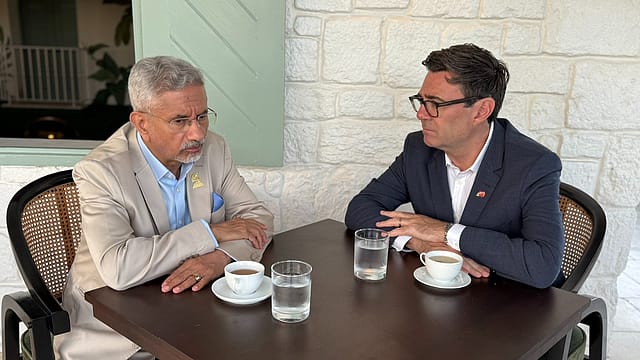
What can countries do when global trade routes become uncertain, supply chains are vulnerable and economic partnerships are being reshaped? For India, the answer involves building stronger links with trusted partners. External Affairs Minister S Jaishankar carried that message to the Commonwealth Heads of Government Meeting (CHOGM) 2026 in Antigua and Barbuda, where he met British Prime Minister Andy Burnham and discussed the next phase of India-UK economic cooperation.
The meeting, held on the sidelines of the summit in St John's, focused on strengthening bilateral economic ties in the context of the Comprehensive Economic and Trade Agreement (CETA). In a post on X, Jaishankar said he had conveyed Prime Minister Narendra Modi's warm wishes to Burnham and discussed the wider global landscape.

The Era of Forever Wars
30 Oct 2026 - Vol 05 | Issue 44
Coping with an explosive Middle East
The meeting comes at a significant moment for both countries. The India-UK CETA, which was signed in July 2025, formally came into force on July 15, 2026. According to India's Commerce Ministry, the agreement gives nearly 99 per cent of Indian exports access to the UK market at zero duty, creating opportunities for sectors ranging from textiles and leather to engineering goods and processed food.
India-UK CETA: Why the trade deal matters now
The agreement is intended to make trade between the two countries easier by reducing tariffs and improving market access. It also covers services, including information technology, professional services, education and business services.
The British government's trade portal says the deal is expected to increase bilateral trade and create opportunities for businesses and consumers in both countries. With the agreement now operational, the focus is shifting from negotiating market access to ensuring that companies can make use of the concessions.
Jaishankar's meeting with Burnham therefore comes at a time when both governments have an opportunity to turn the agreement into greater commercial engagement.
Jaishankar urges Commonwealth countries to diversify supply chains
Trade cooperation was also central to Jaishankar's address at the Commonwealth Heads of Government and Business Leaders Breakfast Meeting. He urged member countries to reduce their dependence on concentrated supply networks and build shorter, more reliable supply chains. Better connectivity corridors, stronger local distribution systems and investment in training and capacity building, he argued, could make trade more resilient.
Jaishankar also highlighted the Indian business community spread across the world as an asset that Commonwealth countries could draw upon to expand commercial links.
Technology, he said, could help improve efficiency, governance and economic growth. The minister has also highlighted India's digital public infrastructure model at the Commonwealth Heads of Government Executive Session, describing it as an example of how digital systems can widen economic participation and strengthen financial accountability.
Climate cooperation and disaster response on India's Commonwealth agenda
Jaishankar called for closer cooperation on climate action, pointing to the International Solar Alliance and the Coalition for Disaster Resilient Infrastructure as platforms that Commonwealth partners could use. He also drew attention to India's experience in humanitarian assistance and disaster relief, arguing that local response hubs and greater mobility of skills could strengthen the group's ability to deal with emergencies.
The wider summit, held from November 1 to 4 under the theme 'Accelerating Partnerships and Investment for a Prosperous Commonwealth', brought together leaders from 56 countries representing around 2.7 billion people. The Commonwealth's final communiqué placed trade, investment, digital infrastructure and climate resilience among its priorities.
For India, Jaishankar's engagements offered an opportunity to connect its bilateral trade agenda with a broader push for economic cooperation across the Commonwealth.
(With inputs from ANI)