Jantar Mantar row: Delhi Police tells Supreme Court it should never have been a protest site
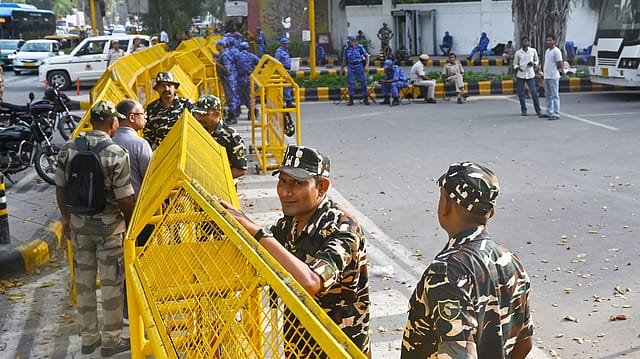
Jantar Mantar has witnessed some of the capital’s most prominent demonstrations. But its long association with public dissent is now at the centre of a legal and political dispute.
On November 5, barricades restricting movement around the area were removed after Delhi Police Commissioner Anurag Kumar’s order denotifying Jantar Mantar as an authorised protest venue. The development follows a fresh affidavit filed by the commissioner before the Supreme Court, defending the decision against a challenge by journalist Swaty Singh.
The police’s central argument is that Jantar Mantar was never suitable for functioning as a permanent protest site. The affidavit described the location as a public road meant for the free movement of people, arguing that its designation as a protest venue had been contrary to public interest.
The commissioner said the decision followed a review of changing conditions around the area, including traffic management, crowd control, public safety and the protection of important government installations.

The Era of Forever Wars
30 Oct 2026 - Vol 05 | Issue 44
Coping with an explosive Middle East
MHA committee report came before Supreme Court observations, police says
The affidavit also seeks to clarify the sequence of events. Delhi Police has denied that it denotified Jantar Mantar simply because of the Supreme Court’s October 9 observations on identifying better-equipped alternative protest venues.
According to the police, the Ministry of Home Affairs had constituted a committee on August 26 to examine whether Jantar Mantar should continue as a designated protest location. Its recommendations were forwarded to the commissioner on September 14, before the Supreme Court made its observations.
The committee reportedly recommended three alternatives: Ramlila Maidan in central Delhi, CBD Ground in east Delhi and Burari Ground in north-west Delhi.
The police said the area around Jantar Mantar has become more sensitive with the presence of the new Parliament complex and several government offices and diplomatic missions. According to the affidavit, more than 1,300 protests and demonstrations take place there annually, even though its assessed capacity is around 1,500 people.
It also flagged the possibility of large gatherings spilling towards Janpath and Connaught Place, affecting traffic and restricting access for ambulances and fire services. The affidavit cited 78 foreign diplomatic missions and 99 central government offices within a three-to-four-kilometre radius.
Supreme Court examines whether protests can be shifted away from Jantar Mantar
The denotification has triggered legal challenges, including Swaty Singh’s petition before the Supreme Court. The court issued notice on the challenge on October 15 and is examining whether the authorities independently assessed Jantar Mantar’s suitability before withdrawing its protest-site status.
The wider question is where the right to peaceful protest meets the rights of residents, commuters and businesses. In a separate hearing on November 3, the Supreme Court observed that no group could occupy a designated protest site indefinitely, and that such permissions should be for an identified period, The Indian Express reported.
Ramlila Maidan, Burari and CBD Ground are now Delhi’s designated protest venues
Delhi Police has named Ramlila Maidan, Burari Ground and CBD Ground as alternative locations for demonstrations. The change does not abolish the right to peaceful protest, but it removes Jantar Mantar’s status as a designated venue.
For activists, however, the question is whether moving demonstrations away from a prominent central location will make it harder for protesters to reach decision-makers and attract public attention.
The barricades may have disappeared, but the dispute over who gets to occupy public space – and where dissent can be heard in the capital – is now before the Supreme Court.
(With inputs from ANI)