The Liver Supremacy
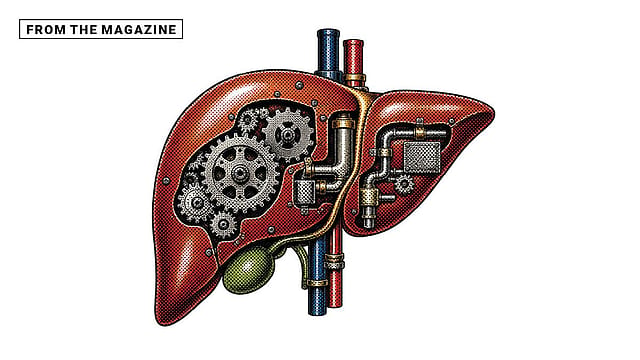
Most water-soluble cargo—the glucose from rice, amino acids from chicken, fructose from onions, vitamins, minerals, spice compounds and whatever was in that second helping of particularly delicious Kolkata biryani (the greatest kind there is)—enters a special vein running straight from the intestine to the liver. It is called the portal vein. The long-chain fat from the ghee takes the scenic lymphatic route we followed earlier and reaches the liver later in fat-carrying parcels. Either way, sooner or later, the liver wants to see the paperwork.
The hepatic portal vein creates an unusual two-stage circulation: blood from the digestive organs passes through one capillary network and then through another in the liver before returning to the heart. Roughly three-quarters of the liver’s blood flow arrives through this portal route; the hepatic artery supplies the rest, bringing oxygen-rich blood for the liver itself.

Losing Memory
16 Oct 2026 - Vol 05 | Issue 42
The making of a medical and social emergency
A paracetamol tablet you swallow reaches the liver before most of it enters the wider circulation. So does alcohol from that Old Monk, although much of it survives the first pass and reaches the brain. Food slows gastric emptying, which is why drinking on an empty stomach generally raises blood alcohol faster. The turmeric supplement peddled by an Instagram celebrity also arrives for inspection. Whether the first pass protects you or harms you depends on the molecule, the dose and the liver’s capacity to process it.
Your liver weighs about 1.5 kilograms. Tucked under your right ribcage, reddish-brown, shaped like a wedge, it’s the largest internal organ in your body (your skin is the largest organ, period). In English, nobody says, ‘I have a strong liver’ the way they say, ‘I have a strong heart’ or ‘I have a strong stomach’. Urdu and Hindi, on the other hand, are exceptions—jigar shows up everywhere, from terms of endearment (jigar ka tukda—piece of my liver, meaning a beloved child) to expressions of courage (jigar wala—someone with liver, meaning someone with guts, heh!). Mirza Ghalib’s liver does a lot of poetic heavy lifting, but even in Urdu and Persian, jigar is a metaphor for emotional depth, and not a recognition of what the organ actually does. In general, when one gazes fondly upon a plate of biryani, one rarely thinks ‘my liver is about to have a very long night’.
After a heavy meal, the stomach gets the complaint while the liver goes about its difficult business with significantly less drama. The liver doesn’t have the stomach’s cultural cache, but what it does, no other organ comes close to matching.
The kidneys are usually reduced to two bean-shaped urine factories. In reality, they continuously edit the blood: regulating water, salt, potassium and acid; controlling blood pressure; finishing the activation of vitamin D and releasing a hormone that tells the bone marrow to make red blood cells. The liver and kidneys form a processing partnership. The liver transforms and packages; the kidneys inspect the final fluid, reclaim what is useful and send the rest towards the toilet.
The liver has a party trick no other major internal organ can match. A surgeon can remove a large portion, and the tissue left behind expands until the organ has recovered much of its original mass and capacity. It does not recreate the missing lobe in precisely its former shape; the surviving liver grows larger and takes over the workload. This is why living-donor transplantation works: one portion goes to the recipient, and both pieces grow over the following weeks and months. Prometheus, chained to a rock while an eagle ate his liver every day, was rather serendipitously close to modern hepatology.
The liver is the only major internal organ in the human body with this capacity for regeneration. The heart, kidneys and brain are nowhere near as forgiving. This regenerative ability has limits, of course. Decades of alcohol abuse, chronic hepatitis infection or progressive fatty liver disease eventually replace functional hepatocytes with scar tissue—fibrosis, then cirrhosis.
When tissue is injured repeatedly, the body lays down collagen as emergency reinforcement. In the liver, early scattered collagen is called fibrosis, and if you remove the cause of injury soon enough, some of it can be dismantled while healthy cells repopulate the area. Cirrhosis is the advanced stage: scar tissue has formed bands, blood flow is distorted and the once-orderly architecture has been remodelled into knobbly islands of working tissue. Some recovery may still be possible, but the further the remodelling has gone, the less of the original plan can be recovered. The word itself comes from the Greek for tawny, after the yellowish colour of a liver that has been through this.
And that is when those 500 chemical reactions it manages begin failing one by one. The organ that could recover from a surgeon’s scalpel in six weeks can’t recover from a bottle of whisky every night for twenty years. The often-repeated figure is ‘more than 500 reactions’, although the true number depends on what one chooses to count. The liver stores and releases glucose, makes albumin and clotting proteins, manufactures bile, builds the lipoprotein parcels that carry fat through blood, stores iron, copper and several vitamins, performs the first activation step for vitamin D, processes bilirubin from dismantled red blood cells, modifies hormones and handles almost every drug you have taken. An incredible number of unrelated systems depend on this one organ.
Complete liver failure therefore disrupts glucose control, clotting, protein production, bile flow and chemical clearance at the same time. The Urdu shayars may have been extravagant about love, but they were not overrating the jigar.
The liver is also not one homogeneous vat. It is tiled with microscopic units called lobules. Blood carrying portal-vein cargo and hepatic-artery oxygen enters around each lobule’s edge, passes through sponge-like channels called sinusoids and drains towards a central vein. Cells along that route experience different supplies of oxygen and nutrients and specialize in different jobs. The factory floor is organized by distance from the loading dock. The same kind of zoning also helps explain why some toxins damage one part of a lobule more than another.
The French physiologist Claude Bernard figured this out in the 1850s, and the discovery was so strange that it took contemporaries years to believe him. The prevailing scientific wisdom at the time was clear: only plants could synthesize sugar. Animals like us simply consumed it, and burned it in our cells. We were not thought to make it. Bernard fed dogs an exclusive meat diet—no carbohydrates whatsoever—then measured the blood leaving their livers through the hepatic vein, and it contained sugar! Glucose, specifically, emerging from an organ that had received no sugar in its blood supply. In a famous experiment, Bernard washed a fresh liver with cold water until every trace of glucose was removed, left it overnight, and found glucose had reappeared the next morning. Sugar was appearing even though the animal had eaten no carbohydrate. The liver was storing a precursor and releasing glucose from it. He isolated the storage form in 1857 and called it la matière glycogène—glycogen, which is the substance the liver packs glucose into when there’s surplus, and unpacks it from when there’s a deficit. Bernard’s larger insight was stranger still: the body actively maintains a stable internal world despite whatever happens outside it. The liver’s glucose trick helped give physiology the idea that would later be called homeostasis.
Before Bernard, the liver was thought to be a glorified bile factory. After Bernard, it became a metabolic processing plant. That shift is one of the foundational moments in physiology, one that started because one Frenchman couldn’t explain where the sugar in a dog’s blood was coming from. Bernard’s wife, appalled by his animal experiments, eventually became an early campaigner against vivisection—the use of live animals in research. Scientific brilliance did not make him pleasant company, and the discovery of glycogen cost him his marriage.
After a meal, the liver sorts incoming cargo. Some glucose is stored, some amino acids are used or stripped for parts, and fats are burned, repackaged or stored. Between meals, the traffic reverses and the liver releases fuel to keep the rest of the body supplied. ‘Stripped for parts’ conceals an awkward problem. Carbohydrate and fat are built from carbon, hydrogen and oxygen, so oxidizing them yields carbon dioxide and water, and the body already has routine exits for both. Every amino acid additionally carries a nitrogen atom, and when the liver strips that nitrogen off to use the carbon skeleton as fuel, it comes away as ammonia, which is poisonous to the brain at even low concentrations. So the liver spends energy—this is not a free conversion—stitching ammonia into urea, a stable and thoroughly boring molecule the kidney can dilute into urine and discard. Protein is the only macronutrient whose waste has to be detoxified before it can be excreted, which is the clearest reason the liver and the kidney work as a pair. It is also why a failing liver produces confusion, drowsiness and eventually coma rather than merely yellow eyes. And it is the origin of the most durable protein myth in India: restricting protein genuinely helps people whose kidneys are already damaged, and that finding has been transplanted wholesale onto people whose kidneys are fine, resulting in an entire cottage industry of ‘protein damages kidneys’ scaremongering.
Type 2 diabetes partly develops when the liver stops obeying the body’s fuel-control signals. The nationwide ICMR–INDIAB analysis, published in 2023 using data collected through 2021, estimated 101 million Indians living with diabetes and 136 million with prediabetes. In a healthy liver, insulin signals ‘stop producing glucose, start storing it’; in insulin resistance, that signal gets muffled. The liver keeps producing glucose even when blood sugar is already high. Excess energy also accumulates as fat in the liver itself. The modern name is metabolic dysfunction-associated steatotic liver disease, or MASLD: excess liver fat occurring alongside cardiometabolic risk. Indian estimates vary by population and method, but a rough ‘one adult in three’ conveys the scale. The liver’s metabolic flexibility, its greatest strength in a world where many humans experienced irregular food supply for most of history, becomes a liability in a world of continuous surplus.
Fatty liver is dangerously common in India, and not just among drinkers. It’s common even among vegetarians, and people who’ve never touched alcohol, and thirty-year-olds who eat home-cooked food but eat too much of it and move too little. ‘Grade 1 fatty liver’ has become such a routine diagnosis that patients treat it like a dental check-up finding—noted, ignored, revisited when something goes wrong. For many people, the fat remains relatively stable. In others, it begins irritating liver cells, inflammation develops and repeated repair lays down scar tissue—all while daily life continues without an obvious warning.
‘But doctor, I only drank socially.’ Or, ‘I’ve never had alcohol at all.’ Dr Cyriac Abby Philips, a hepatologist in Kochi who goes by ‘The Liver Doc’ on social media, told me—‘By the time patients reach me, their liver is often past the point of simple recovery, and the one thing they almost universally share is complete disbelief—because nobody told them that the liver fails silently, without pain, until it is too late.’
This is an edited excerpt from Masala Body: An Engineer’s Guide to Eating (Penguin, 320 pages, `599) by Krish Ashok