National Remedy
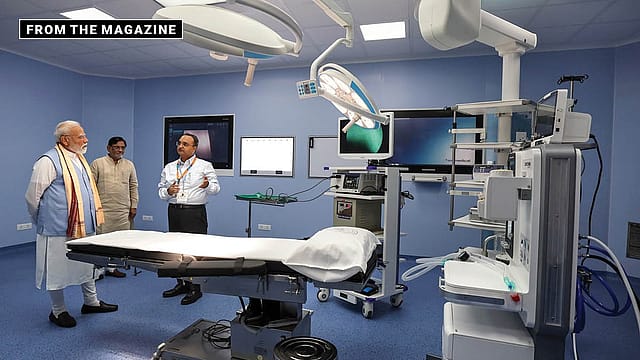
Although it accounts for a small part of the allocations of the Ministry of Health and Family Welfare, the budget for health research, along with new initiatives to make research grants more competitive and accessible, has been steadily increasing. The allocation for the Department of Health Research has increased more than five times, from Rs 932 crore in the 2014-15 revised estimates (RE) to Rs 4,821 crore in the 2026-27 Budget estimates (BE), according to an answer provided by the ministry to Parliament.
In response to a pointed set of questions submitted by Nagaur MP Hanuman Beniwal, the health ministry set out the measures it has taken to strengthen research funding and the Centre’s grant infrastructure, which is divided into four tiers—starting with grants of up to Rs 2 crore that can provide laboratories and researchers much-needed support, and going up to a Rs 15 crore provision for centres of advanced research. “These instruments support investigator-initiated research, proof-of-concept studies, validation of interventions, high-risk and high-reward innovation, multi-disciplinary research and advanced research programmes,” the health ministry said. The Indian Council of Medical Research (ICMR) has dealt with applications without delay, and no project was pending as of July 2026.

Losing Memory
16 Oct 2026 - Vol 05 | Issue 42
The making of a medical and social emergency
Keeping in view the need to both expand healthcare and improve the availability and accessibility of medical professionals, the government launched a major initiative to develop district hospitals into larger facilities with attached medical colleges. Of the 157 new medical colleges approved under the scheme, 137 are functional and offer medical education and clinical services. Around 40 of these projects are located in aspirational districts, and the total outlay for the scheme is Rs 41,000 crore. This planned expansion of medical colleges and hospitals is a key initiative to make advanced medical care available in areas that might otherwise be at a distance from a larger urban centre with government and private facilities. The scheme faces obvious challenges in finding faculty and doctors willing to serve in these districts, but it offers prospects for employment to residents of nearby areas.
The PM Ayushman Bharat Health Infrastructure Mission (PM-ABHIM) has an outlay of Rs 64,180 crore to be utilised between 2021-22 and 2025-26. Its measures cover all levels of care—primary, secondary and tertiary—to prepare health systems to respond effectively to current and future pandemics and disasters. The Fifteenth Finance Commission has recommended grants, channelled through local governments, for specific components such as building health and wellness sub-centres, primary health centres and community health centres; converting rural primary health centres and sub-centres into Ayushman Arogya Mandirs (AAMs); and supporting diagnostic infrastructure at primary healthcare facilities, block-level public health units and urban AAMs, according to information provided by the health ministry to Parliament.
Large amounts have been approved under the State Programme Implementation Plans (SPIPs), with Uttar Pradesh (UP) topping the list, followed by states such as Madhya Pradesh, Maharashtra and Chhattisgarh. For instance, Rs 211 crore has been released to UP, Rs 199 crore to Karnataka, Rs 172 crore to Tamil Nadu and Rs 164 crore to Assam. The 2026-27 Union Budget allocated Rs 1,06,530.42 crore to the Ministry of Health and Family Welfare, and the PM-ABHIM allocation surged by 67 per cent, with a Rs 4,770 crore provision. Funds to support new AIIMS institutions, existing institutions and medical college upgrades—including access to solar capacity—increased to Rs 11,307 crore from Rs 407 crore. The National AIDS Control Organisation (NACO) allocation has been raised to Rs 3,477 crore. There is also a Rs 10,000 crore initiative under Bio Pharma Shakti to encourage biologics, biosimilars and pharma research. As part of its plans to develop accessible medical facilities outside cities, the Budget sets aside allocations for trauma centres in every district hospital.
The health ministry’s official statement on the Budget highlights focused policy interventions that translate into an additional Rs 70,349 crore compared with the Modi government’s first Union Budget in 2014-15. “The Budget provides significant scheme-wise enhancements across key flagship programmes, reflecting the government’s sustained focus on strengthening healthcare access, infrastructure, service delivery and human resource capacity,” the ministry said. The allocation for the PM Jan Arogya Yojana (PM-JAY) was stepped up to Rs 9,500 crore, again aimed at expanding beneficiary coverage, service quality and hospital networks. These budgetary allocations have helped states provide a reasonable degree of technical support to remote district and tehsil health centres, through physical infrastructure and equipment such as laptop-based monitoring of basic parameters and oxygen-generating machines.
The National Health Mission (NHM) allocation was raised to Rs 39,390 crore, an increase of Rs 2,289 crore, or 6.1 per cent, over the 2025-26 RE. NHM allocations are intended to strengthen primary healthcare delivery, maternal and child health services, and disease-control interventions across states, complementing PM-ABHIM’s work to expand critical-care blocks, integrated public health laboratories, and district and sub-district hospitals, among other health infrastructure. Each successive Budget has provided for a substantial increase in MBBS, postgraduate, super-speciality and nursing seats. Other target areas include clinical training, innovation in biomedical fields, and artificial intelligence.
In the important area of disease control and public health, the allocation for the National AIDS and STD Control Programme went up to Rs 3,477 crore, a 30 per cent increase over the 2025-26 revised BE. Attention has also been paid to improving the reliability of blood transfusion systems, which are critical to both disease transmission control and emergency healthcare. Given the rising burden of non-communicable disease and the demand for skilled healthcare professionals, there is a phased outlay of Rs 980 crore over three years. “Allied Health Professional Institutes in 10 key disciplines will be set up and upgraded to create nearly one lakh skilled professionals over five years through public and private sector participation. These measures are intended to enhance diagnostic, preventive, rehabilitative and public health services while positioning India as a global hub for professionals,” the health ministry’s press release on the Budget noted.
The current Budget has set aside Rs 1,725 crore for the establishment of new medical colleges, the upgrade of undergraduate and postgraduate seats, and the augmentation of nursing education. Digital transformation of healthcare delivery is an important goal, and increased funding for the Ayushman Bharat Digital Mission will help expand digital records, interoperable frameworks, telemedicine and integrated hospital information systems—all of which improve the ability of medical professionals to diagnose ailments and help patients. Under the PM Swasthya Suraksha Yojana, 22 new AIIMS have been approved of which 18 are functional, providing world-class tertiary care in underserved and remote regions: “Since 2014, MBBS and nursing seats have more than doubled, and postgraduate and super-speciality seats have increased by 100%. In the last three years alone, over three crore OPD patients and 15 lakh IPD patients received care.” The government’s initiatives also extend to strengthening drug regulation and advanced therapeutics.
The Bio Pharma Shakti programme launched in the current Budget envisages spending Rs 10,000 crore over the next five years. A nationwide, biopharma-focused academic and research network is to be established through the creation of three new National Institutes of Pharmaceutical Education and Research (NIPERs) and the upgrade of seven existing institutes.
The Health Chart
The 2026-27 Union Budget allocated Rs 1,06,530.42 crore to the Ministry of Health and Family Welfare, and the PM-ABHIM allocation surged by 67 per cent, with a Rs 4,770 crore provision.
The 2026-27 Budget set aside Rs 1,725 crore for the establishment of new medical colleges, the upgrade of undergraduate and postgraduate seats, and the augmentation of nursing education.
Of the 157 new medical colleges approved, 137 are functional and offer medical education and clinical services. Around 40 of these projects are located in aspirational districts, and the total outlay for the scheme is RS 41,000 crore.
The PM Ayushman Bharat Health Infrastructure Mission (PM-ABHIM) has an outlay of Rs 64,180 crore to be utilised between 2021-22 and 2025-26. Its measures cover all levels of care—primary, secondary and tertiary.
Large amounts have been approved under the State Programme Implementation Plans (SPIPs), with Uttar Pradesh topping the list, followed by states such as Madhya Pradesh, Maharashtra and Chhattisgarh. Rs 211 crore has been released to UP, Rs 199 crore to Karnataka, Rs 172 crore to Tamil Nadu and Rs 164 crore to Assam.
Funds to support new AIIMS institutions, existing institutions and medical college upgrades—including access to solar capacity—increased to Rs 11,307 crore from Rs 407 crore. The National AIDS Control Organisation (NACO) allocation has been raised to Rs 3,477 crore.