Delhi air pollution: AQI stays above 320 as smog blankets city, GRAP Stage III restrictions continue
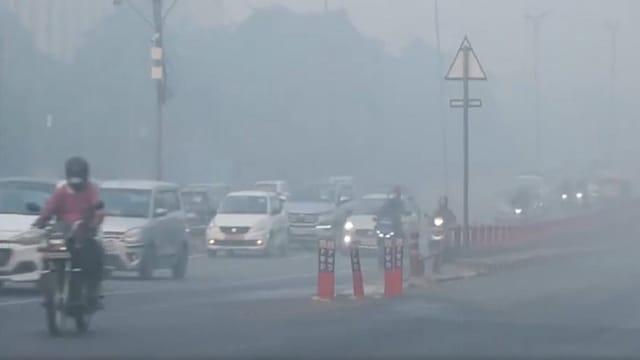
The morning may have brought a slight improvement in Delhi’s air quality, but stepping outside still meant looking through a layer of smog. At 7 am on Thursday, the capital recorded an overall Air Quality Index (AQI) of 321, placing it in the ‘very poor’ category, according to Central Pollution Control Board (CPCB) data.
The pollution was not evenly spread across the city. NSUT Jaffarpur recorded the highest AQI at 399, followed by Chandni Chowk at 387, Pusa (IITM) at 386, NSIT Dwarka at 383 and JNU at 378. Punjabi Bagh registered 371, while Chhawla recorded 368 and CRRI Mathura Road 365.
Some locations offered a comparatively better reading. Karala recorded an AQI of 256, Pusa (DPCC) 269, while Maidan Garhi and Mandir Marg stood at 289. However, these readings did little to change the overall picture: much of Delhi continued to breathe air classified as very poor.

The Wealth Issue 2026
06 Nov 2026 - Vol 05 | Issue 45
Portraits of Dreamers and Doers under 35
Post-Diwali pollution continues as PM2.5 and PM10 dominate Delhi's air
The latest reading follows a sharp pollution spike around Diwali on November 8. Delhi’s average AQI reached 376 that day, its worst Diwali-day reading since 2021, according to The Indian Express. It climbed to around 370 on the morning after the festival, with eight monitoring stations crossing the 400 mark.
The newspaper’s analysis of hourly monitoring data found that average PM2.5 concentrations rose sharply after fireworks began, reaching 493.17 micrograms per cubic metre by 11 pm on Diwali night and climbing further after midnight.
The problem, however, was already building before the celebrations. A Centre for Science and Environment analysis found that Delhi’s average PM2.5 concentration during the week before Diwali stood at 236 micrograms per cubic metre, nearly twice the 120 recorded during the corresponding period in 2025.
GRAP Stage III remains in force across Delhi-NCR
Authorities had moved ahead of the festival rush. The Commission for Air Quality Management (CAQM) invoked Stage III of the Graded Response Action Plan (GRAP) across Delhi-NCR on November 6, after the capital recorded an AQI of 382 and forecasts indicated a possible slide into the severe category.
The restrictions add to measures under the first two stages. They include curbs on dust-generating construction and demolition activities, tighter enforcement against polluting vehicles and steps to reduce emissions across the region. Schools up to Class V may follow hybrid classes, while work-from-home arrangements are to be followed when directed.
The CAQM has also urged residents to use cleaner transport, combine journeys, avoid open burning and reduce unnecessary outdoor exposure. Water sprinkling and dust suppression are among the measures being undertaken by agencies.
CAQM hears AAP delegation as Delhi seeks solutions to pollution
On Wednesday, CAQM Member Secretary and technical members met a delegation from the Aam Aadmi Party at the commission’s office to hear its concerns and grievances over Delhi’s air pollution.
The meeting comes as political pressure grows over the capital’s recurring winter smog. The challenge is not limited to fireworks: vehicle emissions, construction dust, industrial activity, waste burning, farm fires and weather conditions all contribute to the pollution burden.
Mumbai records moderate AQI as Delhi remains in very poor category
The contrast with Mumbai was noticeable on Thursday morning. The city recorded an AQI of 146, classified as ‘moderate’, according to CPCB data cited by ANI. Bandra Reclamation registered 199.
Across Maharashtra, Bhiwandi recorded 221 and Malegaon 208, both in the ‘poor’ category. Most other listed cities remained in the moderate or satisfactory ranges.
Under CPCB’s classification, an AQI of 301-400 is ‘very poor’, while readings between 401 and 500 are considered ‘severe’. Delhi’s reading of 321 may mark a marginal improvement, but it remains a long way from clean air.
(With inputs from ANI)