‘Terrorism by Pakistan Will Have Consequences’: India Hits Back at Sharif at UNGA
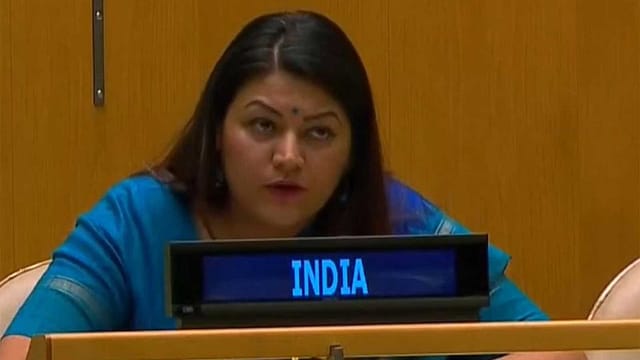
India warned that “terrorism by Pakistan will have consequences” in a sharp response to Pakistani Prime Minister Shehbaz Sharif’s address at the United Nations General Assembly, rejecting his remarks on Jammu and Kashmir and asserting its right to defend itself.
Exercising India’s right of reply on Friday, Petal Gahlot, first secretary at India’s Permanent Mission to the UN, accused Pakistan of using the Assembly to deliver “hypocritical homilies” while suppressing rights at home.
“At the heart of the issue is the long-standing practice of cross-border terrorism by Pakistan,” she said. “Our right to defend ourselves against terrorism will be exercised and continued. Terrorism by Pakistan will have consequences.”
India Puts Cross-Border Terrorism at the Centre
Gahlot said India had demonstrated its resolve against terrorism the previous year, warning that those responsible would find no sanctuary.
Zeroing In on ECI
09 Oct 2026 - Vol 05 | Issue 41
Constitutional legitimacy versus political opportunism
“We demonstrated last year that terrorists will have nowhere to run and nowhere to hide,” she told the Assembly.
The diplomat also invoked the 25th anniversary of the September 11 attacks, observed earlier this month, and referred to Osama bin Laden’s presence near the Pakistani Army’s premier training academy.
She used that reference to challenge Sharif’s praise of Pakistan’s military and question Islamabad’s claims on security.
“They claim to uphold security during the day; they actually carry out terrorism at night,” she said.
‘A Regime of the Army, by the Army, and for the Army’
India’s response also targeted the relationship between Pakistan’s civilian leadership and its military.
Gahlot accused the government of invoking democratic rights internationally while fortifying its capital against its own people.
“We heard some hypocritical homilies about democratic rights and human values from a regime whose capital at this very moment is being fortified against its own people,” she said.
Describing the administration as “a regime of the army, by the army, and for the army”, she alleged that the military remained the country’s decisive authority.
“Their puppets may come and go, but let us have no illusion about who calls the shots,” she said.
Gahlot also cited Pakistan’s 27th Amendment and what she described as lifelong immunity for its “real ruler” to support her criticism of the country’s power structure.
Jammu and Kashmir ‘Will Always Remain’ Part of India
Rejecting Sharif’s references to Jammu and Kashmir, Gahlot reiterated India’s position on the Union territory.
“This is an integral and inalienable part of my country and will always remain so,” she said.
She then directed attention to Pakistan-occupied Jammu and Kashmir, alleging violence and denial of basic rights there.
“Ask the people of Rawalkot about the wanton killings, the brutal violence and the denial of basic rights that they have long experienced,” she told the Assembly.
Minority Rights and Blasphemy Laws Questioned
Gahlot challenged Pakistan’s criticism of religious intolerance by pointing to its blasphemy laws and treatment of minorities.
“This assembly was subjected to remarks about religious intolerance from the very regime whose mainstay is blasphemy laws. The world knows how minorities are treated in Pakistan. No pious platitude can mislead it,” she said.
Closing India’s response, she urged member states to assess Pakistan by its policies rather than its statements at the UN.
“Reiterating falsehoods year after year does not make them true. Pakistan’s terrorism, deceit and duplicity will neither benefit it nor the world,” Gahlot said.
With inputs from ANI