Red Aurora in Ladakh Explained: What Caused This Rare Phenomenon
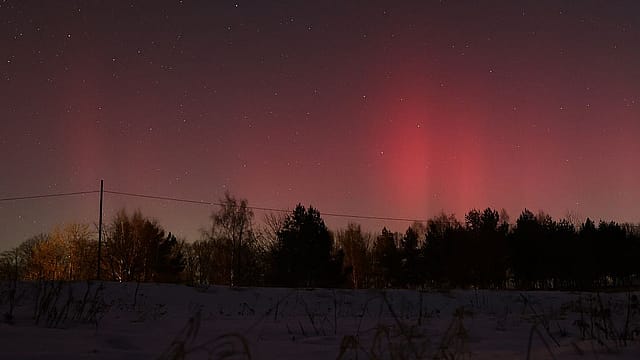
The night skies over Ladakh turned unexpectedly crimson on January 19 and 20. A rare red aurora, usually confined to the Earth’s polar regions, was spotted in northern India, an extraordinary sign of intensifying solar activity.
Here’s what caused the phenomenon and why it matters.
What are the Northern Lights?
The Northern Lights, or aurora borealis, are natural light displays caused when charged particles from the Sun collide with gases in Earth’s upper atmosphere. These interactions produce glowing curtains of light, most commonly green, but sometimes red or purple.
Why did the Northern Lights appear in Ladakh?
Space weather experts say an unusually strong solar storm recently struck Earth. Such storms can expand the auroral zone, allowing auroras to appear far from the poles. The intensity of this geomagnetic disturbance pushed the phenomenon as far south as Ladakh.
What makes a red aurora different from a green one?
Green auroras occur at lower altitudes when oxygen emits green light. Red auroras form much higher up, where oxygen is thinner and emits red wavelengths. Their appearance usually signals a particularly powerful solar storm.

Exclusive: To the Heavens and Back
19 Jun 2026 - Vol 04 | Issue 76
Shubhanshu Shukla relives the space odyssey that put India into orbit
Where exactly was the red aurora seen in Ladakh?
The red aurora was reportedly observed in Hanle, a remote region in Ladakh home to one of India’s highest astronomical observatories. Located over 4,500 metres above sea level, Hanle offers exceptionally clear and dark skies.
What causes solar storms?
Solar storms originate from violent eruptions on the Sun’s surface, including solar flares and coronal mass ejections. These events release massive bursts of energy and charged particles that can travel millions of kilometres toward Earth.
Are solar storms dangerous to humans?
Most solar storms pose little direct danger to people on the ground due to Earth’s magnetic field and atmosphere. However, strong storms can disrupt satellites, GPS systems, power grids, and radio communications.
How often do such rare auroras occur?
Solar activity follows an 11-year cycle. Scientists say the Sun is nearing the peak of Solar Cycle 25, a phase marked by more frequent and intense solar storms. This increases the chances of rare auroras appearing in unusual locations.
Can scientists predict auroras in advance?
To a degree. Space agencies monitor solar activity and issue alerts when storms are heading toward Earth. However, predicting exact visibility locations remains difficult due to variations in Earth’s magnetic field and atmospheric conditions.
Why does this event matter for India?
Beyond its visual spectacle, the red aurora highlights growing solar activity that could impact India’s satellites, navigation systems, and communication networks. Scientists are closely tracking space weather to mitigate risks to critical infrastructure.
(With inputs from yMedia)