Braving the Bad New World
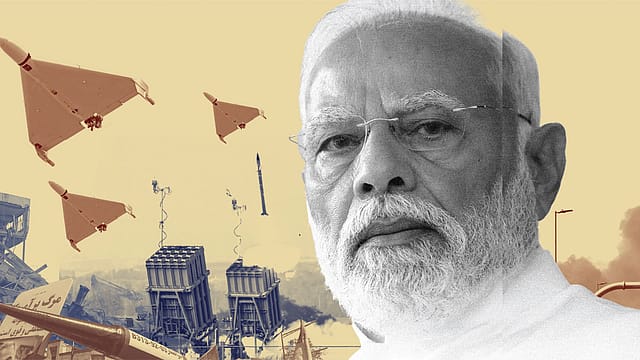
THE CLOSE TO ONE CRORE INDIAN NATIONALS in the Middle East, many located in Gulf nations, have been at the centre of India’s diplomacy since the start of the latest war in the region. The Indian citizens include long-term residents living with families as well as short-term workers. Almost all of them are part of a burgeoning remittance economy that saw $135 billion being sent to India in the financial year 2024-25. What began as a ‘postal order’ economy in the 1980s is now a major Indian presence with growing political and security cooperation. The Gulf Cooperation Council (GCC) accounted for bilateral trade of $178 billion in the same period and the relationship has acquired a strong strategic aspect with Prime Minister Narendra Modi building close ties with rulers of the Arab states and frequently meeting CEOs and business leaders.
Iran’s ‘horizontal’ escalation targeting civilian and military infrastructure in its neighbourhood has cast a long shadow over the lives of millions of Indians and the crowds at airports in Dubai and Doha make protracted hostilities a serious concern for India and External Affairs Minister S Jaishankar did not sugarcoat facts when he told Parliament on March 9 that the situation has worsened. “The conflict has continued to intensify and the security situation in the region has deteriorated significantly. We have noted that, in fact, the conflict spread to other nations with mounting destruction and deaths. Normal life and economic activities in the entire region are visibly affected and, in some cases, had come to a halt,” he said. With the conflict having a direct bearing not only on Indian nationals in West Asia but also on domestic cooking gas and fuel pump supplies, the Modi government quickly shed its initial caution and called for urgent de-escalation. “India is in favour of peace and urges a return to dialogue and diplomacy. We advocate de-escalation, restraint and ensuring the safety of civilians,” Jaishankar said.
It was inevitable that the war would reverberate in India’s domestic politics with the I.N.D.I.A. bloc stalling Lok Sabha when it met on March 9 for the second half of the Budget Session. The opposition parties relented for a couple of days when their motion seeking the removal of Speaker Om Birla was taken up but were back to demanding a discussion, accusing the government of mismanaging India’s energy security. Modi responded during campaign speeches in Tamil Nadu and Kerala on March 11, saying the government will protect India’s interests. “Today, I would like to speak to the people of Tamil Nadu about the conflict in West Asia. It has affected the whole world’s energy supply chain. We believe in the ideology of India first… In any situation, we have seen how our government always puts the interests of Indians above everything. Even in these times, our approach will be the same. There is no need to panic or pay attention to rumours. I would like to appeal to the people, let us spread only correct and verified information,” Modi told a rally in Tiruchirappalli. The Bharatiya Janata Party (BJP) accused Congress of spreading misinformation, claiming the party used a 2011 image of LPG queues which had to be withdrawn. Congress communications in-charge Jairam Ramesh posted on X that the government is refusing to debate the impact of the war on India because its foreign policy stands exposed.
The opposition forced repeated adjournments on March 12 raising the West Asia situation and carrying placards as they did on March 9 when Jaishankar read out a detailed statement on the situation. It was noticeable that in the bedlam only a few opposition MPs like Shashi Tharoor kept their earphones on and heard the minister carefully. Leader of Opposition Rahul Gandhi could be seen engaged in a discussion with his sister Priyanka Gandhi Vadra and largely gave Jaishankar’s statement a miss.
Aware of the domestic and foreign policy implications, government managers organised daily briefings by officials from the petroleum and natural gas, external affairs, shipping and information and broadcasting ministries to explain the measures taken to stabilise supplies and help Indian nationals in the war zone. In a swift rejig of crude oil sourcing, India has moved 70 per cent of supplies outside the war-affected Strait of Hormuz, officials said. Earlier, close to half of India’s needs came through Hormuz from suppliers like Saudi Arabia, the United Arab Emirates (UAE), and Iraq. Two cargoes were due to arrive on March 12 and refineries have been instructed to work at top capacity. Similarly, the government is scrambling to find alternative routes for LNG and two such cargoes were also due from new sources. According to the shipping ministry, 28 Indian vessels are in the Hormuz and Persian Gulf sectors. Of some 9,000 Indian students in Iran, many left after the MEA issued repeated advisories and those who did not are being brought out via Armenia and Azerbaijan. Indian missions are working with Gulf authorities to extend visas for stranded Indian passengers and helping them reach airports in Saudi Arabia, Oman, and Bahrain that are operational.

JUST AS THE GOVERNMENT closely follows events on ground in the Gulf with Modi having spoken to all emirs, crown princes and kings in the region, it is keeping tabs on the Trump administration’s war plans as they unfold. So far, there has been a lack of clarity on what the American endgame could be even as commentators close to the US administration claim the career bureaucracy has been excluded and sensitive discussions are restricted to Trump’s inner circle of Secretary of State Marco Rubio, Secretary of War Pete Hegseth, son-in-law and informal adviser Jared Kushner, and Middle East envoy Steve Witkoff. In their public comments, Trump and senior cabinet members insist there will be no “mission creep” and the US-Israeli campaign against Iran will not be an endless war. On March 11, Trump told news website Axios that there is “practically nothing left to target” in Iran and that “Any time I want it to end, it will end.”
It is indeed true that ending the conflict is the president’s call but his comments are at variance with Israeli statements that insist “regime change” remains an objective and this might take up to a year. Earlier, Trump had not ruled out putting boots on the ground and spoke of timelines of four-six weeks. It is not clear whether these comments are serious projections or part of psychological warfare aimed to convey to Iran’s ruling clergy and the Islamic Revolutionary Guards Corps (IRGC) that they should not bet on the US calling off the offensive due to indiscriminate Iranian attacks in the Gulf region. At different times, Trump officials have said ending Iran’s nuclear weapons programme, curbing its ballistic missile capability, crippling its naval power, and even dismantling of its defence production base are all part of American war goals.
The emerging view in New Delhi is that Iran has shown the capacity to continue launching drones and missiles against Israel and its neighbours even after the reported degradation of its launchers, a fact that US Chairman of the Joint Chiefs of Staff General Dan Caine acknowledged at a press briefing he addressed with Hegseth on March 10. Caine said, “They are fighting and I respect that.” While the regular Iranian army, Artesh, and the IRGC commanders are seen to be operating in an “autonomous” mode according to prior instructions issued before the death of Ayatollah Ali Khamenei, it is evident the command-and-control system continues to function. In fact, it is now estimated that instructions might be updated and the communication between missile units and the central leadership is very much real-time. All of this makes an estimation of timelines difficult even as there are signs that diplomatic exchanges between the European Union (EU), ASEAN, and other nations might result in more insistent calls for dialogue and diplomacy. Although the display of American firepower can be viewed as a deterrent for competitors like China, the ongoing Operation Epic Fury is distracting the US from objectives such as ending the Ukraine war and is certainly depleting its stocks of missile and drone interceptors. But more than the military hardware, Trump’s political capital is being expended at a rapid rate. If the war drags on, it will be difficult to justify the claim that the US is not getting pulled into a stalemate while its actions are posing a serious risk to the global economy.
The closing of the Strait of Hormuz and reduction in energy supplies and the rise in oil and gas prices is seen as a growing pressure point for the US and Trump’s angry outburst on Truth Social on March 10, warning Iran of massive retribution if it prevents the flow of oil, indicates just this: “If Iran does anything to stop the flow of oil within the Strait of Hormuz, they will be hit by the US 20 times harder than they have been hit so far. Additionally, we will take out easily destroyable targets that will make it virtually impossible for Iran to be ever built back, as a nation again—Death, Fire and Fury will reign (sic) upon them—But I hope and pray that does not happen.” This has raised the possibility of Trump declaring “victory” and ending the war, even if it means a serious departure from what Israel is aiming for. A long war, according to Indian sources, is not something the president’s MAGA base desires and in fact finds little resonance in other voting segments. If energy prices rise and begin to impact consumers in the US, the administration might have to consider if the war will—instead of being seen as a major success that tamed Iran—have negative ramifications for Republican prospects in the mid-term elections due later this year.
Although the war in the Middle East is a major disruption, force majeure that can throw all conventional estimates out of the window, Indian diplomacy is on a much stronger footing than was the case in the past. Modi’s ability to reach out personally to the emirs, kings and princes who lead Arab nations has facilitated a faster response to requests by Indian missions. Flights and ships have been accorded priority and even Iran has allowed Indian-flagged oil cargo vessels to sail out of Hormuz unscathed on specific requests. On the one hand, the prime minister has condemned Iranian attacks in conversations with Saudi and Gulf rulers but the lines with Iran also remain open. To date there has been no critical comment regarding India from the Iranian foreign ministry and Jaishankar has spoken to Iranian foreign minister Abbas Araghchi three times since the war began. Although Iran is all too aware of India’s ties with Israel and the US, there is little benefit for Tehran to feud with more nations than it needs to. In the past, Iran has appreciated India’s decision to vote against a resolution censoring Tehran at the UN Human Rights Council in January. The engagement with Iran underlines the Modi government’s desire to preserve working relations with a nation that can be a counterweight to Pakistan and avoid moral grandstanding.
As with Indian relations with Russia in the context of American pressure to reduce oil imports, India refused to see international relations as zero-sum games. Modi’s visit to Israel was a rejection of a view that an open embrace of the Jewish state would alienate Muslim states in the Middle East. Such assumptions had long held Indian leaders in their thrall and while navigating the diplomatic minefield in the wake of the US-Israeli strikes against Iran was never going to be a straight path, India’s interest is best served without allowing a false or exaggerated sense of morality to cloud the view from New Delhi.