PM Modi Calls AI a ‘Civilisational Inflection Point’ as India Positions Itself at the Centre of AI Revolution
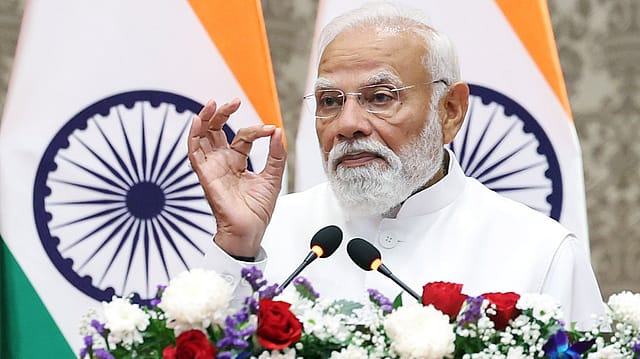
Prime Minister Narendra Modi on Wednesday shared his thoughts on India’s transformative potential and the role the country can play in the global artificial intelligence revolution.
Replying to ANI’s ‘X’ post of his interview, the Prime Minister wrote, "As India hosts the AI Impact Summit in Delhi, I've shared my thoughts on the transformative potential of AI, the role India can play in the AI revolution and more in this interview with ANI."
In the interview with ANI, PM Narendra Modi said AI stands at a civilisational inflection point and has the capacity to expand human capability in unprecedented ways while also testing existing social foundations if left unguided.
Zeroing In on ECI
09 Oct 2026 - Vol 05 | Issue 41
Constitutional legitimacy versus political opportunism
He emphasised that the summit has been deliberately framed around impact to ensure meaningful and equitable outcomes rather than just innovation.
The guiding spirit, "Sarvajan Hitay, Sarvajan Sukhaye", reflects India’s civilisational philosophy, he said, adding that the end goal of technology should be “Welfare for All, Happiness of All” and that technology exists to serve humanity, not replace it.
He noted that the summit is structured around People, Planet and Progress, underlining that AI systems draw upon knowledge and data generated across societies worldwide.
Therefore, India wants the benefits of AI to be diffused to everyone and not just hoarded by early adopters.
Highlighting that it is the first global AI summit hosted in the Global South, the Prime Minister said India is creating a platform that amplifies under-represented voices and development priorities.
He added that AI governance, inclusive datasets, climate applications, agricultural productivity, public health and multilingual access are central issues for India and reiterated that AI must accelerate global development while remaining deeply human-centric.
How will AI transform India’s IT sector and drive growth towards $400 billion by 2030?
Speaking about the growing impact of AI on the IT industry, the Prime Minister said, "India's IT sector has been the backbone of our services exports and a key driver of economic growth. AI presents both a tremendous opportunity and a challenge for this sector. AI market projections show India's IT sector could reach $400 billion by 2030, driven by new waves of AI-enabled outsourcing and domain-specific automation."
Sundar Pichai arrived in the national capital on Wednesday for the Global AI Impact Summit 2026 and is set to deliver the keynote address on February 20.
In a post on X, Pichai said, "Nice to be back in India for the AI Impact Summit - a very warm welcome as always and the papers looked great too."
President of Spain Pedro Sanchez Perez-Castejon also arrived in India to attend the AI Impact Summit 2026 and was greeted by Minister of State for Skills Development and Entrepreneurship Jayant Singh.
What did Demis Hassabis say about AI safety and agentic AI at the AI Impact Summit?
Founder and CEO of Google DeepMind, Demis Hassabis, attended the summit and shared his views on AI safety, agentic AI and ongoing innovations.
"This Summit comes at a critical time as we start seeing more autonomous agentic AI systems," he said, appreciating the government’s efforts and willingness to inculcate AI in their systems.
Commenting on the limitations of current AI systems, Hassabis said, "When I look at the current systems and what's missing from them being a kind of general intelligence, I would say things like continual learning, so learning after they've been trained and put out into the world."
"In today's systems, we train them, we do various different types of training on them, and then they're kind of frozen and then put out into the world. But what you'd like is for those systems to continually learn online from experience to learn from the context they're in, maybe personalised to the situation and the task that you have for them, and today's systems don't do that," he added.
He also highlighted the difficulty current models face in long-term planning, stating, "Also, they have difficulty with things like doing long-term coherent plans. They can plan over the short term, but over the longer term, as the way that we plan can plan over years, they don't really have that capability at the moment."
"I think probably one of the biggest issues is what I would call consistency. So today's systems are kind of like jagged intelligences. They're very good at certain things, but they're very poor at other things, including sometimes the same things," he said.
"So for example, today's systems can get gold medals in the International Maths Olympiad, really hard problems, but sometimes can still make mistakes on elementary maths if you pose the question in a certain way. A true general intelligence system shouldn't have that kind of jaggedness," Hassabis added.
What opportunities of Artificial Generative Intelligence did Demis Hassabis emphasise at the AI Impact Summit?
Hassabis, who founded DeepMind in 2010 which was later acquired by Google, described the summit as timely and significant, noting that it comes at an opportune moment as the world stands on the cusp of Artificial Generative Intelligence.
He praised India for hosting the seminal gathering and emphasised the importance of global dialogue and cooperation to mitigate risks associated with the technology.
"We are at a threshold moment where Artificial Generative Intelligence is on the horizon in the next 5-8 years. So this summit comes at a critical moment as we start seeing more autonomous AI systems. The opportunities are incredible," he said, while also highlighting AI’s potential in science, medicine, climate change and human health.
"AI is going to be the most transformative technology in human history that's just on the horizon now and it is going to affect everybody across the world," he said.
"It's very important to have summits like this to bring the international community together to make sure the opportunities benefit the whole world and how do we mitigate the risks- which would need international cooperation and the first step to that is to have international dialogue," he further added.
Hassabis, an AI researcher, entrepreneur and Nobel Laureate, is the co-founder and CEO of Google DeepMind.
He featured in the Time 100 list of most influential people in 2017 and was awarded a knighthood in 2024 for services to the field of Artificial Intelligence.
(With inputs from ANI)