Pitbull Attacks in India: Rising Incidents, Legal Loopholes & the Battle Over Bans
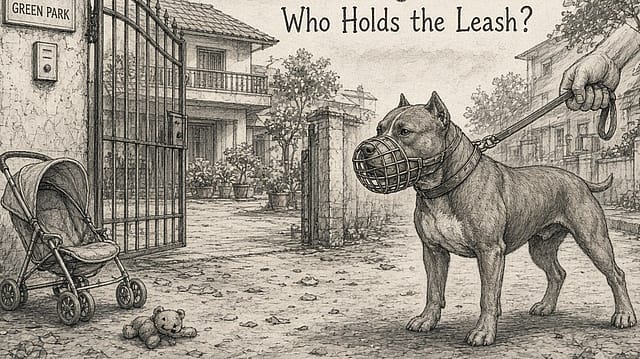
The gate opened. The dog came out. A seven-month-old child ended up in surgery.
That is the sequence Kailash reportedly after an alleged pitbull attack in Sonipat left his infant son with severe injuries. His younger sister had been looking after the baby. The dog’s owner was nearby. Then, according to the father, the owner’s children opened the gate.
At the Post Graduate Institute of Medical Sciences in Rohtak, doctors treated injuries to the baby’s chest and abdomen. Dr Kundan Mittal told ANI that the abdominal trauma required surgery. By September 19, the child was stable and receiving milk through a feeding tube.
Kailash wanted the doctors and administration to give his son the best possible care. He also wanted something done about the dogs.

Zeroing In on ECI
09 Oct 2026 - Vol 05 | Issue 41
Constitutional legitimacy versus political opportunism
“I also request the administration to ban this breed of dog,” he said. Yet he did not want action against the owner, who, he said, had helped the family.
In that distinction sits the dilemma at the heart of India’s pitbull debate. An owner can help after an attack. A family can be grateful. Neither resolves the question of how a dog reached a baby, or what will prevent it from reaching another.
An Ordinary Errand
Six months earlier, another family had been taken to the same Rohtak hospital.
According to media reports, a 13-year-old boy had stepped out with his younger brother to buy lassi near their uncle’s home in Basant Vihar. Two pet pitbulls allegedly chased him, attacked his abdomen and dragged him down. A passer-by intervened. Police registered a case against the owners. The March 2026 incident turned a neighbourhood errand into a hospital emergency.
In Patiala, the errand was to view a property. In August, a couple reportedly suffered injuries when a pitbull attacked them at a house in Ghumman Nagar. The husband, Ankit Sabharwal, described receiving stitches and said his wife had undergone surgery. Accounts differed over who opened the gate, but the reported consequence was clear: both visitors needed treatment.
In Gurugram, cab driver Anil Kumar had been looking for a mechanic to help a colleague whose vehicle had broken down. He told police a pitbull attacked him near a café in Sector 29 on May 19, 2025. The 52-year-old reported wounds to his arms, hands and legs. An FIR was subsequently registered against the unidentified owner.
Four days later, in Dehradun’s Vikasnagar, a neighbour’s pitbull allegedly entered Suman Agrawal’s shop and attacked her. According to the police account carried in media reports, the 50-year-old fell backwards, injuring her head. Doctors diagnosed a brain haemorrhage and other injuries. Her case illustrates why the consequences of an attack cannot be measured solely by counting bites.
These encounters involved people going about ordinary business. They had not chosen to own the animal whose control suddenly became their problem.
The Warning Before the Bite
The most disturbing question in Delhi’s Prem Nagar was whether there had already been warnings.
On November 23, 2025, a six-year-old boy was severely injured in an alleged attack by a neighbour’s pitbull. He lost an ear. The owner was arrested, and the dog was subsequently taken into municipal custody.
The child’s father later approached the Delhi High Court, seeking at least ₹25 lakh in compensation. During the December proceedings, the Municipal Corporation of Delhi told the court that the dog had been unregistered. The father’s petition alleged earlier attacks and complaints that had brought no action.
Those allegations require their own scrutiny. But they raise an essential issue for any system claiming to regulate dangerous animals: what happens after somebody reports the first incident?
The court directed that the dog should not be released until adequate arrangements were made to prevent a recurrence, and called for an expeditious police investigation. The compensation figure was a demand, not an award. For the family, the immediate problem extended from treatment to the cost of recovery.
An arrest after a grievous injury establishes that authorities have acted. Whether they could have acted earlier is a different, equally consequential test.
A Count With Missing Pages
A review of accessible reports for January 2025 to September 19, 2026 identified 11 distinct incidents involving dogs described as pitbulls: ten involving people and one involving a community dog. It is a minimum assembled from reporting, not a comprehensive national tally.
The record includes four Maharashtra incidents described in July 2025 coverage of a PETA India appeal: an attack on a community dog in Aurangabad on January 9; injuries to two people at Mumbai’s Mahim Beach on January 22; an attack involving a pitbull and a Doberman on a 37-year-old woman on March 25; and an incident in which a man allegedly encouraged a pitbull to attack an 11-year-old boy.
The distinctions matter. The community-dog case is not a human attack. Injuries involving two breeds cannot automatically be attributed to one. Multiple stories about the same hospitalisation do not make multiple incidents.
Even basic details can differ. Earlier coverage described the Sonipat infant as six months old; ANI’s latest medical update put his age at seven months. This account follows the latter.
The available cases establish serious harm. They do not establish a national growth rate, the proportion of pitbulls that attack, or a reliable comparison with other breeds. Those conclusions require consistent incident records, dependable breed identification and information about the population of dogs being compared.
Without that foundation, a succession of frightening videos can become a statistic nobody has actually measured.
Banned, Where?
Chennai’s response shows how an attack can move the issue from a hospital to a municipal rulebook.
In August 2025, a 48-year-old man was reportedly killed by a neighbour’s pitbull in Jafferkhanpet. The Greater Chennai Corporation subsequently issued directions on leashing and muzzling dogs in public, licensing and vaccination.
In December, the corporation announced restrictions on pitbulls and Rottweilers, stopping fresh licences and renewals and specifying a ₹1 lakh penalty for newly acquired or unlicensed dogs covered by the decision. Existing valid licence holders were required to use leads and muzzles outdoors.
Those announcements document a city’s response. They cannot, by themselves, establish a uniform national prohibition or demonstrate how consistently restrictions have been enforced.
Elsewhere, policy remained contested. A February 2026 report from Bengaluru described authorities awaiting recommendations after public consultation on proposed breed restrictions, against a background of litigation over the policy.
For residents, the useful questions are specific. Which rule applies in their city? Who checks compliance? Where does a complaint go? Who can impose restrictions before another injury?
A prohibition announced at a council meeting still needs somebody to enforce it at a house.
The World Has Different Leashes
The international debate offers several answers, with very different demands on owners and authorities.
In England and Wales, prohibited dog types include the Pit Bull Terrier. Qualifying exemptions come with conditions, including neutering, microchipping, secure containment and a lead and muzzle in public. Identification depends on physical characteristics, rather than simply the name an owner gives the dog.
XL Bullies are subject to their own detailed rules and should not be casually merged with pitbulls when counting attacks. Keeping one without a valid exemption is an offence; breeding, selling and abandoning them are also prohibited. Exempted animals must still be securely contained and controlled in public. The ban therefore creates an ongoing enforcement task around the dogs that remain.
Across the Atlantic, Prince George’s County in Maryland introduced a pitbull permit pilot in 2026. Its requirements include an annual permit, microchipping, rabies vaccination, sterilisation with a limited exhibition exception, an owner education certificate and a signed responsibility agreement.
One requirement is particularly relevant to the Indian debate: owners must report an escape or an attack on a person or animal within eight hours. The system makes the owner’s obligation explicit before a victim decides whether to complain. It is county policy, not a nationwide American rule.
Hong Kong regulates supply through import and transshipment restrictions covering specified fighting-dog types, including Pit Bull Terriers and their crosses. That approach addresses how animals enter the jurisdiction. It is distinct from rules governing a dog already living in somebody’s home.
The human consequences travel across borders, too. In Rio de Janeiro, a child reportedly died after an attack by a pitbull belonging to her mother’s partner on September 17, 2026. The owner was arrested and the circumstances remained under investigation. In Toledo, Ohio, three people were reportedly injured in a pitbull attack in May, with two requiring hospitalisation.
Neither those incidents nor the existence of overseas restrictions proves which policy reduces injuries most effectively. That assessment needs comparable outcomes, enforcement records and time. A law’s title cannot supply the evidence of its success.
Before the Next Gate Opens
The argument over breeds can become so absorbing that the practical questions receive less attention.
Could the dog escape? Was the person handling it capable of controlling it? Had it attacked before? Were complaints recorded and investigated? Could officials identify the owner? Who would pay for the injured person’s treatment?
These questions belong alongside the debate over breed restrictions. They remain necessary under a permit system and under a ban with exemptions.
Owner responsibility must also mean something that can be checked. A registration should connect an animal to a person. A complaint should generate a documented response. A containment requirement should address the gate through which a dog can actually leave. Otherwise, responsibility becomes a reassuring word discovered too late in a police complaint.
The Sonipat father’s account brings that problem into focus. He has acknowledged the owner’s assistance. His appeal for a ban comes while his child is recovering from injuries that required surgery.
The family’s gratitude cannot answer the public-safety question on its own. Nor should a baby’s protection depend on whether a parent is willing to pursue a neighbour.
At PGIMS Rohtak, doctors have begun feeding the infant again. His father wants him to recover, and wants another family spared the same ordeal. The next test belongs at the gate, before it opens.
With inputs from ANI & agencies