Rajnath Singh Says India's Economic Momentum Remains Intact, Cites 7.8% Growth Amid West Asia Crisis
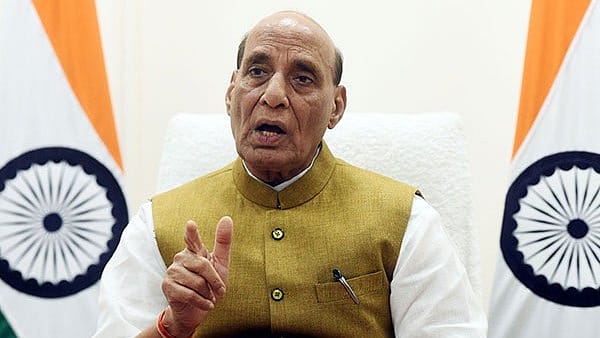
Union Defence Minister Rajnath Singh on Wednesday said India's economic momentum remained intact despite the ongoing West Asia crisis and disruptions to oil tanker movement through the Strait of Hormuz, citing an economic growth rate of around 7.8 per cent.
Addressing members of the Indian community in Tokyo, Singh said India continued to be among the world's fastest-growing economies despite international conflicts and economic uncertainties.
"No one can deny the reality that India now stands as one of the world's fastest-growing economies. The West Asia crisis is ongoing, and you see various other crises in the international community. Despite all that, our growth rate stands around 7.8 per cent. This is no small achievement," he said.

The Wealth Issue 2026
06 Nov 2026 - Vol 05 | Issue 45
Portraits of Dreamers and Doers under 35
STRAIT OF HORMUZ DISRUPTIONS
Referring to the difficulties faced by oil tankers transiting through the Strait of Hormuz, Singh said the challenges had not affected the country's economic growth.
"Consider how difficult and risky it is for oil tankers to transit the Strait of Hormuz. The required volume of oil cannot easily pass through the Strait of Hormuz to India. Despite these challenges, our government has ensured that the momentum of the Indian economy has not slowed down," he said.
Singh also highlighted the government's record over the past twelve and a half years under Prime Minister Narendra Modi, claiming that no allegations of corruption had been established against any minister or the government as a whole.
He urged members of the Indian community in Japan to maintain their integrity and credibility, describing these values as important to India's international reputation.
50 CRORE PEOPLE LIFTED OUT OF POVERTY
The Defence Minister claimed that nearly 50 crore people had moved out of poverty over the past twelve and a half to thirteen years.
He said he had earlier cited a figure of 25 crore but subsequently began referring to 50 crore after international agencies published estimates supporting the higher figure.
"Two or three international agencies are reporting the same figure: that roughly 50 crore people in India have crossed the poverty line in the last twelve and a half to thirteen years," he said.
Singh also spoke about the government's efforts to minimise corruption through reforms in welfare delivery systems, particularly the direct transfer of benefits to beneficiaries.
He said that earlier, only 40 to 60 per cent of welfare assistance reached intended beneficiaries, with the rest lost to corruption.
"Today, if 100 paise leave a bank in Delhi, all 100 paise reach the intended beneficiary. Not a single paisa leaks out," he said.
Citing the scale of digital transactions, Singh said UPI transactions worth Rs 31.53 lakh crore took place in October alone. He added that India's foreign exchange reserves had reached USD 700 billion.
DEFENCE EXPORTS TOUCH RS 40,000 CRORE
Highlighting India's progress in defence manufacturing, Singh said defence exports had increased substantially under the government's focus on self-reliance.
He said India's defence exports, which were earlier between Rs 600 crore and Rs 1,200 crore, had now reached Rs 40,000 crore.
Defence production had also risen from around Rs 40,000 crore to Rs 46,000 crore before the present government came to power to more than Rs 1.80 lakh crore, he said.
Referring to Operation Sindoor, Singh praised the capabilities demonstrated by the Army, Navy and Air Force.
During an interaction with members of the Indian community, he also addressed questions about indigenous defence technology, including the development of the Kaveri engine.
Assuring the audience that work was progressing, Singh said the concerns surrounding the engine were legitimate and that efforts were moving in the right direction.
Asked whether India's defence budget could increase from around USD 80 billion to USD 100 billion or USD 120 billion, Singh said allocations were growing rapidly. He added that the government had increased the defence allocation by approximately Rs 1 lakh crore in the latest Budget.
INDIAN DIASPORA IN JAPAN
Before Singh's address, India's Ambassador to Japan, Nagma Mallick, said around 60,000 Indians were living in Japan, working across sectors including information technology, management, accountancy, finance, education and hospitality.
Mallick highlighted the historical and cultural links between the two countries, recalling that India's earliest direct contact with Japan dated back to 752, when Indian monk Bodhisena consecrated the statue of the Great Buddha at Todai-ji Temple in Nara.
She also recalled the contributions of prominent Indians associated with Japan, including Swami Vivekananda, Rabindranath Tagore, JRD Tata, Netaji Subhas Chandra Bose, Rash Behari Bose and Justice Radhabinod Pal.
Praising the Indian diaspora's contribution to bilateral ties, Mallick said the community had played an important role in strengthening cooperation in technology, education, culture and trade.
She also highlighted India's progress in defence modernisation, indigenisation, research and development and manufacturing, saying the country's focus on Atmanirbhar Bharat had strengthened its strategic autonomy and technical self-reliance.
With inputs from ANI