India’s Summer of Student Discontent: Why Student Protests Are Rising Again
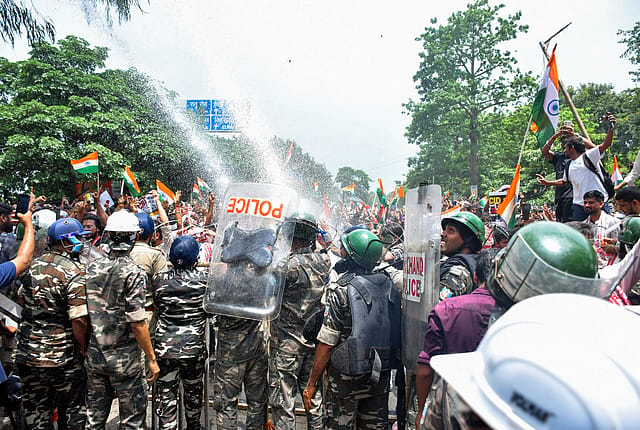
Truncheons, water canons and if all else fails, the old-fashioned lathi charge seems to be the fate of protesting students these days. What happened in New Delhi last month was also seen in Ranchi on Monday.
That is where the differences end. The “students” in New Delhi got what they wanted. The scalp of a Union Minister and the promise of necessary reforms. Their cousins in Jharkhand, who wanted a probe by the Central Bureau of Investigation (CBI) into exam leaks, have not received the assurances they wanted from the state government, so far. That is not all: the events in the National Capital—which were not just a “student” protest but a far more ambitious political adventure—got the headlines and prime time. Parliament remained fully stalled for the better part of the Monsoon Session and the logjam continues, all in the name of “students.” In Jharkhand, where students went on a hunger strike, some had to be admitted to hospitals as their health deteriorated. Late in the day, when the situation deteriorated to the point that students in Ranchi were lathi-charged as they marched to the Jharkhand Assembly, the Leader of Opposition in New Delhi issued a homeopathic statement condemning police action against them. But even then, he equated the “protest” in New Delhi with that in Ranchi instead of unequivocally condemning what happened in the state capital.
Beyond explanations resting on “centre vs periphery”—Jharkhand is a far-off province that no one bothers about in the National Capital—is an economic reality that has caused disquiet among youth. But these explanations tend to be self-serving, depending on which side of the coin analysts prefer. There are, no doubt, economic forces at play that leave students worried about their future, but it is an entirely different matter to wholly blame economic factors for the contemporary ferment.

Losing Memory
16 Oct 2026 - Vol 05 | Issue 42
The making of a medical and social emergency
Economics and politics of the “boil”
Two different pieces of data shed some light on the economics of diminished expectations among youth in India in recent decades. It is well-known that graduates enjoy a wage premium over those with no qualifications. The 2023-24 Periodic Labour Force Survey (PLFS) showed that male graduates have a 2.3-time wage premium over those with no education. In the case of women, this premium is even higher at 4-times that for illiterates.
That, however, is only a part of the story. When earnings are split according to age cohorts, between 20-29 year and 30–64-year groups over time, a different story emerges. Data highlighted in the State of Working India 2026 report issued by Azim Premji University shows that for the 20–29-year age group, average monthly earnings rose significantly between 1993 and 2011. This was true for men as well as women even as earnings for non-graduate men and women lagged, as is to be expected. This growth in earnings peaked in 2011 and slowed thereafter. This is especially true for men. For women, 2017 marked a trough of sorts and there has been a mild recovery since then. But even in 2023, average monthly earnings for women have not crossed the 2017 level.
In recent years, the growth in salaried earnings, for 20-29 years age group and the 30-64 years age group, has stalled. The two “golden periods” in this respect were 1993-2004 and 2004-2011, when salaried earnings for men graduates in the 20-29 years group increased 2.8 times (1993-2004) and 3.4 times (2004-2011). For women in the same age segment, these earnings grew by 2.4 times (1993-2004) and 4.1 times (2004-2011). From 2011 onward, this growth has collapsed for male graduates.
The second set of data, the Reserve Bank of India’s (RBI) Consumer Confidence Survey (CCS), highlights the more visible aspects of this situation. Seen together, the wage premium and the RBI surveys helps one understand the politics and economics of current situation as well as urge caution in drawing political conclusions from these events beyond what they merit.
The CCS has two distinct indices, the Current Situation Index (CSI) that deals with the current period compared to the period one year earlier and the Future Expectations Index (FEI) that looks at the period one year ahead. These indices, in turn, have a series of sub-indices that look at various economic parameters such as the general economic situation, inflation, income and employment among others aspects of economic life. The time series for the CCS and its parts goes back to September 2012, when the surveys began.
The sub-index that matters for understanding the present political situation is the perceptions and expectations on employment index.
From the perspective of the current political conjuncture, one can divide the run of the Narendra Modi government into three distinct parts, each coinciding with the five-year term of the first two Modi governments (2014-2019 and 2019-2024) and the first 2.3 year of the third Modi government.
In each of these periods, the expectations on employment index has remained negative except for some odd months in each of the three terms of the Modi government. The net response—the difference between the perception that the employment situation has improved and that it has worsened—has, by and large, remained negative through these periods. This was the case before 2014 as well. There are, however, important differences here. These perceptions hardened during the second Modi government especially since the start of the Covid19 pandemic. This can be seen clearly from May 2020 when expectations on employment touched a negative 48.2, going all the way down to -73 in May, 2021. Since then, the sentiment on employment has improved greatly but the index continues to hover in negative territory. For example, the figure in January this year was -6.3 and -9.1 in March. The last two editions of the CCS returned more negative readings at -14.4 in May and -21.9 in July. The last two readings indicate a deteriorating sentiment, touching double digit territory for the first time since November 2023.
But here is the question: If negative perceptions about employment are fuelling unrest in India’s youth, there were certainly many occasions earlier when matters should have come to political boil? Why did that not happen earlier? Even if one excludes the worst phases of the pandemic years, from mid-2020 to mid-2021, there was plenty of negative sentiment in the following years.
One can always say there was no trigger, such as the exam leaks this year. Maybe or maybe not. The twists and turns in the Cockroach Janta Party (CJP) agitation and what is happening in Jharkhand shows that economic factors cannot be linearly extrapolated to the political domain. The danger here is that in such cases explanations either tend to be wholly deterministic for example in claims such as “the economic discontent was just waiting to boil over” or become idiosyncratic in the manner that, “the examination mess has galvanized the youth.” Surely there were other moments for “galvanization” and economic discontent has been around for a while as can be seen through various data. Pinning cause and effect rigourously in such “movements” is notoriously difficult. Commentators and politicians have made matters worse by painting the situation in existential colours.
Parallels have also been drawn with previous periods of youth unrest such as 1975-1977 and 1989-1992 among other episodes from Independent India’s history. Without going into comparative details of each case, one can safely say that each such historical moment was unique, with its own sequence of cause and effect. What makes the current period different from earlier occasions is the nimbleness of government response. In the case of CJP’s demands--chief among which was the resignation of Union Minister Dharmendra Pradhan—all were met in a short span of time. The alleged student’s movement led by the CJP now stands defanged. The efforts of its founders to raise “other issues” is unlikely to succeed. If the CJP tries to form a political party, it will realise very soon that while entry barriers to politics in India have lowered considerably, it requires a wholly different set of attributes to succeed in the quicksands of India’s politics. CJP’s founders are now being scrutinised intensely and they have a tough battle ahead to convince India’s “Gen Z” and “Gen Alpha” that they can succeed where others have failed.
The more reasonable demands—as exemplified by the students from Jharkhand—should be met. A fair and impartial probe followed by fixing of administrative loopholes in the examination system is a genuine demand. Not acceding to these demands would a travesty.
The trouble for any students’ agitation is that their demands are immediate and involve specific issues—exam leaks, education infrastructure and, in general, problems confronting their educational life—while sustained political action requires building coalitions across segments of the Indian population. This is never easy as “entrepreneurial ventures” like the Aam Admi Party (AAP) have found to their cost. The CJP is now desperately trying to keep “issues” alive even as opposition political parties try to “cash in” the CJP’s agitation. This is unlikely to go anywhere even as students remain in ferment.