Portrait of a Drought
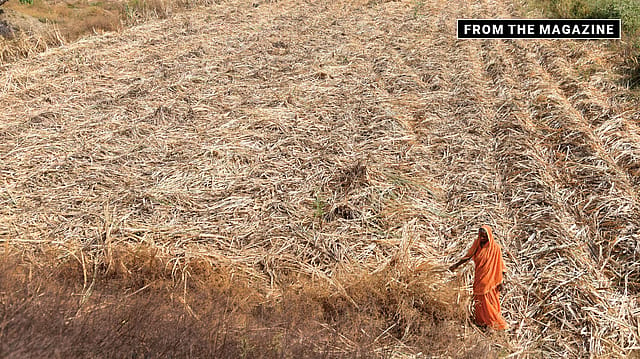
The drought is not the drought of your imagination. There are no endless barren grounds cleaved with dust and children with bones sticking out. In interior Maharashtra it is fields that still look as if they have crops and to the eye that does not know it might even be full. But scratch that tenuous surface and the full import of what is happening leaps out at you from every farmer.
Take a simple calculation. In Karanjgaon village, just a turn off the Samruddhi Expressway about 75km before Chhatrapati Sambhajinagar town, there is 32-year-old Sachin Kalange. He has two acres in which the cotton plants are standing. You can take the cotton boll in your hand, pry out its shell and feel the fluff, white as snow. The field looks neither dry nor empty. But every year these two acres brought him 25 quintals of cotton. That is 2,500 kilos. This year it is 70 kilos.
Kalange has a mother, father, wife and three children to support. He has goats to feed. Everything is dependent on getting 2,500 kilos. It would give him Rs. 2.5 lakh, and that is what gets him through an ordinary year. This time he will get Rs. 7,000. The gulf between Rs. 2.5 lakh and Rs. 7,000 for a family to survive is what drought is.
To someone from the city, who spends that amount on a mobile phone, it might be hard to conceive what is at stake. So imagine you have no savings and a salary of Rs. 1 lakh a month, all of which goes entirely into expenses--rent, school fees, food, clothing and the many things essential to life. Suddenly you come to know that from now on you will only get Rs. 2,800 per month. It won’t even cover your food delivery bills.
He has seen droughts in the past, but Kalange says this is different. “Earlier you would at least get a little something. The shopkeeper’s dues would get paid for the seed and whatever else we had taken. This year even that has to come out of our own pocket. And there is nothing in the pocket,” he says.
On another side of Karanjgaon lives Ravindra Mokle. He is 41 and has been farming since the age of 20 in his five acres. He can’t afford labour, so does it himself with his wife and children helping out. For an acre, he says, around Rs. 30,000 to 35,000 was spent. The cost of cultivation, seeds, fertilisers and so on. Forget profit; all he made this year is Rs. 5,000 per acre. He has Rs. 3 lakh of loans. In his house, he shows me a diary in which numbers are neatly written, the red ink ones for debts. “If I am no more, my children should know who to pay back and how much,” he says.
A part of his field is dry black soil where maize was sown but failed, almost entirely destroyed, its dry yellow stalks emanating from the ground before folding in defeat. Only 25 per cent of the maize could be harvested. Nearby is a patch of toor, whose plants should have been the height of a small man but is stunted to knee level, its beans of no use. But what has been the most crushing for Mokle is the guava orchard. During Covid, when he planted the trees, he decided to go organic because those fruits command a better price. It was a waiting game. For five years he had to nurture them because organically grown trees take longer to grow and start giving fruits. It was an upfront investment for rewards that would come annually later. He got one year of fruit eventually. This year was to be the year of profits. But there was no rain and the fruits are small, dry shells. That is not the end of it. Most of the trees are dead or dying. He gets tanker water to try to save the rest that are surviving. It is an increasingly lost cause.

“That orchard is seven years old. To raise a new one will take another seven years. Whatever was spent is gone, and it will have to be tended for seven years more,” he says. “I had to look after it more than I could look after my children. What can I do?”
Water is now available only from tankers, even drinking water. But at least that is provided by the panchayat. For everything else, like watering the fields, private tankers need to be paid, and they require money that farmers are running out of. Sonyabapu Zimman, a 64-year-old in the same village, takes us behind his land, where there is an artificial pond that supplies water to fields. It is parched. He is among the farmers here with more land, around 10 acres. He also has more debt, and the moneylenders and shopkeepers who gave on credit are calling. Not paying means future lines of credit will stop. “They will phone. If you don’t return what you owe us, don’t come back to us. That is how they will be,” he says. There is a surprising green patch of land with papayas there. His brother, Vithal, 48 and also a farmer, plucks one out and shows it around. It is rotten. Most haven’t ripened. The entire crop won’t earn anything.
Ten kilometres away there is the small village of Khirdi. Nitin Tambe comes on a motorcycle. We follow the 38-year-old to his land, where there are little tree stumps arrayed throughout. His story is similar to what Mokle went through, except that this is a mosambi orchard. It too takes years of patient nurturing before the trees start giving fruits. He got crops for a couple of years. Last year, there was a flood in Marathwada, and the trees didn’t bear fruit because of the excess water. This year, therefore, the mosambis were important to him. The fruits had set, and he was expecting them to grow. But then the rains played truant, and they ended up small and dried out. Even the trees couldn’t survive without water. He had to cut them down. They were given away as firewood.
“Since August 3 not a drop of rain has fallen. Ninety per cent is lost. I have gone back ten years. To raise this again will take me years,” he says.
His annual kharif crops--maize, cotton, toor--have all mostly failed. Tambe has a square face with a moustache, and when he speaks there is strident enunciation. It is when I ask him whether he will have to sell his livestock that he breaks down. He chokes on his own words: “I will never sell them.” Livestock have costs attached to them. They need to be given fodder and that takes money. Because other farmers are also suffering, there are no buyers among them. Prices have crashed. The only buyers are butchers, one farmer tells me later.
There are 358 talukas in Maharashtra. On November 17 the state government added four more to the list of drought-affected talukas, taking the total to 308. That makes 86 per cent of the talukas undergoing drought. It is not confined to just Maharashtra. The Indian Institute of Technology Gandhinagar’s Water and Climate Lab maintains an India Drought Monitor. Its latest weekly report shows that 46 per cent of the country is currently in drought. Vimal Mishra, a professor at the institute who is the project-in-charge, says the primary cause is El Niño, a periodic warming in the Pacific Ocean, which affects the monsoon winds over India. The weather phenomenon correlates with drought years. This year’s is being called a super El Niño. “This time it (the drought) is more impactful in the southern part of the country. Maharashtra, Karnataka, Telangana, Andhra Pradesh,” he says.
El Niño can affect not just the monsoon but winters, making them warmer. That worsens the situation because water resources will get used even more. “If temperatures are also abnormal, (an increase of) two to three degrees Celsius this year, then states like Karnataka, Maharashtra, by February or January, will have a much higher irrigation water requirement that will impact pumping, reservoir storage. If next monsoon season is again deficit, then it will become long-term drought,” he says.
Omkar Ugale, project manager with Marathwada Gramin Vikas Sanstha, who works on water resource development initiatives in Chhatrapati Sambhajinagar and other districts in the region, believes that this crisis, already so severe, is right now just in its beginning. He travels extensively meeting farmers almost daily and says they have had no choice but to accept that their kharif crops will be a total loss. Another real crisis around the corner would be of drinking water. “Already in some villages the groundwater table has fallen very low. We work in Beed, and around that area there is no water source at all. They are saying they will have to bring water from Jayakwadi, 100 to 150km away. Bringing tankers from that far, whether they can bear that cost, all of that is an issue,” he says.
Ugale takes us to Adul Tanda in Paithan taluka, on the border with Jalna district. Tanda in these areas means a hamlet next to a village of the same name. Banjaras stay there. Nomads once, they settled in these regions and speak a dialect that sounds Gujarati in tone. Adul Tanda has around 500 people, and there we meet Bharat Jadhav, who has four acres in his father’s name. He spent around Rs. 40,000 on it this year and says nothing came back.
He now makes ends meet by doing daily labour at construction sites. But even construction is slowing down because of water scarcity. “This year there is no time even to stay at home. Go, do a day’s labour, come back, and only then does the house run,” he says. “The day the water runs out, the work stops."
Behind the hamlet is a well, and next to it is a stream that looks like a path because it has entirely dried up. Tankers come once in 15 days and refill water in the well. Next to it, I meet Pandit Jadhav, who says the well was first dug by his grandfather in 1972, when Maharashtra saw one of its worst droughts in recent memory. It led to famine. He remembers people migrating out for work then. “If there is no water what will people do? They will leave for faraway places. Those who went in 1972 didn’t come back. They stayed there only,” he says.
It is a two-hour drive from Adul Tanda to Ghansawangi, one of the worst-hit talukas of Jalna district. In the village of Dhakephal, water pipes crisscross the air between terraces of houses like electricity lines. The villagers don’t have piped water connections and have come up with these “air pipelines” to the nearest water sources. Outside the village are the fields, and Eknath Gadve has 12 acres. He got 70 quintals of cotton last year; this year it was seven.
One portion of it is a mosambi orchard. It was five years ago that he planted it. The trunks and branches are dead brown, and the leaves are the colour of pale rust. The fruits are like desiccated orange golf balls. This orchard is ruined. Even cutting down the trees will come at a cost that he cannot afford. They remain like dead men waiting for funerals. “Even if it rains, they won’t green now. They will all have to be removed,” he says.
Near his field is a water body which Murlidhar Gadve spent Rs. 5 lakh on. He has a sugarcane patch next to it. This region doesn’t usually see too much sugarcane farming, but the artificial pond allowed for it. It is empty now. Behind it the sugarcane field is carpeted with tall pale leaves that have been cut down. Without water, the stalk, from which the sugar is processed, didn’t grow; only the leaves went up until they too dried out.
Jalna Resident Deputy Collector Shashikant Hadgal says that more than 33 per cent of the kharif crops have been lost in the district, with soya, cotton, maize and toor mainly hit. The sowing of rabi crops, which should follow now after the kharif harvest, will also be badly hit. “I think fewer than 12 percent of the usual number of farmers might sow rabi, because there is very little water left,” he says. Whatever water is remaining has been prioritised for drinking. The number of government tankers to supply water has increased in a month from 68 to 117. Hadgal expects it to go up to 200 to 250 by March. Government officials have been asked to repeatedly visit villages to find out what is needed. Panchnama, or the survey of damaged crops and losses, has been done. Once the government decides on the compensation rate, farmers will get it. With the crisis only getting worse till the next monsoon, the administration has classified villages into green, yellow and red, depending on severity. “Most of the villages will be falling in the red after March. So our first concern will be the water filling points to fill the tankers,” he says.
A little over 10 kilometres from Dhakephal is Borgaon Tanda, another hamlet. We are greeted at the entrance with large plastic water drums. In what passes for a small square between the homes are still more drums. This is a place which even otherwise only gets water from tankers. The drought has made it worse. The tankers come once in 15 days. I speak to the women there. One of them, a 17-year-old, says her sister is getting married in a few days. The number of guests has been pruned to the minimum because there won’t be water. Another says the water used for bathing is collected and then reused for other purposes. “Just arrange water for us. We don’t ask for anything else. Just bring water here,” says yet another. As we leave, I see a woman putting a steel pot into a drum and taking the water out. She gives the pot to her little daughter, who hoists it on her head, and they walk under the blazing sun.