‘Jantar Mantar Protests Inspired Jamia Students to Wage 18-Day Battle for Student Union’
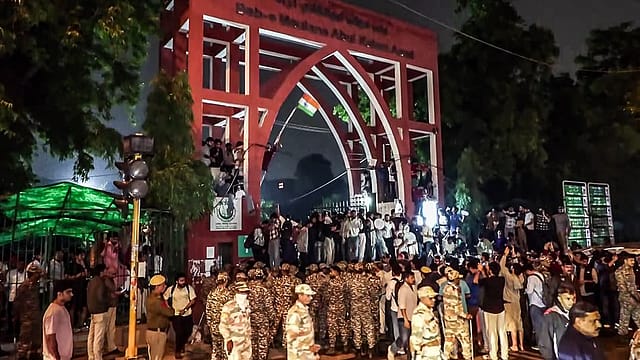
A research scholar at Jamia Millia Islamia (JMI), Sanam Husain, who is pursuing her PhD in nanotechnology and was at the forefront of the protests demanding a student union and elections in the university, talks to Open about the 18-day agitation that resulted in the authorities agreeing to the students’ demands. Husain, who took part in an indefinite sit-in at Gate 7 of the JMI campus in Delhi before she developed serious health complications on the night of October 21, said the protests brought multiple student organisations and independent groups together, including NSU(I), the Students Federation of India (SFI), All India Students Federation (AISF) and others. An alumnus of Aligarh Muslim University (AMU) who has acquired an MTech in Energy Science and Technology, Advanced Post Graduate Diploma in Nanotechnology and a BTech in Electrical and Electronics Engineering is an SFI leader. She has raised allegations earlier that she was harassed by her PhD supervisor because of her student politics and activism. Husain notes that in the absence of a student union, authorities had subjected students to “severe repression” in JMI. “A group of more than four people were not allowed on campus without prior permission,” she recalls, adding that it was the June-July Jantar Mantar protests, in which she had taken part, that inspired JMI students to stand up for their rights and fight against university authorities. The latest protest, which began on October 12, urged the restoration of an elected Jamia Millia Islamia Students’ Union (JMISU) that had been dissolved more than 20 years ago. Edited excerpts:
How long have you been a student at Jamia Millia Islamia (JMI)?
I was admitted in 2021 for my master’s. And then I enrolled in a PhD in 2024. Yes. So, it’s been five years.


The Era of Forever Wars
30 Oct 2026 - Vol 05 | Issue 44
Coping with an explosive Middle East
How did this agitation start? The demand has been there for far too long because there were no elections for more than 20 years.
From what I see, I think it’s not an isolated thing. It’s the Jantar Mantar protest, which gave students confidence. Then it was the 20-day AMU movement. Just before Jasim Ali Khan initiated the hunger strike, AMU got its union after a long gap.
I know from 2022 that there has been severe repression going on in JMI. A group of more than four people were not allowed on campus without prior permission. We’ve been receiving show-cause notices over conducting protests, organising reading sessions, musical programmes, etc.
I myself have been targeted over my student politics. Even students raising voice for bad infrastructure, low-quality food, and so on received show-cause notices. I remember a while ago the proctor held a committee where around 42 students were called before a disciplinary committee and they were given show-cause notices. Some of them faced campus bans (meaning they could not enter the campus).
I know two people right now who have campus bans on them. One is Saurabh Tripathi, a PhD student. Left student leader Hasan Farooq, a mathematics BSc student, is another. His crime: raising slogans for a union, and he had to pay a fine of Rs 5,000 and serve a campus ban for two years. This was a very common thing in Jamia. Imagine like a PhD student who has a campus ban. He cannot access the library. He cannot come and meet the supervisor.
Who took these kinds of decisions?
It is mostly the registrar, vice-chancellor, proctor, and controller of examinations. These four or five people, along with them is the Dean of Students’ Welfare (DSW). Because if we go to the DSW to talk about anything, she does not listen.
I myself faced all kinds of harassment from my professor. He was trying to keep me away from the lab. If someone is political, they want to ensure that the person leaves the campus.
Which is why, initially, students were unwilling to support the hunger strike and protests. Every time there is a protest, authorities typically send guards without badges to throw out students from the campus. They also took help from the police.
This time, however, when the same thing happened this month, students reclaimed the campus. They fought back. I mean, I remember the next day we had called for a protest around four o’clock in the evening. Everybody gathered. And then we broke through the gates and got inside. We took control of one of the gates, which was in front of the library. That’s when more students joined the protests.
So from there on, the movement gained momentum, and everybody started coming. Girls were not coming because they felt uncomfortable. They were scared of being targeted. So I gave a call for an indefinite sit-in there. And then more girls started joining. But I couldn’t continue it because my health deteriorated.
However, more people were ready to take part in the hunger strike whenever someone had to be taken to the hospital. One journalist told me then that what the authorities are scared of is the spirit of the students and the realisation that if one student ends the strike, another will be there to take their place. And then like a lot of negotiations happened between the administration and the students. We had a delegation of six people representing the students.
In the middle of the dialogue with the students, problems arose again because some people began to dismantle the protest site. And many professors also backed out because they felt like they were betrayed by higher-ups.
After that, we realised that we were not safe. So we took over the entire Political Science Department and made it the protest venue.
When was it?
I think it was on October 17. We were all inside that political department. However, the barricading, like the surveillance outside the campus, reached another level. The Border Security Force was around. Many gates were welded. There were tin sheets that were put on these gates. The administration stopped power and water supply. And nobody was allowed to supply us food. The canteens were shut. And anyone who tried sending us food was detained and taken away. Two or three people landed in Tihar Jail for doing that. But then lawyers who were part of the JMI alumni turned up to speak up for us.
We would go to the main gate and talk to those lawyers and journalists. Then there were support groups who ensured that we get food, water, medicine, blankets, everything.
I attended a press conference where representatives of Jamia Millia Islamia’s founding families were present, talking about what the idea of JMI was, that it was a dream of a few people to build an anti-imperialist, anti-colonial university. So they also submitted a memorandum to the vice-chancellor. Other people also started saying: What are you doing to the students?
Even so, every night we were very scared of a crackdown because the presence of the forces was huge outside. The administration had converted the university into an open prison.
So, when did you get to see some rays of hope of a settlement?
During the protests, we reached out to the authorities, and the administration was also coming under pressure. They also realised that things were getting out of control and that they needed to be less harsh on the students. And then the agreement was arrived at on October 29: that the university will hold elections next year.
How long did the negotiations on October 29 take?
So there were two meetings that happened. An MP, Haris Beeran, got involved in this. He spoke on behalf of the students. Finally, JMI authorities agreed to revive its Students’ Union following hours of negotiations. As they announced, the Registrar’s office set May 15, 2027, as the final deadline for approving and implementing the Jamia Millia Islamia Students’ Union (JMISU) constitution and said that elections will be conducted within six weeks of the start of the next academic session, scheduled to begin on July 15, 2027 (which means polls are expected by August 2027).
The administration also announced that it will revoke all show-cause notices, disciplinary proceedings, suspensions, rustications and campus ban orders connected to the student protests.
So how is the atmosphere on campus now?
Everyone is delighted.