From German Shepherds to Mudhol Hounds: Inside the Indian Army’s Elite Dog Units
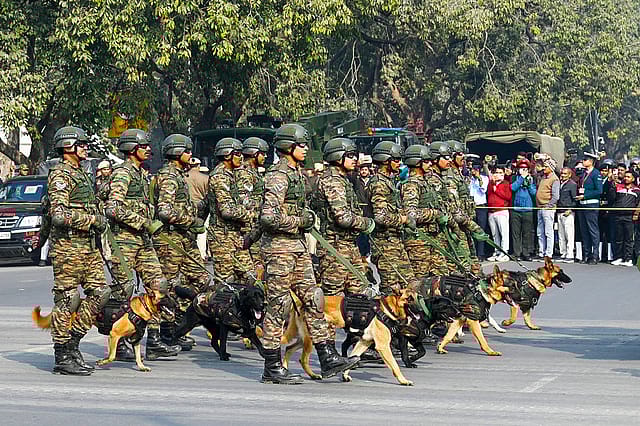
In a recent counter-terror operation on February 22, 2026, an Army dog was injured while assisting troops in Jammu and Kashmir, underscoring the frontline role of K9 units in active combat.
Dogs in the Indian Army are not ceremonial mascots; they are trained assets deployed across counter-terror, border and disaster-response missions. The incident highlights how breed selection and specialised training shape the effectiveness of dogs in the Indian Army across diverse terrains and missions.
What is the role of dogs in the Indian Army?
Dogs in the Indian Army serve as first responders in counter-terror and security operations. They are deployed for explosive detection, mine detection, tracking militants, search and rescue, avalanche response, guarding and patrol duties. Each dog is trained for a single discipline based on aptitude and operational requirement.
How many specialisations do Indian Army dogs have?
The Indian Army deploys dogs across eight specialities: explosive detection, mine detection, tracking, search and rescue, avalanche rescue, guarding, infantry patrol, and narcotic detection.

Look Who's Talking Regime Change
23 Oct 2026 - Vol 05 | Issue 43
Each dog is exclusively trained in one discipline based on breed and aptitude. Senior Army officials told ThePrint that since July 2019, K9 units have recorded 53 confirmed operational successes, including 30 IED recoveries and five direct terrorist tracking operations.
What recent incident highlights the combat role of dogs in the Indian Army?
On 22 February 2026, an Army German Shepherd named Tyson from 2 Para Special Forces was shot during a counter-terror operation in the Chhatroo area of Kishtwar, Jammu and Kashmir, while leading troops toward militants.
Despite being injured, the dog continued assisting the unit, and three Jaish-e-Mohammed terrorists were later eliminated in the encounter. Tyson was subsequently airlifted for treatment and is reported to be stable.
Which dog breeds are used in the Indian Army?
The Indian Army primarily uses four foreign breeds: the German Shepherd, Belgian Malinois, Labrador Retriever and Great Swiss Mountain Dog. Breed selection depends on terrain, climate and task requirements.
All dogs are trained at the Remount and Veterinary Corps (RVC) Centre and College in Meerut.
Why is the German Shepherd one of the most used dog breeds in the Indian Army?
German Shepherds are valued for their intelligence, strength and versatility. They are commonly deployed in guarding, patrol and assault-support roles where endurance and command responsiveness are critical.
What makes the Belgian Malinois important for combat operations?
Compact, fast and highly agile, the Belgian Malinois is preferred for counter-insurgency and counter-terror missions. Their lighter build and higher agility have made them the preferred breed for special forces units worldwide.
Phantom, a Malinois attached to 9 Para Special Forces, was posthumously awarded the Mention in Despatches in 2025, marking a first for an Indian Army dog.
Why are Labradors used as detection dogs?
Labrador Retrievers are widely used for explosive, mine and narcotics detection. Their strong scenting ability combined with a calm temperament makes them effective in high-pressure and civilian-heavy environments, including VIP sanitisation duties.
Are other breeds like Cocker Spaniels used in the Indian Army?
Yes. Cocker Spaniels are deployed in counter-infiltration and explosive detection roles due to their agility and sharp scenting capability. A Cocker Spaniel named Sophie received the Chief of Army Staff Commendation Card after detecting an IED initiator during an active operation.
Is the Indian Army inducting indigenous dog breeds?
Yes. Under the Aatmanirbhar Bharat initiative, the Mudhol Hound from Karnataka has been inducted for border surveillance and IED detection. Himalayan breeds such as the Bakharwal, Gaddhi and Bhutia are being evaluated for high-altitude deployment due to their natural adaptation to cold climates.
Why does breed selection matter in modern combat?
Breed selection determines a dog’s endurance, climate adaptability, scent efficiency and operational suitability. In mountainous terrain, dense forests and urban counter-insurgency environments, properly selected and trained dogs often detect threats that technology alone may miss, making them a critical support element in India’s defence operations.
As security challenges evolve, the role of specialised dog breeds in the Indian Army is likely to expand alongside technological advancements.
(With inputs from yMedia)