Chandigarh Schools Receive Bomb Threat Emails, Massive Security Sweep Underway
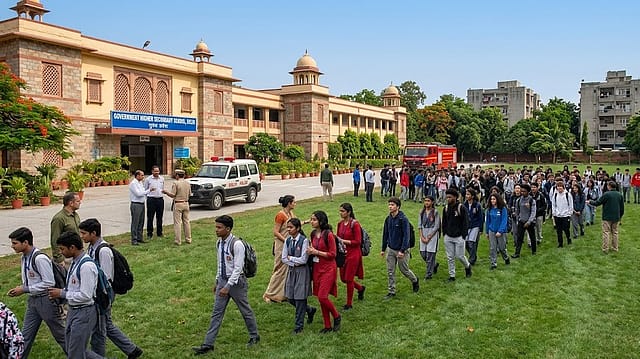
Several prominent schools in Chandigarh received anonymous bomb threat emails on Thursday morning, leading to a massive security alert across the Union Territory. The administration immediately coordinated with police and security agencies to implement emergency safety measures and begin investigations into the threats.
According to Chandigarh Police, the emails appeared to follow a pattern similar to previous bomb threat messages sent to institutions in recent months. Authorities confirmed that no suspicious object had been found so far.
Officials said investigations are ongoing while efforts are also being made to prevent panic among students, parents, and residents.
Similar Threats Had Earlier Put Chandigarh on Edge
The latest incident comes weeks after a similar bomb threat email triggered panic across Chandigarh in April.
That email warned of multiple bomb blasts at major locations in the city, including the Mayor’s office, the Secretariat, Chandigarh University, Gandhi Bhavan, and several schools. The sender had even specified timings for the alleged explosions.
The message claimed that schools could be targeted at 1:11 pm, the Mayor’s office at 2:11 pm, and the Secretariat at 3:11 pm. It also threatened a grenade attack at Chandigarh University’s Gandhi Bhavan at 9:11 pm.
The threatening email read, "Khalistan wale bachian de khilaf nahin Hindu-stan Modi sarkar nu tabah karange KHALISTAN," which translates to "Khalistanis are not against the children; rather, they will destroy the 'Hindu-stan' Modi government--Khalistan."

Exclusive: To the Heavens and Back
19 Jun 2026 - Vol 04 | Issue 76
Shubhanshu Shukla relives the space odyssey that put India into orbit
The message further warned residents to “save their children,” while referencing broader threats across the city.
Link to Nationwide Hoax Threat Investigation
The Chandigarh threats emerged amid a wider investigation into a series of hoax bomb threats sent across India.
Earlier, the office of Delhi Mayor Raja Iqbal Singh had also received a threatening email, prompting heightened security measures in the national capital.
Meanwhile, Delhi Police recently arrested 47-year-old Srinivas Louis for allegedly sending more than 1,000 hoax threat messages targeting government offices, High Courts, educational institutions, and other public establishments nationwide.
Police stated, "47-year-old Srinivas Louis, who was arrested for allegedly sending more than 1,000 hoax threat messages targeting several institutions, High Courts and government offices across the country, has been sent to a 6-day Delhi Police remand. It has come to light that he had a land dispute in Mysuru, Karnataka, and his father was not getting his share. Due to this, Srinivas Louis wanted to study Law and was miffed with the Court as justice was not being done to him. He had qualified for NET and had worked as an Assistant Professor."
Officials further added, "Most of the mails/messages were sent by him from his phone. The police team has gone to Mysuru to take the device into their custody. He was an expert in masking his IP address. He had sent emails to a few cities, even in Pakistan. He kept changing his address, fearing that he would get caught. Not just Courts across several cities, but even the Supreme Court was on his target."
What Authorities Are Saying Now
Police officials in Chandigarh have urged the public to remain calm and avoid spreading rumours on social media. Security checks continue across affected schools and surrounding areas as cyber experts trace the source of the emails.
Authorities have not yet confirmed whether the latest threats are directly linked to earlier hoax campaigns, but investigators are examining possible similarities in email patterns, language, and digital footprints.
(With inputs from ANI)