Camels, Ponies, Dogs: India’s Unseen Defenders March on Republic Day
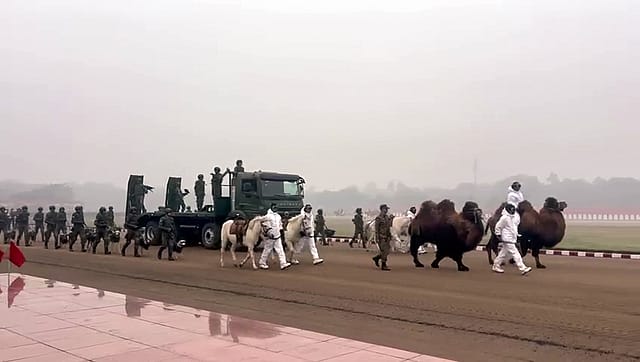
India will witness a rare and stirring spectacle on Republic Day 2026 as animals of the Indian Army march down Kartavya Path, embodying resilience, adaptability and a form of military service that predates modern warfare. For the first time, a specially curated animal contingent of the Remount & Veterinary Corps (RVC) will be showcased, spotlighting the indispensable role animals play in safeguarding India’s most challenging frontiers.
The contingent will bring together an extraordinary mix: two Bactrian camels, four Zanskar ponies, four raptors, ten Indian-breed Army dogs, and six conventional military dogs currently in service. Together, they represent a seamless blend of tradition, operational innovation and India’s growing emphasis on self-reliance in defence.
Leading the formation will be the Bactrian camels, recently inducted for operations in the cold deserts of Ladakh. Built for extremes, these camels thrive in sub-zero temperatures, thin air and altitudes above 15,000 feet. Capable of carrying loads of up to 250 kilograms while surviving on minimal water and feed, they have emerged as critical assets for logistics and patrols along the Line of Actual Control, particularly in sandy terrain and steep gradients.
Look Who's Talking Regime Change
23 Oct 2026 - Vol 05 | Issue 43
Marching alongside them will be the Zanskar ponies, a rare indigenous mountain breed from Ladakh. Small in size but formidable in strength, these ponies routinely carry 40–60 kilograms across long distances in temperatures plunging to minus 40 degrees Celsius. Since their induction in 2020, they have operated in some of the world’s harshest conditions, including the Siachen Glacier. In mounted patrols, they can cover up to 70 kilometres in a single day, standing shoulder to shoulder with soldiers in high-risk zones.
Adding a modern operational edge to the formation will be four raptors, deployed for bird-strike control and surveillance—an example of how the Army is harnessing natural capabilities to enhance safety and effectiveness.
One of the most emotionally resonant segments of the parade will be the Army Dogs, often referred to as the Indian Army’s “Silent Warriors.” Raised and trained by the RVC Centre and College in Meerut, these dogs play vital roles in counter-terrorism, explosive and mine detection, tracking, guarding, disaster response and search-and-rescue missions. Over the years, their bravery—often under fire—has earned them gallantry awards and national commendations.
In line with Atmanirbhar Bharat and Make in India, the Army has increasingly inducted indigenous dog breeds such as Mudhol Hound, Rampur Hound, Chippiparai, Kombai and Rajapalayam. Their presence on Kartavya Path will underline India’s push towards self-reliance and the successful integration of native breeds into specialised military roles.
As this animal contingent marches past the saluting dais, it will serve as a powerful reminder that India’s defence strength is built not by soldiers and machines alone. From the icy heights of Siachen to the cold deserts of Ladakh and disaster-hit civilian areas, these animals have quietly shared the burden of duty, courage and sacrifice.
They march not merely as support units, but as warriors on four legs—living symbols of loyalty, resilience and the Indian Army’s unwavering resolve to protect the nation under all conditions.
(ANI and yMedia are the content partners for this story)