Milind Soman’s Fitness Philosophy: Train for Life, Not Just for Looks
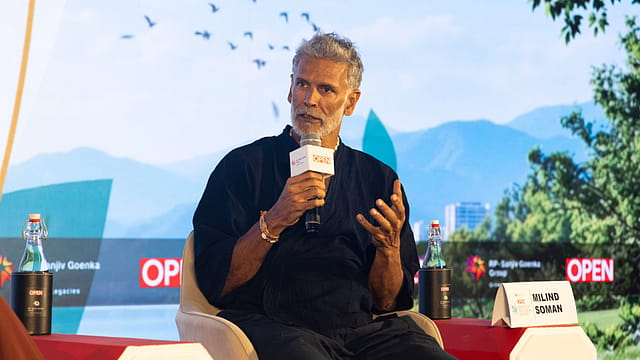
For a culture increasingly obsessed with six-pack abs, calorie deficits, step counts and the promise of eternal youth, Milind Soman offers a different definition of fitness. It has little to do with how the body looks and everything to do with what it can do. Fitness, he argues, is the ability to enjoy life, respond to stress and overcome obstacles, whether they are physical, mental or emotional.
At the OPEN Health & Wellness Summit, Soman, one of India's most recognisable fitness icons, challenged the idea that a healthy life can be reduced to an exercise routine or a particular body type. “The highest level of fitness is when you can transform stress into an opportunity,” he said, describing how the ability to respond to challenges shapes not just physical health but the quality of life itself.

Losing Memory
16 Oct 2026 - Vol 05 | Issue 42
The making of a medical and social emergency
The distinction matters in a world where fitness has increasingly become a visual language, communicated through sculpted bodies, performance metrics and carefully curated lifestyles. Soman draws a line between appearance and performance. “That is not fitness. That is appearance,” he said. “It is about looks versus performance. What can you do with your body? Does it help you live a better life?”
For him, fitness is not a destination to be reached but a capacity to be developed, one that allows a person to participate more fully in life.
The Body Is Designed for Struggle
Soman's philosophy begins with a simple proposition: the human body and mind are not designed for perpetual comfort. They require challenge to remain functional. Modern life, with its conveniences and sedentary habits, may have made daily existence easier, but it has not changed the fundamental needs of the human body.
“The fact is that your body and mind are designed by nature for struggle and challenge,” he said. “If you don't challenge them, they deteriorate and begin to fall apart.”
The argument is not that fitness must involve extreme physical exertion. Soman is clear that movement can take many forms, from walking and yoga to running, cycling, swimming and dancing. The point is to break away from inactivity and gradually discover what the body can do.
He describes movement as the starting point of a healthier life, rather than something that needs to be packaged as a demanding exercise programme. One immediate physical benefit, he told the audience, is improved blood circulation, which helps deliver oxygen and nutrients to the body's cells.
But the challenge extends beyond the physical. Frustration, anxiety, anger and the inability to deal with everyday difficulties are also signals that deserve attention. Fitness, in this sense, is about understanding one's weaknesses and working on them over time.
Soman's approach also rejects the idea that ageing must inevitably mean surrendering physical and mental capacities. He acknowledges that the body changes with age, but argues that taking care of it can help slow the decline.
“You will get older, but you don't have to get old. There is a difference,” he said.
For him, the goal is not to reverse ageing but to preserve the ability to feel strong, capable and ready to confront obstacles. “I want to feel strong and invincible. I want to feel that I can do anything and that I can overcome any obstacle I confront. That is the feeling I love. That is fitness.”
Pinkathon and the Power of a Shared Challenge
Soman's understanding of fitness extends beyond individual discipline. His work with Pinkathon, the women's running initiative he helped establish, grew out of a question about participation: why were women making up only a small share of the runners at events across the country?
He believed the answer was not simply a lack of awareness about the benefits of exercise. Women needed a space where they could participate without feeling watched or judged.
“I realised that women did not have a space to gather and celebrate unless it was political or religious,” he said. Pinkathon became a place where women could “sing, dance, jump, run and simply be themselves”.
The initiative began with short walks and runs, gradually expanding to longer distances as participants asked for greater challenges. Today, Soman says, it offers events ranging from 3 kilometres to 100 kilometres, bringing together women across ages and abilities, including visually impaired participants.
The community aspect is central to his understanding of why people take up running in the first place. A person who begins with a short walk may eventually attempt a marathon or an endurance event, inspired by watching others do something they once thought impossible.
“Everyone is inspiring each other,” he said. “If he can do it, if she can do it, why can't I?”
The idea also offers a response to the pressure surrounding contemporary fitness trends. Not everyone needs to become a competitive athlete or take on an extreme challenge. What matters is finding a challenge that makes sense for one's own life and gradually building the capacity to meet it.
The Right Time to Begin Is Now
For all his emphasis on physical effort, Soman does not frame fitness as a pursuit reserved for the young. Asked when a person should begin thinking about fitness and whether it is ever too late, he offered a simple answer: “The answer to both questions is now.”
He recalled a woman who began running at the age of 93 and went on to represent India in international masters competitions, winning medals into her later years. She had not spent her life as an athlete; she began running in her nineties.
Her story, Soman suggested, illustrates how fitness can open up possibilities that people may have assumed were beyond their reach.
Nutrition and rest, too, are part of the larger picture. Soman spoke about his own experience with intermittent fasting, which he has followed for two years, while making clear that he was describing what worked for him rather than prescribing it for everyone. His broader point was that people need to understand how their bodies respond rather than follow trends unquestioningly.
Ultimately, Soman's idea of fitness is less about the pursuit of a perfect body than about preparing for the unpredictability of life. Comfort may make daily routines easier, but it cannot eliminate difficulty. The capacity to meet that difficulty, he believes, comes from movement, experience and the willingness to keep challenging oneself.
“Life is tough,” he said. “Choose your own challenges and prepare yourself for difficult circumstances.”
In a culture that often sells fitness as an image to achieve, Soman returns to a more fundamental question: not how fit do you look, but what are you capable of doing with the life you have?