Empire of Fear
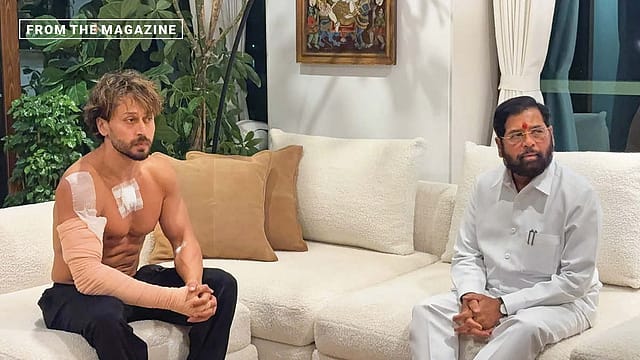
Every Sunday, a group of actors and filmmakers from the Mumbai film industry gathers to play football, organised by film producer and sport entrepreneur Bunty Walia who runs the All Stars Football Club. On October 18, the football match was at the Jamnabai Narsee School grounds in Juhu. Tiger Shroff, a regular at these matches, was leaving in his BMW sedan when he was shot at by three young men on a motorcycle.
He survived with minor injuries but the damage done to the city’s psyche is still being felt, with discomfiting memories of life under the gun in the 1990s at the height of gang wars caused by the split in Dawood Ibrahim’s empire of fear.
A young man connected to Lawrence Bishnoi, a gangster lodged in Ahmedabad’s Sabarmati Central Jail, took responsibility on social media, announcing that it had been done to send a message to the actor, best known for his martial artistry on screen, to not work with Salman Khan. Further investigations have revealed that their real target was Salman, until they discovered his security has become impenetrable. The motive? Revenge for Salman’s killing of a black buck in 1998 while shooting for Sooraj Barjatya’s Hum Saath Saath Hain in Jodhpur, an act considered a desecration for the Bishnoi community.

This is not the first instance of Bishnoi targeting the Mumbai film industry or Salman. In October 2024, politician and businessman Baba Siddique was shot dead in Bandra East, Mumbai. Siddique’s Iftar parties were legendary and it was at one such celebration in 2013 that Salman and Shah Rukh Khan patched up after years of friction. Then in February this year, unidentified gunmen fired five rounds at filmmaker Rohit Shetty’s multi-storey home, Shetty Tower, in Juhu.
Bishnoi’s intimidation of Salman is older. He issued his first public death threat against Salman in 2018. Following Sidhu Moose Wala’s death in 2022, Bishnoi warned Salman again. In November 2023, Bishnoi claimed responsibility for a shooting at actor-singer Gippy Grewal’s home due to his alleged association with Salman. Grewal denied any such friendship.
In April 2024, Lawrence Bishnoi’s brother Anmol took responsibility for shots fired at Salman’s first-floor Galaxy Apartments flat at around 5AM, calling it a “first and final warning.” Salman’s famous first-floor darshan for fans has ceased, with the balcony and windows now covered with bulletproof glass since January 2025. His security is now handled by the Elite Security Group, part of the Reliance Global Corporate Security, comprising former Indian Armed Forces commandos. He travels with a posse of at least 30 such elite veterans, in a fortified, bulletproof Mercedes, and whenever he can, he spends time at his farmhouse in Panvel which is protected by electric fencing and surveillance cameras, among other things. Yet, last year, there were two separate instances of trespassing at Galaxy Apartments by fans, including a young woman who claimed she had been invited by the actor.
There is outrage at the ease with which actors are being targeted, though much of it is in whispers. There is also post-traumatic stress, with memories of the 1990s surfacing, when stars and filmmakers would get calls from unknown numbers, who would use a mix of threats and braggadocio to get what they wanted. Sometimes it would be extortion money, at other times, it would just be diabolical playfulness, as in when Shah Rukh Khan got a call from Captain, Abu Salem’s pseudonym, who proceeded to berate him for apparently not being regular in his prayers.
In many ways though this time, it is worse.
Then the enemy was known, intimately intertwined in the city’s economic, social and cultural fabric. The mafia had a finger in every business, from real estate to hawala to cinema, with estimates that at least 40 per cent movies were financed by members of the underworld called ‘carry forwards’.
Until the 1993 blasts made him a persona non grata, knowing Dawood was almost a badge of honour, with invitations to hang out with him being coveted, from a star-studded birthday party for his nephew in Dubai in 1988 to invitations to sit in his private cricket box at the Sharjah Stadium. The trips to Dubai, where Dawood had fled in 1985 jumping bail, came to be called raat rokis (night halts). And by all accounts, by 1990, the raat rokis had peaked.
Beginning in the 1970s with the king of smuggling, Haji Mastan Mirza, the relationship between the underworld and the mafia was one of mutual fascination. Now, the enemy is unknown, almost invisible. “Bishnoi’s actions seem less a result of business deals gone wrong, and more the outcome of brand building,” says filmmaker Ram Gopal Varma.
There’s another difference. The film industry of the 2020s is vastly different from that of the disorganised but closely knit 1990s. Production companies are structured like corporate firms, even if still largely family-run. Streaming giants, many of them multinational, are big players, run by professionals. Actors are less accessible, with several levels of gatekeeping, though they may be more visible thanks to staged paparazzi shots. The homes of most stars are tourist destinations, whether it is Amitabh Bachchan’s Jalsa in Juhu or Shah Rukh Khan’s Mannat in Bandra. While Bachchan continues his Sunday darshan, Shah Rukh is renovating Mannat, from the terrace of which he often greets his fans, choosing to divide his time between London and Dubai in the interim.
There is brotherhood, but it is a silent solidarity. Mahesh Bhatt, who recalls the ’90s vividly, says: “In those early days, I called an eminent voice of the establishment and asked him to help me understand what was happening and what we should do. His answer was three short phrases: stay firm, stay united, stay alert. That advice held our industry together through the worst of it. In those days, when our people were killed, there was one voice of outrage, whatever the party. Today, before the smoke has cleared, the politics begins. We cannot stay united when we can no longer grieve together.”
But the industry has been silenced for a while now. It doesn’t have leaders of the stature of the late Yash Chopra and Sunil Dutt, who continued the good fight against terror despite his son Sanjay Dutt’s arrest under the erstwhile Terrorist and Disruptive Activities (Prevention) Act.
Take the most recent case of Maatrubhumi: May War Rest in Peace, produced by Salman Khan and starring him, which was cleared by the Army as the original Battle of Galwan, but after relations with China improved, Salman was ordered to reshoot portions to not offend our neighbour, which cost time and money. Shah Rukh has stopped giving interviews to the media after the arrest of his son Aryan in 2021 over drug charges that were not proven. Aamir Khan speaks but carefully avoids mentioning politics, given the vicious trolling he faced after his then wife Kiran Rao talked about rising intolerance in India in 2015.
Actors, even the biggest stars, now routinely do as they are asked by the establishment, whether it is making videos praising the government or appearing at the consecration of the Ram Lalla idol in Ayodhya in 2024. Those who have not made their peace with the new subservience have exited the city, like Anurag Kashyap who now lives mostly in Bengaluru, or the country, like Taapsee Pannu who lives for several months of the year in Denmark, where her husband is based. No one speaks up for anyone in trouble.
The third most critical difference between the 1990s and now is that violence in daily life has become more commonplace. Guns are easily available, as are shooters. Bishnoi claims he has a network of 700 shooters. They will commit heinous crimes for tiny pay cheques, underlining both the desperation among the youth as well as their willingness to break the law. The three shooters who were picked up in the Tiger Shroff shooting were willing to commit murder for as little as `34,000 and safe passage to Canada via Nepal. And it is likely to continue. “The underworld has always thrived on publicity. They are rebels and want to play god. Issuing repeated threats is like oxygen for them,” says Varma, whose 2002 film Company traces the conflict between Dawood and his chief aide Chhota Rajan, currently lodged in Delhi’s Tihar Jail.
After the split in Dawood’s empire, the game moved to extortion and calls were routinely made for protection money. It was one such call from Abu Salem (currently serving two concurrent life sentences in Nashik Jail) that cost Gulshan Kumar his life. Having paid the first instalment of a `10 crore extortion, the juice vendor-turned-music baron ignored the demand for another instalment. His routine and route to the Shiv mandir in Lokhandwala near his home was well-known. On August 12, 1997, three gunmen shot him dead, pumping 16 bullets into his body.
It was followed by an attempt on Rakesh Roshan in 2000, the assassination of Manisha Koirala’s secretary Ajit Dewani in 2001, and many more.
In 2001, Bollywood got another reality check, when Chori Chori Chupke Chupke produced by diamond merchant Bharat Shah was said to have been financed by Chhota Shakeel (currently reported to be in Karachi). This was an offshoot of Shah’s alleged relationship with Dawood which dated back to the 1980s and solidified when Shah sorted out a property dispute involving the late smuggler Yusuf Patel, Dawood and a third party, and for which he was rewarded with a prime property at Chowpatty that belonged to Patel. That was also when Salman was interrogated by the Mumbai Crime Branch. He was questioned again when in 2005, a newspaper published excerpts of conversations from 2001 between him and Aishwarya Rai, allegedly trying to intimidate her into performing at a show and claiming connections to figures like Abu Salem, Chhota Shakeel, and Dawood Ibrahim. The tapes were found to be doctored.
But by 2005, the Mumbai Police encounter specialists had eliminated around 1,000 gangsters, in what the city thought was a final goodbye to the reign of terror. It had not accounted for the rise of an invisible, Instagram-happy don whom no one had met or known.
Filmmaker Ashoke Pandit, chief adviser of the Federation of Western India Cine Employees, believes the fear psychosis will die down due to strict policing by the government. “The system is strong, and people are already recovering,” he says.
It’s not a confidence shared by most of his contemporaries.