When Non-Issues Drown Out Issues That Really Matter
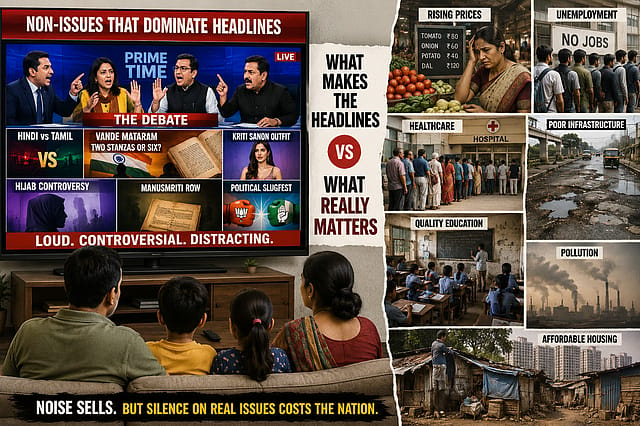
What does an average Indian expect from the government? The cryptic answer: Roti, Kapda aur Makan. To elaborate: good education, employment, reasonably priced vegetables and groceries, good roads and transport connectivity, cleanliness, a pollution-free environment, affordable healthcare and housing. Potable water, LPG cylinders and electricity are a given.
Eighty years after Independence, many of these basic necessities still elude the average Indian, especially those living in rural India. Sure, we have come a long way. Today, India is a $4.15-4.19-trillion economy, ranking sixth — or fifth, depending on specific IMF/World Bank updates — in the world. But its per capita income remains very low at around $2,800 giving it a rank of 153 among nearly 200 countries. The U.S. ranks No 1 with $94,430 per capita income while China stands at 77 with per capita income of $14,874.
So, the greatest challenge before the Modi government is not merely to enlarge the size of the economy and make India one of the world's top three economies, but also to raise per-capita income rapidly so that prosperity becomes visible in the everyday lives of its citizens.
This brings me to the real issue. When economic realities are staring us in the face, one is quite shocked and surprised to see the media — mostly TV news channels — hotly debating non-issues or disproportionately amplified issues during prime time. Surprise, surprise, even politicians are playing to the gallery. This has been happening for quite some time but has become more pronounced over the last six months.
Zeroing In on ECI
09 Oct 2026 - Vol 05 | Issue 41
Constitutional legitimacy versus political opportunism
Anybody watching these intense and, at times, unruly debates would feel that law and order is in a mess, the country is burning and a revolution is around the corner. That may seem like hyperbole.
But just look at Parliament. We saw how repeated disruptions diverted Parliament from debating key issues. One could say the 2026 Monsoon Session was a washout because Rahul Gandhi and a few Opposition parties did not allow it to function. For Rahul Gandhi, the big question was: Who gave the orders to fire at the Cockroach Janta Party protesters at Jantar Mantar in Delhi? Even though there were no casualties, the incident was amplified as though it were Tiananmen Square. For the uninitiated, such orders are generally given by an Executive Magistrate, not the Home Ministry.
Feeling strongly about this, I have picked a few non-issues or disproportionately amplified issues which will neither qualitatively nor quantitatively transform anybody’s life, yet they have invaded our living rooms via TV news.
Marathi Test For Auto & Cab Drivers: Take the Maharashtra government's insistence that auto-rickshaw, taxi and app-based cab drivers must possess a working knowledge of Marathi. The government has amended the Motor Vehicles Rules, and non-compliance can invite suspension and eventually cancellation of a driver's licence.
There is nothing wrong with encouraging people who earn their livelihood in Maharashtra to learn Marathi. It helps them communicate with passengers and integrate better. But should language proficiency become such a major political and media issue?
I think nobody has an issue if it is implemented across Maharashtra, but pushing it in a cosmopolitan city like Mumbai can become problematic. A large proportion of Mumbai's commuters are non-Maharashtrians. More importantly, for the average commuter, language is hardly the priority. Refusal to ply, tampered meters, passenger safety and poorly maintained vehicles are far more pressing concerns. Today, language alone cannot win you seats.
Tamil Nadu's ‘Down With Hindi’ Battle: Then there is the perennial Hindi-versus-Tamil controversy. Tamil Nadu has steadfastly defended its two-language formula, and successive governments have regarded Delhi's three-language policy as an attempt to impose Hindi. Anti-Hindi protests erupted in Tamil Nadu in 1965, and the controversy continues to this day.
But does learning an additional language necessarily diminish Tamil? In today's world, knowing another Indian language can arguably be an asset rather than a cultural surrender.
The more important questions concern the quality of education. Are our children learning mathematics, science and communication skills adequately? Are they employable when they graduate?
Vande Mataram: Six Stanzas Or Two?: Written by Bankim Chandra Chatterjee, Vande Mataram, which inspired generations during India's freedom struggle, has once again become a political football.
The Congress party has reaffirmed its old position that only the first two stanzas should be sung at party programmes, citing the historic 1937 decision. The BJP has attacked the move and passed a resolution condemning the Congress stand, insisting that there can be no compromise over the honour of the National Song.
And TV news channels found it opportune to convert the controversy into a full-fledged debate.
I am a nationalist, but can singing two stanzas instead of six create one additional job? Will singing six stanzas reduce food inflation, improve a government school or provide a hospital bed?
Patriotism cannot be measured with a stopwatch.
Hijab Controversy Continues: The hijab controversy is another example of an issue that refuses to die. It invariably gets raised around election time.
Recently, the Allahabad High Court rejected a school student's plea to wear a hijab. The judgment has been criticised by Muslim clerics, some of whom argue that the hijab is integral to Islam and want the matter reviewed.
There is a larger question concerning religious freedom, institutional discipline and individual choice, and ultimately the courts must interpret the law.
For millions of ordinary Muslim families, however, education, jobs, housing, healthcare and economic advancement are equally — if not more — consequential. TV debates over what a girl wears should not drown out the far more important discussion about the quality of education she receives.
Rahul Gandhi And Manusmriti: Rahul Gandhi has once again raked up the Manusmriti debate. Speaking to women students in Pune, he attacked what he described as the patriarchal thinking associated with this ancient text and accused the BJP-RSS ecosystem of wanting to restrict women's freedom.
HIs remarks predictably produced a BJP counterattack. It was grist for the TV channels.
But how relevant is Manusmriti to the everyday aspirations of an Indian woman in 2026? The Constitution, not an ancient religious text, governs modern India.
The urgent questions are women's safety, education, employment, equal pay, nutrition, maternal healthcare and economic independence. The big issue is crime against women.
Kriti Sanon's Raksha Bandhan Outfit: Actor-MP Kangana Ranaut raised a stink over actor Kriti Sanon’s outfit in a Raksha Bandhan advertisement. Sanon's bralette-style blouse and accompanying outfit were considered inappropriate for a traditional Hindu festival by Kangana.
Sanon defended herself, Rahul Gandhi backed her and social media exploded. Finally, jewellery brand GIVA withdrew the advertisement.
One advertisement had become a national cultural argument — an ideological war. Once again, a needless controversy was created and became a hot TV debate.
Meanwhile, India has serious challenges involving women's safety, female workforce participation, malnutrition and economic opportunity.
My limited point is that the real issues that can transform the lives of citizens get relegated to the background, while issues such as Kriti Sanon’s outfit occupy mind space.
Politicians know that controversies generate instant emotion and connect with their voter base. For TV channels, that emotion generates eyeballs; translated into commercial terms, it means advertisements.
There are two more recurring issues. Bollywood films such as The Kashmir Files, Dhurandhar and Padmavat become subjects of raging debate. Likewise, offering namaz on roads every Friday has become both a sensitive and vexing issue.
Here, I am reminded of an interesting quote by English writer Charles Caleb Colton: “Men will wrangle for religion, write for it, fight for it, die for it; anything but live for it.”
The issue is not that TV channels debate too many non-issues. A democracy should debate everything. The danger begins when the issues that generate the most noise become more important than the issues that determine how people actually live.
Finally, I feel it is the moral duty of the media and politicians not to digress from the main issues merely for TRPs or vote banks and amplify non-issues. It benefits nobody.
Noise should not drown out the issues that really matter.